
JASMINE

- Botanical name
- Jasminum grandiflorum / Jasminum sambac
- Also known as
- Royal jasmine (grandiflorum), Arabian jasmine (sambac), Mogra (Hindi sambac)
- Main flavour compound
- Benzyl acetate
- Part used
- Dried flower (whole)
- Method of cultivation
- Two main commercial species in the spice/perfumery trade: *Jasminum grandiflorum* (Royal/Catalan/Spanish jasmine — from the lower valleys of the Indian Himalayas, now cultivated in India, Egypt, Morocco, Italy and France) and *Jasminum sambac* (Arabian/Sambac jasmine — from Eastern India and southern Himalayas, also widely grown in China). Both are evergreen climbing or shrubby vines of the Oleaceae family. Tamil Nadu alone produces around 30,000 tons of jasmine annually.
- Commercial preparation
- Flowers are hand-picked at peak fragrance — almost always at night or in pre-dawn cool, because jasmine releases its strongest aromatic compounds in the dark. The freshly-picked flowers are either steam-distilled within hours (for essential oil), solvent-extracted (for absolute), or air-dried whole for the tea and dried-spice trade.
- Non-culinary uses
- One of the most economically important perfumery ingredients in the world — foundational to almost every high-end Western perfume since the late 19th century; jasmine sambac is the traditional flavouring for Chinese jasmine tea; cosmetics, aromatherapy, religious offerings across South and South-East Asia.
"Jasmine" in the spice and perfumery trade refers to two main species: Jasminum grandiflorum (Royal Jasmine, Spanish or Catalan Jasmine — from the lower valleys of the Indian Himalayas, now cultivated commercially in India, Egypt, Morocco, Italian Calabria and French Grasse) and Jasminum sambac (Arabian Jasmine — from Eastern India and southern Himalayan country, also widely grown in China). [source] Both are climbing or shrubby evergreen vines of the Oleaceae family, with small white star-shaped flowers that release their characteristic narcotic-sweet aroma most strongly at night.
Whole dried flower
The standard form — striking visually and slow-releasing in cool extraction.
Loose petals
Faster extraction; less visual appeal.
Region of cultivation
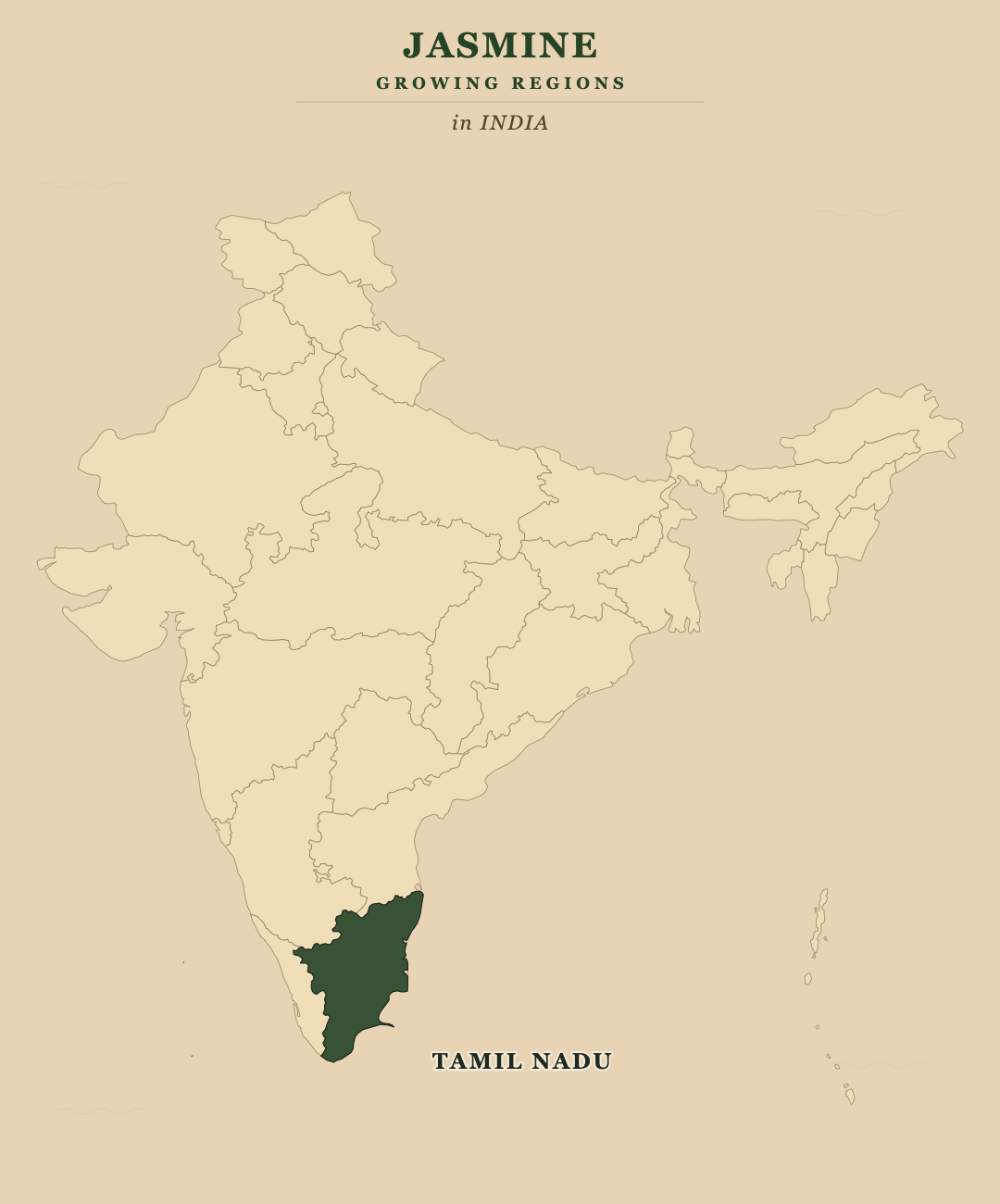
Jasmine is primarily cultivated in India (Tamil Nadu — sambac), Egypt (grandiflorum), Morocco (grandiflorum), with secondary growing regions in China, Italy (Calabria), France (Grasse — premium).
Spice Story
Jasmine is one of the most economically and culturally important flowering plants on Earth. India's Tamil Nadu region alone produces around 30,000 tons of jasmine flowers annually, most of it the sambac variety for religious offerings, cosmetic use and the jasmine tea trade. Jasminum sambac is the species used to perfume Chinese jasmine tea — the freshly-picked flowers are repeatedly layered with green tea leaves overnight so the tea absorbs the aromatic compounds. The famous Chinese folk song "Mo Li Hua" celebrates this very variety. In Western perfumery, jasmine (especially Grasse and Egyptian grandiflorum) is one of the foundational floral notes of almost every high-end fragrance since the late 19th century. In gin, jasmine has emerged as a contemporary signature botanical, particularly in Eastern-influenced and floral garden-gin profiles.
Gin Creativity
Jasmine is powerful and distinctive — a little goes a long way. A full sachet pushes a gin firmly into clearly floral territory; a quarter to half sachet provides a quietly intoxicating background that integrates with juniper. Pair with bergamot for an Earl-Grey-jasmine profile, or with rose petal and pink peppercorn for a contemporary floral blend.
Blending Science
Main flavour compounds
 Benzyl acetatejasmine-floral, fruity
 Linaloolfloral, soft
 Indolenarcotic floral, animalic
 Jasmonewarm floral, jasmine
Pairs well with
Jasmine's chemistry is one of the most studied in perfumery, with several dozen compounds contributing to its character. Benzyl acetate is the most abundant — sweet, fruity-floral, jasmine's "core" note. Linalool adds a soft floral lift familiar from coriander and lavender. Indole is the surprise: present in significant amounts, indole on its own smells distinctly faecal-narcotic — but in the context of jasmine's other compounds, indole contributes the deep, complex, almost animal quality that distinguishes real jasmine from synthetic imitations. Jasmone is a sesquiterpene contributing the warm-floral body. Cool, brief extraction preserves the bright floral top; warm or long extraction can emphasise the heavier indolic notes.
Food Partners
- Jasmine rice and South-East Asian dishes — natural pairing.
- Jasmine tea desserts — Chinese-influenced ice creams and panna cottas.
- Stone-fruit pairings (especially peach) — peach-and-jasmine is a chef's classic.
- Soft white cheese — fresh ricotta with jasmine syrup.
- Light spiced syrups — jasmine syrup over poached pears.
Cocktails To Try

- Jasmine Gimlet — jasmine gin, lime cordial, mint.
- Floral Spritz — jasmine gin, prosecco, soda, fresh jasmine garnish.
- Earl-Grey-Jasmine MarTEAni — Earl Grey jasmine gin, lemon, sugar, egg white.
Release The Flavour
- Cool extraction — preserves the bright floral top.
- Brief contact — 30 minutes to 2 hours; longer extractions emphasise heavier indolic notes.
- Whole flowers — visual appeal in compound gins; release character slowly.
- Source matters — Grasse (France), Egyptian and Tamil Nadu jasmine each have distinct chemotypes.
Discover more
From the same region
Pairs well with
Same flavour family
Surprise me

Sources & Citations
- jasminum_grandiflorum_origin (Indian Himalayan lower valleys):www.fragrantica.com/news/Jasmine-Grandiflorum-vs-Sambac-2...
- jasminum_sambac_origin (East India / southern Himalayas, also China):www.fragrantica.com/news/Jasmine-Grandiflorum-vs-Sambac-2...
- tamil_nadu_30k_tons_production:www.fragrantica.com/news/Jasmine-Grandiflorum-vs-Sambac-2...
- chinese_jasmine_tea_uses_sambac:en.wikipedia.org/wiki/Jasminum_sambac
- main_flavour_compounds (CSV-sourced):inputs/source.csv — Jasmine row
