
EARL GREY TEA (FRENCH)

- Botanical name
- Camellia sinensis (tea) + Citrus bergamia (bergamot oil)
- Also known as
- Earl Grey, Bergamot tea
- Main flavour compound
- Theaflavins
- Part used
- Black tea leaves (dried, fermented and oxidised), flavoured with bergamot oil and/or dried bergamot peel
- Method of cultivation
- Black tea is processed from the leaves of *Camellia sinensis*, an evergreen shrub of the Theaceae family native to East Asia. The "French" designation in the name typically refers to a particular blend style — often using a stronger bergamot flavouring than English-style Earl Grey, sometimes additionally scented with French lavender or rose petals, and frequently using a Chinese or Indian black tea base. Tea is cultivated at altitude across China, India (Assam, Darjeeling), Sri Lanka, Kenya and Vietnam; bergamot is cultivated almost exclusively in Calabria, Italy.
- Commercial preparation
- Black tea is processed by withering, rolling, oxidising and drying *Camellia sinensis* leaves. Earl Grey blends are then either coated/sprayed with bergamot essential oil (the modern, stronger-flavoured method) or blended with dried bergamot peel. French-style Earl Grey often uses both methods plus additional floral additions for complexity.
- Non-culinary uses
- Hot beverage (the foundational use); Earl Grey ice cream and cake glazes; the bergamot oil component is also used independently in perfumery; the tea component is the basis of all commercial black tea.
Earl Grey is a blend, not a single botanical — black tea from Camellia sinensis flavoured with bergamot oil from Citrus bergamia. The tea plant is an evergreen shrub of the Theaceae family, native to East Asia and now cultivated at altitude across China, India (especially Assam and Darjeeling), Sri Lanka, Kenya and a dozen other countries. The bergamot tree is a small citrus, almost certainly a lemon × bitter-orange hybrid, grown almost exclusively along a single stretch of Italian Calabrian coastline that produces 90%+ of the world's bergamot oil. The "French" designation in this entry refers to a French-style blend — typically using a stronger bergamot flavouring than English-style Earl Grey, often supplemented with additional floral notes (French lavender, blue cornflower, rose petal) for additional complexity.
Loose-leaf Earl Grey (French-style blend)
The standard form — open the leaves up before extraction so the oils release cleanly.
Tea-bag form
Convenient but typically uses lower-grade tea and synthetic bergamot oil.
Region of cultivation
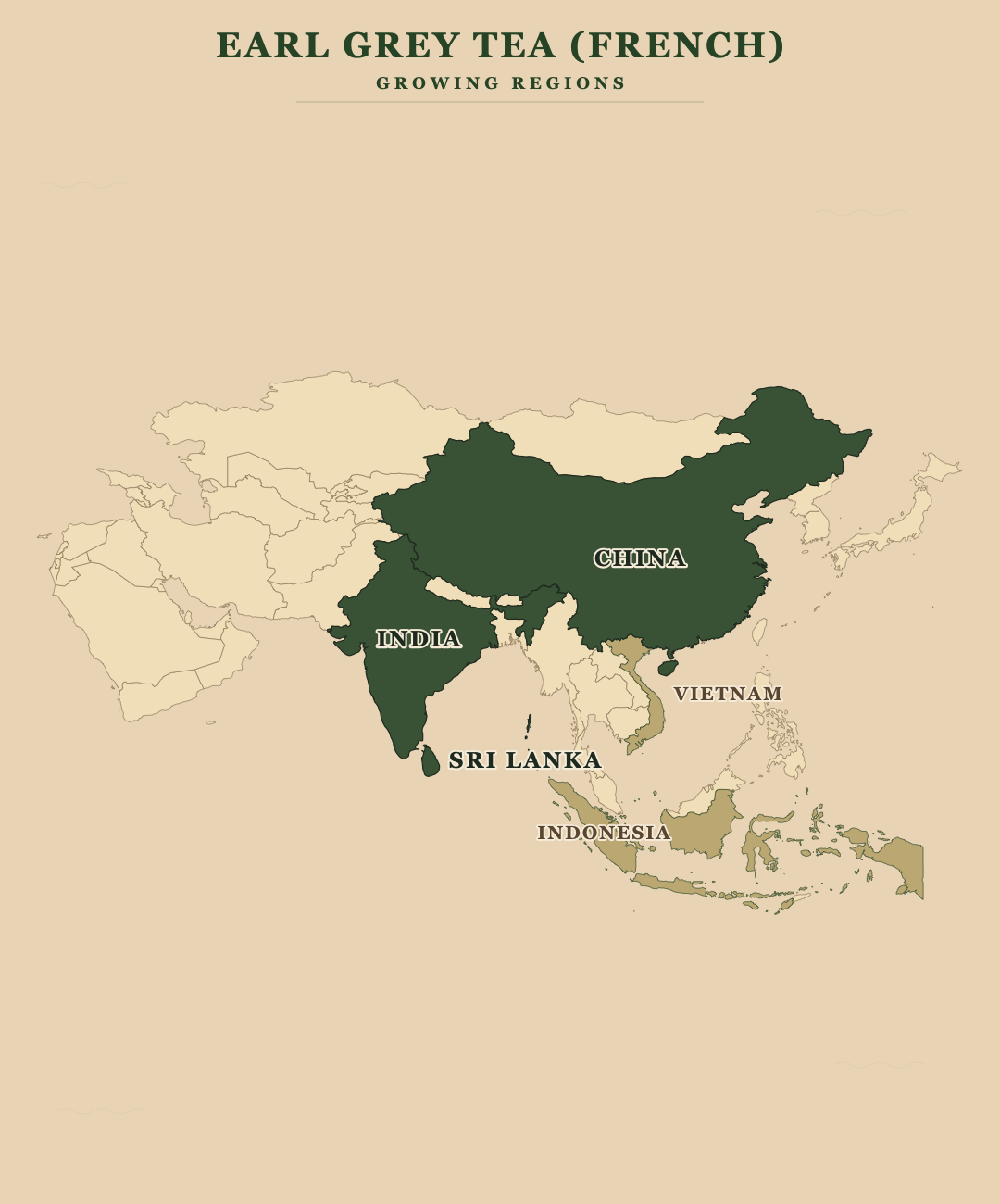
Earl Grey Tea (French) is primarily cultivated in Tea: China, India, Sri Lanka, Kenya | Bergamot: Italy (Calabria) — 90%+, with secondary growing regions in Tea: Vietnam, Turkey, Indonesia | Bergamot: Côte d'Ivoire, Argentina.
Spice Story
The earliest written reference to tea flavoured with bergamot dates to 1824, and the Earl Grey name is most commonly attributed to Charles Grey, 2nd Earl Grey and British Prime Minister in the 1830s, who reputedly received the tea blend as a diplomatic gift from a Chinese tea trader. Lady Grey used the blend to entertain in London as a political hostess; it proved so popular she was asked if it could be sold to others, and Twinings began commercial production. [source] The "French" Earl Grey style emerged later — often used by Parisian tea houses (Mariage Frères, Damman Frères, Camellia Sinensis) to denote a blend with heavier bergamot flavouring and the additional florals. [source] In gin, Earl Grey tea (especially the French style) has become a signature contemporary botanical — particularly visible in the Earl Grey MarTEAni (Audrey Saunders, NYC) and a generation of "tea-infused" craft gins.
Gin Creativity
Earl Grey French brings two distinct character layers at once: the malt-tannic body of black tea, plus the floral-citrus brightness of bergamot. A full sachet pushes a gin firmly into tea-cocktail territory — perfect for MarTEAni-style drinks. A half-sachet adds a quiet tea-and-bergamot background that pairs naturally with juniper and adds Earl Grey complexity to a London Dry. It pairs particularly well with rose petal and lavender (echoing the floral element of the blend) or with cardamom and orange peel for a "chai-Earl-Grey" hybrid. Avoid long warm extraction — the tea tannins go astringent quickly.
Blending Science
Main flavour compounds
 Theaflavins—
 Caffeine—
 Linalyl acetate (from bergamot)—
 Limoneneclean citrus lift
Pairs well with
Two chemical layers carry the character. From the tea side: theaflavins (oxidation products formed during black tea processing) contribute the malt-tannic body and copper colour; caffeine adds bitterness rather than aroma. From the bergamot side: linalyl acetate carries the floral-citrus lift that defines bergamot oil, and limonene provides the bright citrus top. The "French" blend's additional florals contribute their own compounds — lavender adds more linalool, rose petal adds geraniol and citronellol. Cool short extraction emphasises the bright bergamot top; longer warm extraction draws out tea tannins, which can taste bitter if pushed too far.
Food Partners
- Earl Grey-flavoured desserts: Cakes, ice cream, panna cotta, crème brûlée — try with a finishing pour of Earl-Grey gin.
- Cured meats with citrus glazes: Especially duck and venison with bergamot reduction.
- Dark chocolate: Earl Grey-infused ganache is a chef's classic.
- Lemon tarts: Earl Grey gin in the lemon curd.
- Soft-ripened cheeses: Camembert, Brie, washed-rind — Earl Grey gin in a fruit reduction.
Cocktails To Try

- Earl Grey MarTEAni (Audrey Saunders, NYC): Earl Grey-infused gin, lemon, sugar, egg white.
- Earl Grey Negroni: Earl Grey gin, Campari, sweet vermouth — bitter and floral.
- French Earl Grey Spritz: Earl Grey gin, prosecco, soda, fresh lavender garnish.
Release The Flavour
- Cool extraction: Preserves the bergamot brightness; warm extraction emphasises tea tannins.
- Brief contact: 30 minutes to 2 hours is enough; longer extractions go astringent.
- Strain finely: Tea fragments leach tannins into the bottle if left.
- Source matters: French-style blends from established tea houses (Damman, Mariage) give distinctly different results from supermarket Earl Grey.
Discover more
From the same region



Same flavour family
Surprise me

Sources & Citations
- tea_scientific_name (Camellia sinensis):en.wikipedia.org/wiki/Earl_Grey_tea
- bergamot_scientific_name (Citrus bergamia):en.wikipedia.org/wiki/Earl_Grey_tea
- history (first reference 1824; Charles Grey 2nd Earl Grey, PM 1830s; Twinings marketing):en.wikipedia.org/wiki/Earl_Grey_tea
- bergamot_production_calabria (90%+ world output):en.wikipedia.org/wiki/Earl_Grey_tea
- preparation_method (essential oil spray vs dried peel):premiumsteap.com/blogs/news/how-earl-grey-is-made-bergamo...
- french_style_blend (stronger bergamot, sometimes lavender):camellia-sinensis.com/en/blog/earl-grey-a-time-honoured-c...
- main_flavour_compounds (CSV-sourced):inputs/source.csv — Earl Grey Tea (French) row
