
CALAMUS ROOT

- Botanical name
- Acorus calamus
- Also known as
- Sweet flag, Vacha (Sanskrit), Myrtle flag, Beewort, Cinnamon sedge
- Main flavour compound
- Beta-Asarone (variable — often regulated)
- Part used
- Dried rhizome (underground stem, not technically a root)
- Method of cultivation
- Aquatic or semi-aquatic perennial of the Acoraceae family, growing in shallow water margins, ditches and wetlands across the Northern Hemisphere. There are several genetic varieties differing dramatically in chemistry: the North American variety (*A. calamus* var. *americanus*, often considered the type form) has low beta-asarone; the European, Indian and East Asian varieties have much higher concentrations.
- Commercial preparation
- Rhizomes are dug in autumn or early spring, washed thoroughly, sliced and air-dried until brittle. Quality grades vary by origin — European and North American varieties are preferred for food and beverage use because of their lower asarone content.
- Non-culinary uses
- Traditional medicine across many cultures — Ayurvedic (where it's called *vacha*, "speech"), Chinese, Native American, European herbalism — primarily for digestion, mental clarity and respiratory complaints; the rhizome is also used in perfumery and as a fixative for other aromatics. Historical use in tonic wines and bitters dates back to medieval Europe.
Calamus — Acorus calamus — is a tall, sword-leaved aquatic perennial that grows in the shallow margins of slow water, lakes, ditches and marshes across temperate Eurasia and North America. The leaves resemble those of iris or sweet flag (a common name), and the plant produces small unobtrusive yellow-green flower spikes (spadices) low on the stem. What we use is the rhizome — the thick, knobbly horizontal underground stem — which has a distinctive sweet-aromatic character that becomes warmer and spicier on drying. There are several recognised varieties, with the North American form (var. americanus) containing dramatically less of a key compound (beta-asarone) than the Asian and European forms — a distinction that has become regulatorily important.
Dried slices or chips
The standard distilling form — slow-extracting in alcohol.
Powdered
Faster extraction but harder to portion and prone to clouding the spirit.
Region of cultivation
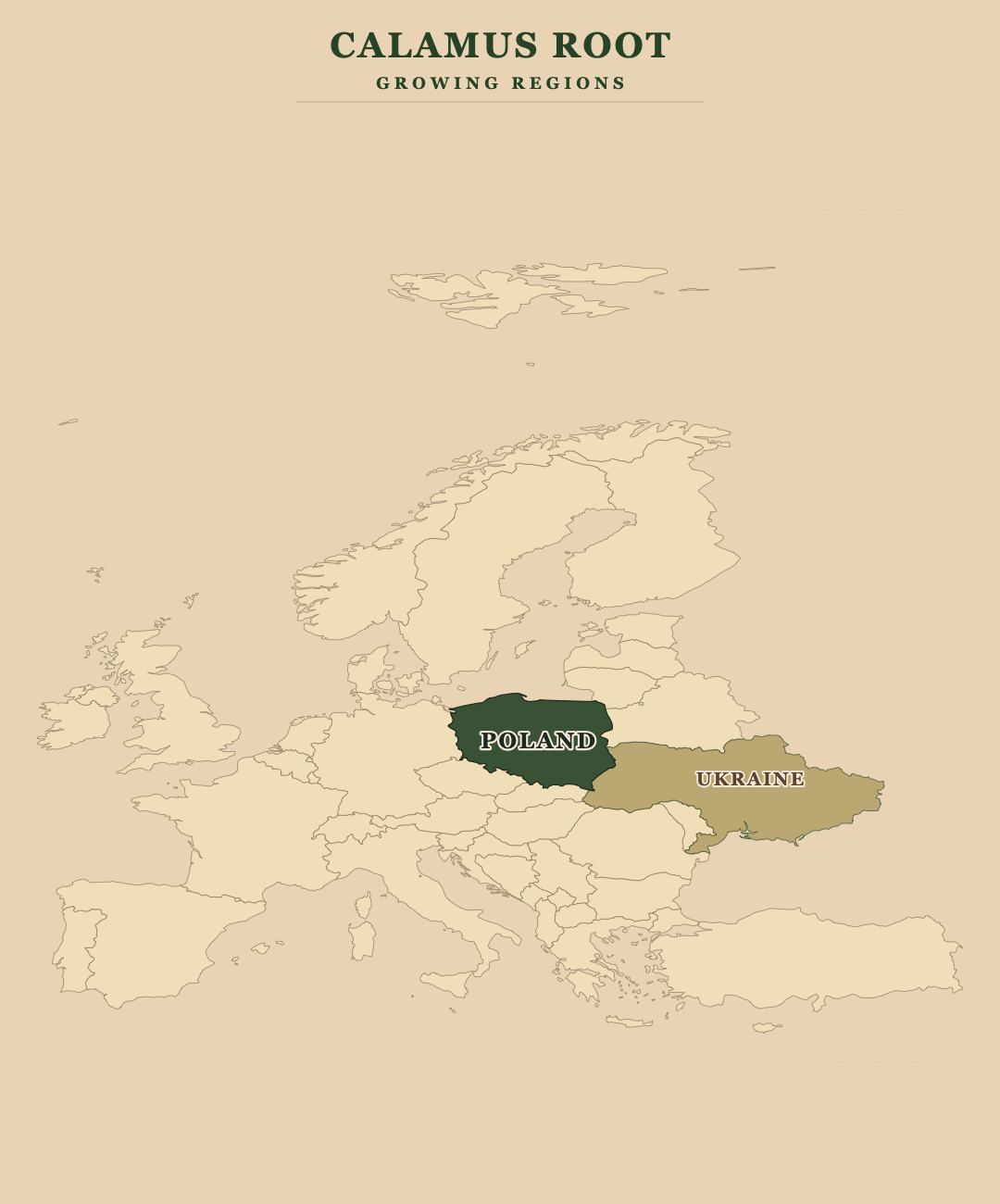
Calamus Root is primarily cultivated in Eastern Europe, North America (regulated jurisdictions vary), with secondary growing regions in India, China, Russia.
Spice Story
Calamus has been described as the oldest continuously used medicinal plant on Earth — 4,000 years of documented use across Ayurvedic, Chinese, Egyptian, Native American and European herbal traditions. [source] In Ayurveda it's called vacha ("speech"), valued for cognitive clarity; in medieval European herbalism it was a foundational ingredient in tonic wines, bitters and herbal liqueurs, and it lingers in some modern commercial bitters formulations. Its position in modern distilling is more cautious. The Joint FAO/WHO Expert Committee on Food Additives flagged toxicity concerns for beta-asarone in 1981, and both the US FDA and EU regulators have since imposed exposure limits — meaning calamus is only legally usable in food and beverage products when sourced from low-asarone varieties (typically the North American type). [source] Confirm your source's variety and certification before using.
Gin Creativity
Calamus, used carefully and sourced correctly, brings a unique bittersweet warmth and an old-fashioned bitters-style depth to a botanical bill. A quarter to half sachet is plenty — full-strength use risks tipping a gin into medicinal territory and may exceed regulatory limits depending on jurisdiction. It pairs particularly well with angelica root and orris (both share the structural fixative role) and with juniper for an old-style London Dry or genever. Avoid pairing with very subtle florals — calamus's warmth dominates them.
Blending Science
Main flavour compounds
 Beta-Asarone (variable — often regulated)calamus, sweet-warm
 Alpha-Asaronecalamus, sweet-warm
 Acorone—
 Isoacorone—
Pairs well with
The defining compounds are the asarones — phenylpropanoid relatives of safrole and methyl eugenol — which carry the warm, slightly spicy aromatic character. Beta-asarone is dominant in most Asian and European varieties (up to 96%) and is the compound regulators have flagged for toxicity. [source] Alpha-asarone is the closely-related isomer present in lower concentrations. Acorone and isoacorone are sesquiterpene ketones that contribute the deeper, woody-spice depth. The North American variety produces much more of the supporting sesquiterpenes and very little beta-asarone, which is why food-grade calamus producers preferentially harvest from that population. Long, warm extraction draws out the deeper sesquiterpenes; short extraction emphasises the lighter aromatic top.
Food Partners
- Bitter aperitifs and amari: Calamus's traditional home — a structural background note in classical bitters.
- Game terrines: The earthy warmth supports rich game meats.
- Marmalade-glazed pork: Calamus and citrus marmalade work surprisingly well together.
- Slow-cooked beans: Eastern European tradition — calamus in cassoulet-style dishes.
- Aged Gouda: Calamus's bittersweet warmth pairs with aged sheep's-milk or cow's-milk hard cheese.
Cocktails To Try

- Vermouth-and-bitters: A traditional reset — high-quality vermouth, ice, a dash of calamus-bitter gin.
- Old-style Negroni: Calamus-leaning gin instead of standard, with classic Campari and vermouth.
- Bitters-spiked Martini: A drop of calamus-gin in a classical Martini for vintage depth.
Release The Flavour
- Slow infusion: Calamus character develops over days, not hours.
- Warm extraction works: Both vapour and traditional maceration draw out the sesquiterpenes well.
- Source carefully: Verify that the dried calamus you buy is the low-asarone variety; check supplier documentation if selling commercially.
- Use sparingly: A small amount goes a long way; overuse pushes a blend medicinal.
Discover more
From the same region

Pairs well with

Same flavour family
Surprise me

Sources & Citations
- scientific_name (Acorus calamus, Acoraceae):en.wikipedia.org/wiki/Acorus_calamus
- cultivation_history (4000+ years; Ayurvedic vacha; Chinese, NA, European traditions):www.traditionalmedicines.org/full-text/the-history-of-the...
- variety_chemistry (NA low-asarone; Asian high-asarone):knowledgevoyager.com/calamus-root-the-sweet-flags-hidden-...
- regulatory_status (FDA prohibits beta-asarone-rich preparations in food; EU exposure limits):knowledgevoyager.com/calamus-root-the-sweet-flags-hidden-...
- medieval_european_use_in_bitters:smokableherbs.com/plant/calamus-root/
- main_flavour_compounds (CSV-sourced):inputs/source.csv — Calamus Root row
