
LIQUORICE ROOT


- Botanical name
- Glycyrrhiza glabra
- Also known as
- Licorice (US spelling), Sweet root, Spanish juice
- Main flavour compound
- Glycyrrhizin
- Part used
- Dried root and rhizome (sliced or chipped)
- Method of cultivation
- Hardy perennial legume of the Fabaceae family, native to the Mediterranean, southern Europe, and central/southwest Asia. The plant grows about 1 metre tall, with feathery pinnate leaves and small purple-blue flowers in summer. Cultivated commercially in China (now the dominant world producer), Iran, Iraq, Russia, central Europe and the Mediterranean. The plant prefers sandy soil and a temperature range of 5–25°C with 400–1160 mm annual rainfall; the root takes 3–4 years to reach commercial size.
- Commercial preparation
- Roots are dug in autumn, washed, sliced, and dried at low temperature. The active sweetening compound glycyrrhizin is about 50 times sweeter than sucrose — which is why a small piece of root tastes intensely sweet.
- Non-culinary uses
- Foundational ingredient in European liquorice confectionery (and in Italian sambuca, French pastis and dozens of liqueurs); traditional medicine across European, Middle Eastern, Indian Ayurvedic and Chinese systems for respiratory and digestive complaints; sweetener in tobacco products.
Liquorice — Glycyrrhiza glabra — is a hardy perennial legume of the Fabaceae family, native to the Mediterranean, southern Europe and central/southwest Asia. The plant grows about 1 metre tall with feathery pinnate leaves and small purple-blue pea-shaped flowers. The Latin name comes from Greek glykos (sweet) + rhiza (root), reflecting the defining feature: the root contains glycyrrhizin, a glycoside that is approximately 50 times sweeter than sucrose. [source] The plant takes 3–4 years to develop a commercial-size root.
Dried sliced root
The standard form — slow-extracting.
Powdered
Faster extraction; loses character within months.
Region of cultivation
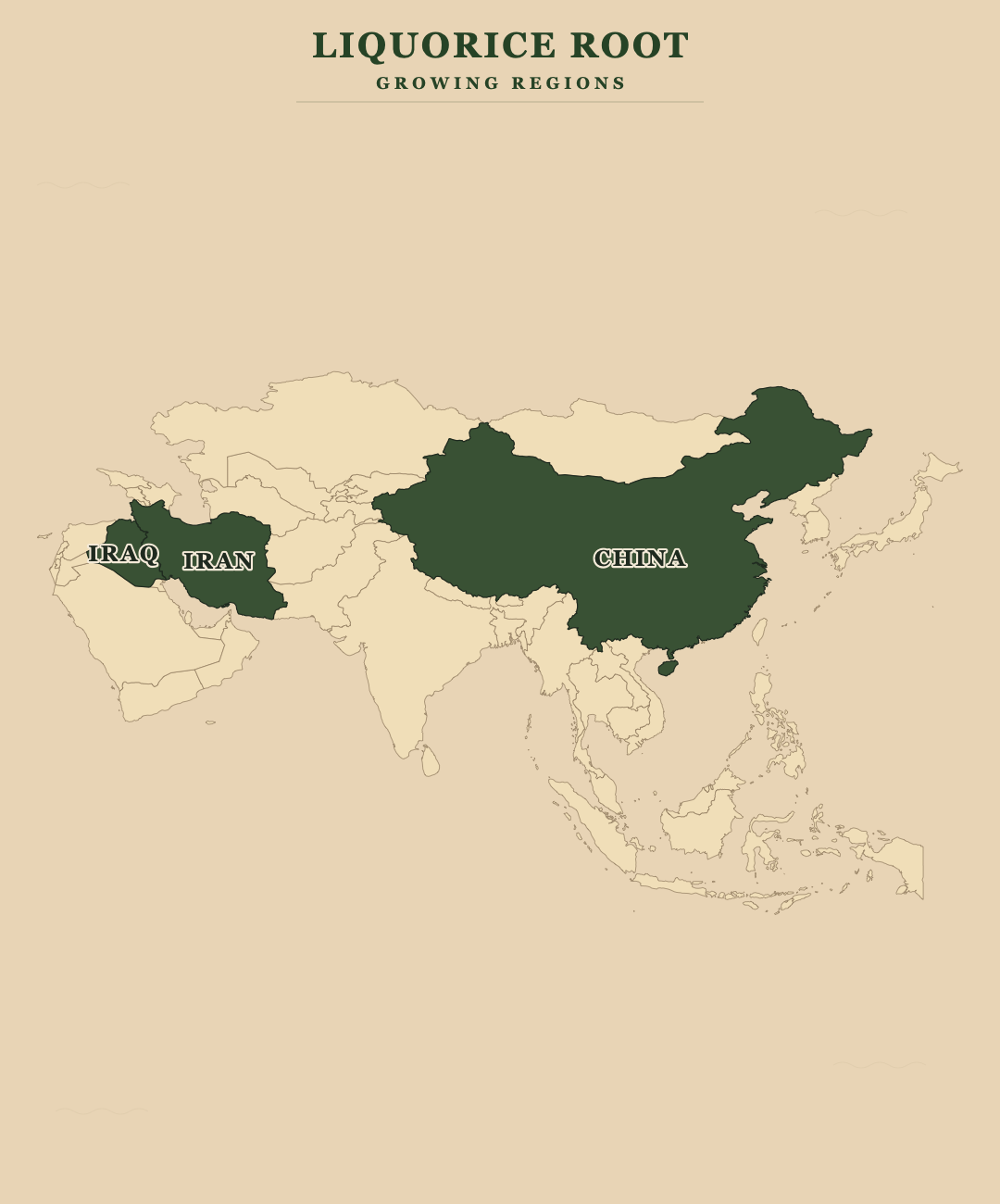
Liquorice Root is primarily cultivated in China (dominant producer), Iran, Iraq, with secondary growing regions in Russia, Italy, Spain, Turkey, Greece.
Spice Story
Liquorice root has been cultivated and used continuously across the Mediterranean, Persia, India and China for at least 3,000 years — Egyptian tombs have yielded liquorice root, and the plant is a foundational element in classical Chinese, Ayurvedic and Greek herbal medicine. The commercial liquorice trade has been dominated by Iran, Iraq and Russia for centuries; China is now the dominant world producer. [source] In European confectionery, liquorice root is foundational to traditional "liquorice" sweets (which are flavoured with the root) and to anise-and-liquorice spirits like sambuca, ouzo and pastis. In gin, liquorice root is a foundational supporting botanical, particularly in genever-style and London Dry expressions where it adds smooth sweetness and depth.
Gin Creativity
Liquorice root brings smooth sweetness and a faint anise-edged warmth without added sugar. A full sachet pushes a gin firmly into anise-leaning territory; a half-sachet provides a soft sweet body that integrates with juniper and angelica. Pair with aniseed and fennel for a layered anise profile, or with orange peel and cinnamon for a softer warming blend.
Blending Science
Main flavour compounds
 Glycyrrhizin—
 Anethole (small amounts)anise, sweet
 Glabridin—
Pairs well with
Glycyrrhizin is the defining compound — a triterpene saponin 50 times sweeter than sucrose. [source] Trace anethole contributes a faint anise-warm edge familiar from aniseed and fennel. Glabridin is a non-volatile isoflavonoid contributing soft astringent depth. Long warm extraction develops the smooth sweetness; cool extraction is faster but produces less body.
Food Partners
- Liquorice confectionery — natural pairing.
- Anise-flavoured desserts — sambuca-style preparations.
- Slow-braised game meats — liquorice in the braising liquid for venison.
- Pickled stone fruit — liquorice in the pickling spice.
- Aged spirits and digestifs — liquorice complements amaro.
Cocktails To Try

- Liquorice Old Fashioned — liquorice gin, demerara, orange bitters.
- Anise Negroni — liquorice gin, Campari, sweet vermouth.
- Sambuca-style highball — liquorice gin, cold water, sugar — a pastis-like aperitif.
Release The Flavour
- Long warm extraction — develops the sweet body.
- Slice thin — increases surface area for slow-extracting root.
- Pair carefully — liquorice's sweetness can dominate.
- Source matters — Iranian and Italian Calabrian liquorice are premium grades.
Discover more
From the same region

Pairs well with
Same flavour family

Surprise me

Sources & Citations
- scientific_name (Glycyrrhiza glabra, Fabaceae):www.sciencedirect.com/topics/agricultural-and-biological-...
- china_dominant_producer:herbawave.com/en/learn/ingredients/licorice-root
- native_mediterranean_central_asia:herbawave.com/en/learn/ingredients/licorice-root
- glycyrrhizin_50x_sweeter_than_sucrose:www.sciencedirect.com/topics/agricultural-and-biological-...
- cultivation_conditions:www.sciencedirect.com/topics/agricultural-and-biological-...
- main_flavour_compounds (CSV-sourced):inputs/source.csv — Liquorice Root row
