
ANGELICA ROOT


- Botanical name
- Angelica archangelica
- Also known as
- Garden angelica, Wild celery, Norwegian angelica
- Main flavour compound
- Pinene
- Part used
- Dried root (taproot, harvested in the plant's second year)
- Method of cultivation
- Cultivated and wild-harvested biennial of the Apiaceae family (the same family as carrot, parsley and celery). In the first year the plant grows leaves only; in the second year it sends up a fluted hollow stem up to 2.5 metres tall. The root is dug late in the first year or very early in the second, before flowering depletes its sugars.
- Commercial preparation
- Roots are washed, split lengthways to speed drying, and dried at low heat until brittle. For gin, the dried root is then coarsely chipped or chopped to expose surface area before maceration.
- Non-culinary uses
- Traditional medicine across Scandinavia and northern Europe for digestion, respiratory complaints, and as a circulatory tonic. Crystallised stems are used in confectionery, especially in French and English baking.
Angelica is a tall, statuesque biennial — Angelica archangelica of the Apiaceae family, related to carrot, celery and parsley. The first year is unglamorous, all low leaves; the second year, the plant sends up a thick fluted hollow stem topped with vast umbrella heads of pale green-yellow flowers, often reaching head height or more. It thrives in cold, damp soils across northern Europe — Iceland, Norway, the Scottish Highlands — and was cultivated as a vegetable and medicinal plant across Scandinavia from at least the 10th century. [source] What we use in gin is the taproot, dug in the first year before the plant exhausts itself flowering.
Chipped or chopped dried root
The standard distilling form — extracts cleanly in alcohol.
Powdered
Faster extraction but more prone to releasing bitter compounds; use sparingly.
Region of cultivation
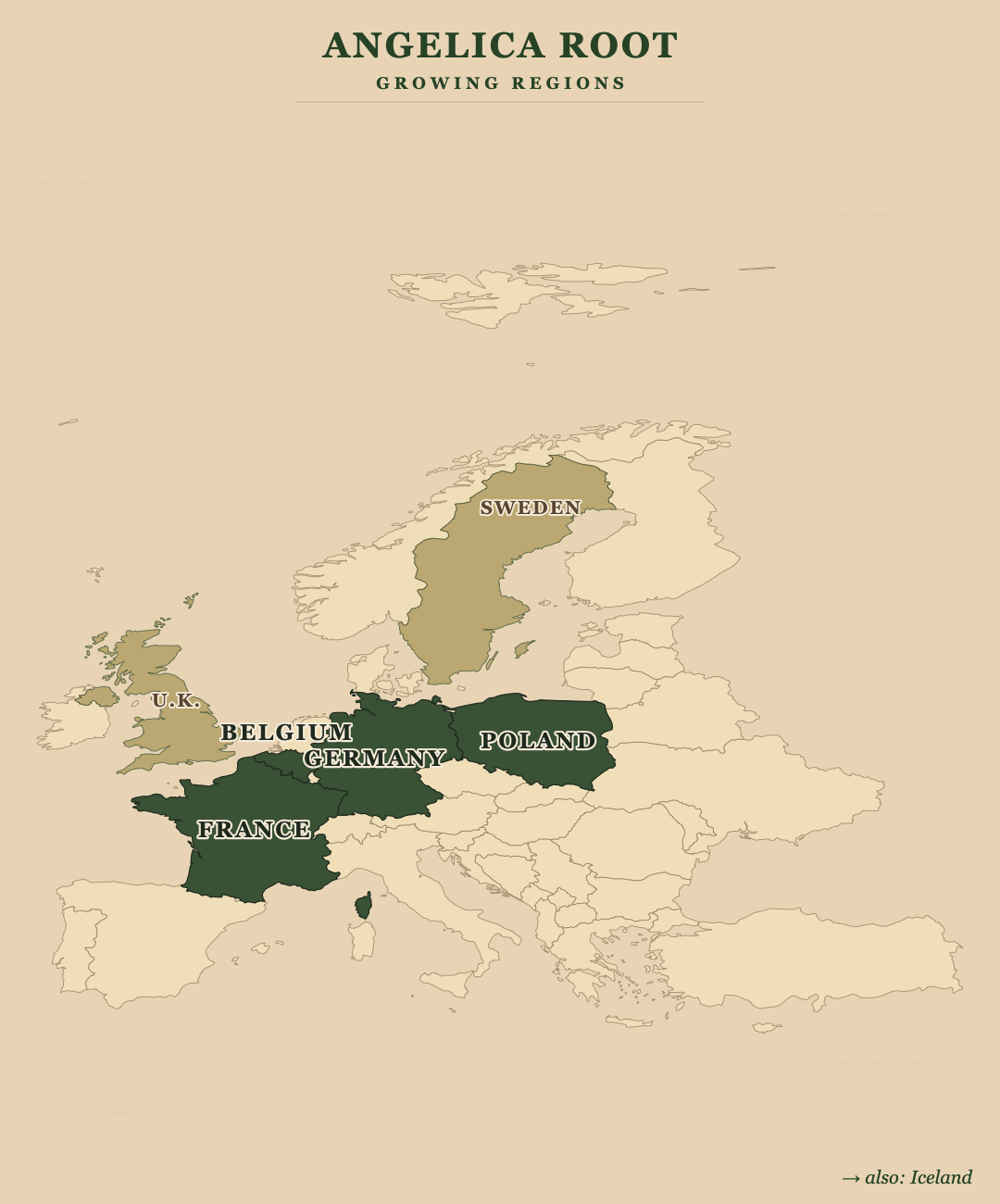
Angelica Root is primarily cultivated in France, Germany, Belgium, Eastern Europe, with secondary growing regions in Iceland, Scandinavia, United Kingdom.
Spice Story
Angelica is the third corner of the classic gin trinity — juniper, coriander, angelica root — and one of the few botanicals named in the Icelandic Sagas. The "archangelica" suffix is medieval European: legend held that an angel revealed the plant's medicinal virtues to a monk during a plague, and the church kept hold of the name. [source] It was used through the medieval period as a respiratory and digestive tonic — Carmelite nuns famously combined it with lemon balm into Eau de Mélisse des Carmes, a 17th-century cordial still made today. In gin, angelica plays a structural role rather than an aromatic one: it binds the more volatile aromatics together, deepens the body of the spirit, and contributes a musky, earthy length on the finish. Without it, a gin can taste thin no matter how good the juniper is.
Gin Creativity
Angelica is rarely the headline — it is the foundation. Use a full sachet alongside juniper and coriander for the classic London Dry trinity; reduce to a half-sachet only if you are pursuing a deliberately lighter, more contemporary style. Pair with cardamom and liquorice root for depth; pair with citrus peel for lift. The earthy-musky note builds across the extraction, so don't judge your blend after the first hour.
Blending Science
Main flavour compounds
 Pinenefresh pine, top note
 Phellandrenecitrus-mint, peppery
 Borneolcamphor, herbal-cool
Three terpenes dominate. Alpha-pinene echoes the pine character of juniper, which is why the two botanicals bond so well — they reinforce each other's top notes. Phellandrene brings a slightly minty, peppery green note characteristic of the Apiaceae family. Borneol adds a cool, camphor-edged depth that reads as "herbal" rather than "minty". Angelica root is also rich in non-volatile bitter compounds and natural sugars that act as a fixative, slowing the evaporation of the more volatile aromatics — which is the structural role distillers value most. A long, gentle extraction draws out the fixative chemistry; a short one captures only the top-note terpenes.
Food Partners
- Game terrines: Earthy and rich; angelica's musk echoes the depth of liver and game.
- Roast rhubarb: Traditional Northern European pairing — try a syrup of angelica-infused gin over rhubarb.
- Custards and crème anglaise: Angelica stems were historically candied and folded into baked custards.
- Bitter leaves (chicory, radicchio): Angelica's mineral edge supports bitterness.
- Pickled fish: A traditional Scandinavian use — angelica in the pickling spice for herring or salmon.
Cocktails To Try

- Martini: A high-angelica gin shows itself most clearly here, where there is nowhere to hide.
- Chartreuse-adjacent cocktails: Chartreuse uses angelica heavily; a gin with strong angelica plays beautifully against it.
- Gin and rhubarb cordial: Angelica-rhubarb-citrus is one of the great trios of British drinks.
Release The Flavour
- Chip, don't pulverise: Coarse pieces release their fixative chemistry slowly; powder turns bitter.
- Time: The structural notes need at least 24 hours to develop fully.
- Heat: Angelica is heat-stable; vapour and maceration both work.
- Quantity: Less is more — angelica supports rather than leads.
Discover more
From the same region

Pairs well with
Same flavour family
Surprise me

Sources & Citations
- scientific_name and family:en.wikipedia.org/wiki/Angelica_archangelica
- biennial life cycle, 2.5m stem:en.wikipedia.org/wiki/Angelica_archangelica
- cultivation history (10th century onward; Sámi use; Icelandic Sagas):en.wikipedia.org/wiki/Angelica_archangelica
- gin preparation (chipped/chopped before distillation):theginlounge.com/gin-botanicals-angelica-root-botanical-p...
- role in gin (binding agent with juniper and coriander):www.theginguild.com/ginopedia/gin-botanicals/angelica-root/
- main_flavour_compounds (CSV-sourced):inputs/source.csv — Angelica Root row
