
CARDAMOM GREEN


- Botanical name
- Elettaria cardamomum
- Also known as
- True cardamom, Green cardamom, Elaichi, Queen of Spices
- Main flavour compound
- 1,8-Cineole (eucalyptol)
- Part used
- Dried seed pod (whole) or decorticated seeds
- Method of cultivation
- Perennial herb of the Zingiberaceae family (ginger family), endemic to the wet evergreen forests of the Western Ghats of Kerala in southwest India — particularly the "Cardamom Hills" of the Idukki district. The plant grows under canopy shade to 2–4 metres tall, producing flowering stems at ground level that bear small pale flowers and, eventually, the familiar pale-green seed pods. Plantings take 3 years to first crop and remain productive for around 10–15 years.
- Commercial preparation
- Pods are hand-picked just before full ripeness (when still green but mature inside), washed, and dried on bamboo mats at low temperature to preserve the pale-green colour. Sun-drying or high-heat kiln-drying turns the pods pale and reduces the volatile oil content. Top-grade cardamom retains a bright olive-green colour and a firm, intact pod.
- Non-culinary uses
- Traditional Ayurvedic medicine for digestion, respiratory and oral health; the essential oil is widely used in perfumery and aromatherapy; cardamom appears in chewable form across South Asia as a breath freshener.
Green cardamom — Elettaria cardamomum — is a tall, leafy perennial of the ginger family, native to the wet shaded forests of the Western Ghats in Kerala, southern India. The plant grows under canopy shade to 2–4 metres tall, with long lance-shaped leaves and flowering stems that emerge directly from the rhizome at ground level. The flowers themselves are small and pale; the seed pods — what we use — are pale green, three-sided, finger-tip sized, and packed with small dark fragrant seeds. The "Cardamom Hills" of Kerala's Idukki district are named after this single plant, and cardamom remains one of the foundational economic spices of the region.
Whole pod
The standard form — crush gently to crack the pod before use, but keep the seeds inside until distillation.
Decorticated seeds
More efficient extraction but lose volatile compounds within months — buy whole pods and crack as needed.
Region of cultivation
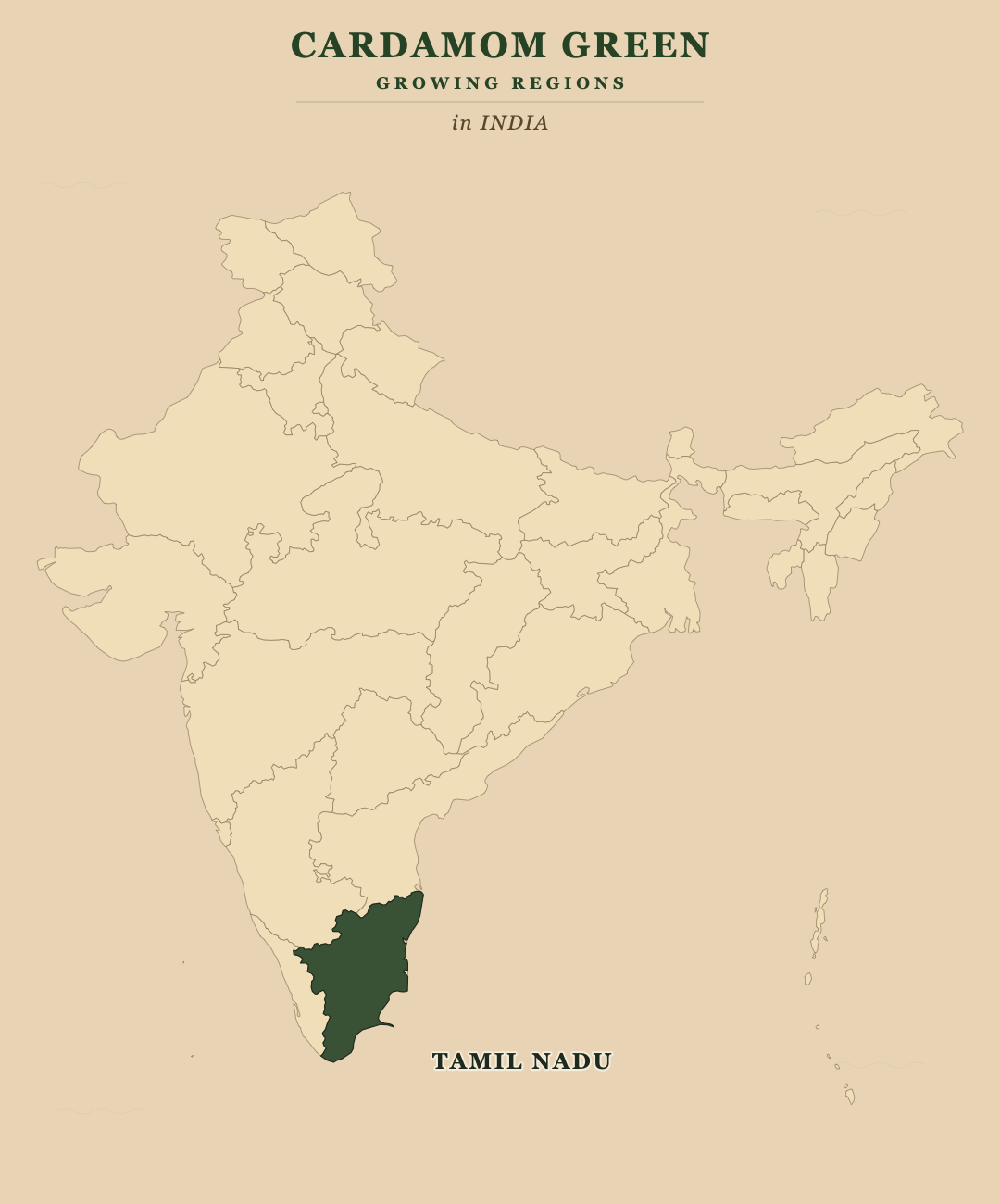
Cardamom Green is primarily cultivated in Guatemala (largest producer since 1980), India (Kerala, Tamil Nadu, Karnataka), with secondary growing regions in Sri Lanka, Tanzania, Papua New Guinea.
Spice Story
Cardamom has been called the Queen of Spices since at least the medieval period — second only in commercial value to black pepper, the King of Spices. [source] The plant was cultivated by South Indian tribes for over 2,000 years and was traded along the ancient spice routes to the Middle East, Egypt (where it has been found in tombs) and Mediterranean Europe; it is mentioned in Sanskrit medical texts as early as the 4th century BCE. [source] Carl Linnaeus formally described the species in 1753. The most surprising twist in the modern story is geographic: although the plant is endemic to India, Guatemala has been the world's largest producer since around 1980 — the spice was introduced to the country's Alta Verapaz highlands in the early 20th century and the favorable highland climate plus high-quality genetic stock pushed it ahead of Indian production after the Second World War. [source] In gin, cardamom is one of the most important contemporary botanicals — present in everything from Hendrick's-style floral gins to spice-forward London Drys.
Gin Creativity
Green cardamom is one of the most versatile contemporary botanicals — powerful, distinctive, and capable of bridging both floral and spice profiles. A full sachet pushes a gin into clearly cardamom-spice territory; a half-sachet adds a quieter aromatic lift that integrates beautifully with juniper. It pairs particularly well with coriander seed and orange peel for a classic contemporary gin profile, or with saffron and cinnamon for a chai-inspired blend. Avoid combining with very heavy smoky spices — green cardamom's bright character is buried under smoke.
Blending Science
Main flavour compounds
 1,8-Cineole (eucalyptol)eucalyptus, cool
 Alpha-Terpinyl acetate—
 Limoneneclean citrus lift
 Linaloolfloral, soft
Pairs well with
The chemistry is built around four major terpenes. 1,8-cineole (eucalyptol) carries the cool, almost camphor-like note that defines cardamom's brightness — it's the same compound that defines eucalyptus and bay leaf. Alpha-terpinyl acetate layers a sweet floral note on top, and is the compound that distinguishes cardamom from its eucalypt-leaning relatives. Limonene adds a citrus brightness, and linalool contributes a soft woody-floral lift that bridges cardamom to coriander and bergamot. All four are alcohol-soluble and survive both vapour infusion and traditional maceration cleanly. Cool extraction emphasises the camphor brightness; warm extraction develops the sweet floral body.
Food Partners
- Indian sweets (kheer, halwa, kulfi): The defining sweet use — cardamom in milk and sugar.
- Scandinavian baking (kardemummabullar): Swedish cardamom buns, where the spice is heroic.
- Middle Eastern coffee: Arabic qahwa with cardamom is a foundational pairing.
- Rice pilaf: A traditional Mughlai use — whole pods in basmati rice.
- Slow-cooked lamb curries: Cardamom in rogan josh and similar dishes.
Cocktails To Try

- Cardamom Martini: Cardamom-and-orange gin, dry vermouth.
- Spiced Gimlet: Cardamom-gin, fresh lime, cardamom syrup.
- Cardamom Negroni: Cardamom-rich gin, Campari, sweet vermouth.
Release The Flavour
- Crush gently: Crack the pod to expose the seeds; this maximises surface area.
- Heat-friendly: Both vapour and warm maceration work well.
- Time: A short infusion (2–4 hours) captures the bright top; longer extractions deepen the sweet body.
- Whole, not ground: Pre-ground cardamom loses character within months.
Discover more
From the same region
Pairs well with
Same flavour family
Surprise me

Sources & Citations
- scientific_name (Elettaria cardamomum, Zingiberaceae):www.sciencedirect.com/science/article/abs/pii/S0065211306...
- native_range (Western Ghats, Kerala Cardamom Hills):spiceofindian.com/kerala-green-cardamom-worlds-finest-spice/
- cultivation_history (2000+ years, Sanskrit texts 4th c. BCE, Egyptian tombs):grokipedia.com/page/Elettaria_cardamomum
- Guatemala_top_producer_since_1980:www.olfactivestudio.com/blogs/news/cardamom-guatemala-s-g...
- Queen_of_Spices_name (2nd most valuable spice after black pepper):www.boloji.com/articles/50552/cardamom--the-queen-of-spices
- Linnaeus_description_1753:grokipedia.com/page/Elettaria_cardamomum
- main_flavour_compounds (CSV-sourced):inputs/source.csv — Cardamom Green row
