
CLOVE

- Botanical name
- Syzygium aromaticum
- Also known as
- Cengkeh (Indonesian), Lavang (Hindi), Karayampu (Tamil)
- Main flavour compound
- Eugenol
- Part used
- Dried flower bud (the unopened bud, picked just before flowering)
- Method of cultivation
- Evergreen tree of the Myrtaceae family, exclusively native to Indonesia's Maluku Islands (the Moluccas), where it has been cultivated for over 2,000 years. Plants are propagated from seed, planted out in coastal areas at altitudes up to about 200 m, and begin producing flower buds after about four years. A mature tree can produce reliably for many decades. Modern commercial production is dominated by Indonesia (60% of world output) and Zanzibar (which grew to be the largest single producer after Dutch and British colonial transfers in the 19th century).
- Commercial preparation
- The unopened pink flower buds are hand-picked at the right moment — just before they would otherwise open — and either sun-dried or low-temperature kiln-dried until they turn the familiar dark brown and shrink to about half their fresh size. Maluku-origin cloves command 20–30% higher prices than Zanzibar cloves because of historical prestige and slightly higher eugenol content.
- Non-culinary uses
- Dental medicine (eugenol is the active anaesthetic in many traditional toothache remedies and is still used in modern dental cement); perfumery (eugenol-based warm-spice accords); the essential oil is used as a clove-bud chewing tobacco flavouring in *kretek* cigarettes (a major Indonesian use); pomanders and traditional pomade.
Clove — Syzygium aromaticum — is a tall evergreen tree of the Myrtaceae family (the same family as eucalyptus, allspice and anise myrtle), exclusively native to a tiny archipelago in Indonesia: the Maluku Islands, sometimes called the Spice Islands. The tree grows to about 12 metres, with smooth grey bark and large dark-green leaves, and produces clusters of pink flower buds that are picked at exactly the right moment — fully formed but not yet open. The bud's distinctive shape (a long shaft with a knobby head) gives the spice its name: "clove" derives from the Latin clavus meaning "nail". [source]
Whole dried bud
The standard form — holds character for years if kept airtight.
Ground
Convenient but fades fast as eugenol oxidises.
Region of cultivation
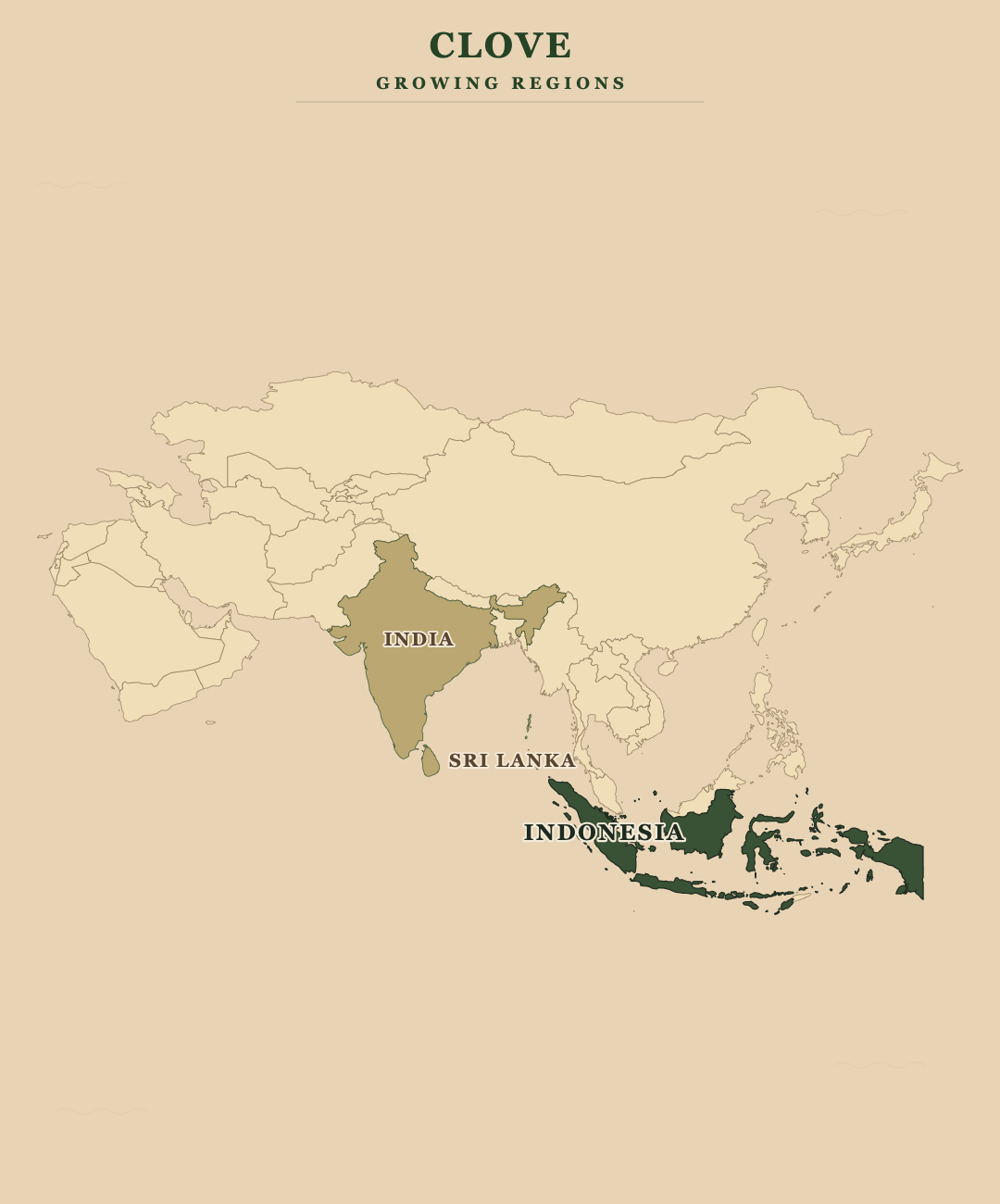
Clove is primarily cultivated in Indonesia (especially Maluku Islands), with secondary growing regions in Zanzibar/Tanzania, Madagascar, Sri Lanka, India.
Spice Story
For over 2,000 years cloves were exclusively a Maluku product, traded outward via Asian and Arab spice routes long before Europeans understood where the spice came from. The European discovery of the Maluku source in the 16th century triggered some of the most violent commercial competition in history: Portuguese, Spanish, Dutch and English forces fought for control of the islands across two hundred years, and the Dutch eventually established a near-total monopoly by uprooting clove trees on every island except those they directly controlled. The monopoly was finally broken in 1770 when the French smuggled seedlings to Madagascar and Réunion; later transfers established Zanzibar (1818) as the world's largest non-Indonesian producer. [source] Today Indonesia produces 60% of global cloves; Zanzibar/Tanzania produces another large share, and Maluku-origin cloves command premium prices because of historical prestige and slightly higher eugenol content. [source]
Gin Creativity
Clove is potent — a little goes a long way. A full sachet pushes a gin firmly into spiced-winter territory and pairs naturally with cinnamon, nutmeg, allspice and orange peel for a Christmas-spice blend. A quarter to half sachet adds quiet warmth that integrates with juniper as a contemporary supporting note. Avoid pairing with very subtle florals — clove's warming-numbing character dominates them. The faint tongue-tingling sensation you taste in a clove-rich gin is a real chemical effect — eugenol is a mild topical anaesthetic.
Blending Science
Main flavour compounds
 Eugenolclove-like, warming
 Caryophyllenewarm woody, peppery
 Eugenol acetateclove-like, warming
Pairs well with
Clove's chemistry is one of the most concentrated of any common spice. Eugenol makes up 72–90% of the essential oil — one of the highest single-compound concentrations of any spice — and is responsible for almost all of clove's character: the warm-pungent flavour, the sweet-resinous aroma, and the mild numbing effect. [source] Caryophyllene layers a woody-spice depth underneath. Eugenol acetate is a related compound contributing the sweeter, slightly fruity edge that distinguishes high-grade Maluku clove from coarser commercial stock. Eugenol is heat-stable, fat- and alcohol-soluble, and survives both vapour infusion and traditional maceration cleanly; it is also one of the few aromatic compounds with significant biological activity, which is why clove appears in toothache remedies and traditional antibacterial preparations.
Food Partners
- Christmas baking: Gingerbread, fruitcake, mince pies — every Christmas-spice tradition uses clove.
- Slow-braised meats: Pot-au-feu, beef bourguignon, Indonesian rendang — clove and slow braising are made for each other.
- Mulled wine: Cloves studded into orange peels, simmered with red wine, cinnamon, sugar.
- Ham glazes: Cloves pressed into a Christmas ham — the classic Western use.
- Pickled fruits: Pickled pears, peaches, plums all take clove well.
Cocktails To Try

- Mulled Gin: Cinnamon-clove-orange gin gently warmed with apple juice or red wine.
- Christmas Negroni: Clove-and-orange gin, Campari, sweet vermouth.
- Hot Toddy: Clove gin, hot water, honey, lemon, whole cloves studded in the lemon.
Release The Flavour
- Whole, not ground: Whole buds release oils slowly; ground clove can overpower fast.
- Heat-tolerant: Eugenol survives both vapour and warm maceration.
- Time: 24–48 hours builds the warmth; longer extractions can turn medicinal.
- Quantity: Less is more — three whole cloves can dominate a small-batch gin.
Discover more
From the same region
Same flavour family
Surprise me

Sources & Citations
- scientific_name and family (Myrtaceae):en.wikipedia.org/wiki/Clove
- native_range (Maluku Islands only):spice.alibaba.com/spice-basics/10-things-you-didn-t-know-...
- 2000_year_cultivation:spice.alibaba.com/spice-basics/10-things-you-didn-t-know-...
- Zanzibar_transfer_1818_colonial_history:en.wikipedia.org/wiki/Clove
- eugenol_content (72-90% of essential oil):pmc.ncbi.nlm.nih.gov/articles/PMC3819475/
- modern_production (Indonesia 60%, Zanzibar 70% global non-Indonesian; Maluku 20-30% higher prices):lodhigarden.com/which-country-is-the-largest-clove-produc...
- main_flavour_compounds (CSV-sourced):inputs/source.csv — Clove row
