
CACAO NIBS

- Botanical name
- Theobroma cacao
- Also known as
- Cocoa nibs, Cacao tips
- Main flavour compound
- Theobromine
- Part used
- Roasted and broken cacao beans (the bean cotyledon, shell removed)
- Method of cultivation
- Small evergreen tree of the Malvaceae family, native to the equatorial lowland rainforests of Central and South America. The genus name *Theobroma* means "food of the gods" in Greek. Trees produce large football-shaped pods directly on the trunk and main branches (cauliflorous fruiting); each pod contains 30–50 seeds embedded in white pulp. Main commercial producers today are Ivory Coast and Ghana (volume), with single-origin Ecuador, Peru, Venezuela and Madagascar dominating the fine-chocolate trade.
- Commercial preparation
- After harvest, beans are removed from pods and fermented in wooden boxes or banana-leaf piles for 5–7 days — this is the critical flavour-development step, where microbial and enzymatic activity reduces bitterness and creates the precursors that become "chocolate flavour" during later roasting. Beans are then sun-dried to safe storage moisture, lightly roasted, the brittle shells removed, and the remaining cotyledons broken into small chips: the nib.
- Non-culinary uses
- Cosmetics (cocoa butter); pharmacology (theobromine is studied for vascular and respiratory effects); traditional Mesoamerican religious and ceremonial use predating Spanish contact by millennia.
The cacao tree — Theobroma cacao — is a small evergreen of the Malvaceae family, native to the warm, humid lowland forests of equatorial Central and South America. It is cauliflorous: the large football-shaped pods grow directly from the trunk and main branches, not from twigs, which gives a mature tree an unmistakable silhouette. Each pod contains 30–50 cream-coloured seeds embedded in a sweet white pulp — the pulp itself is sometimes eaten fresh as a tropical treat. The genus name Theobroma means "food of the gods" in Greek, given by Linnaeus in recognition of how seriously the Aztec, Maya and Olmec cultures took the bean.
Whole roasted nib
The standard form — crack lightly with a mortar to expose more surface for extraction.
Cracked or ground
Faster extraction but the cocoa butter content makes ground nibs prone to clumping.
Region of cultivation
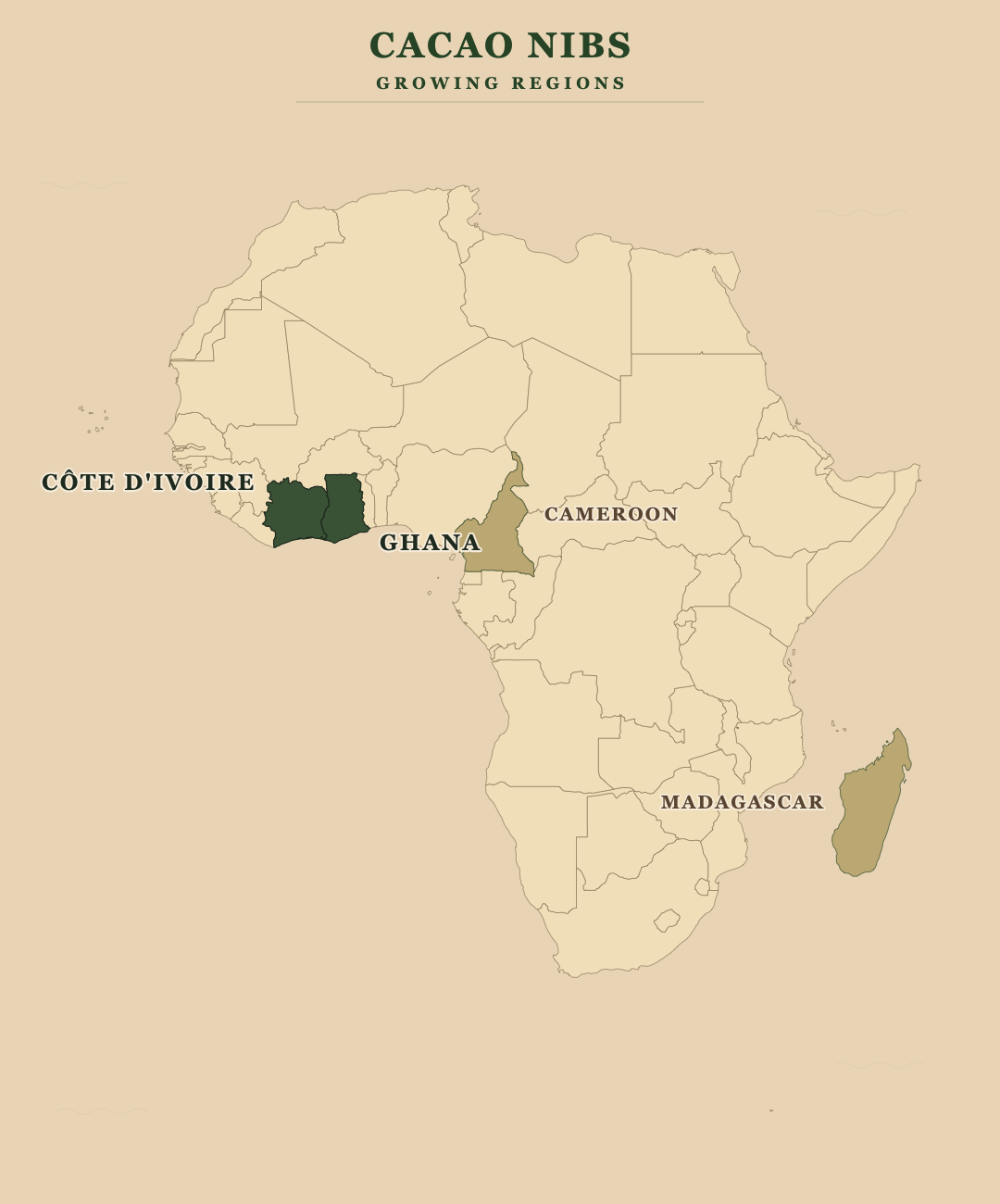
Cacao Nibs is primarily cultivated in Ivory Coast, Ghana, Ecuador, Indonesia, with secondary growing regions in Brazil, Peru, Venezuela, Madagascar, Cameroon.
Spice Story
Cacao was first cultivated and used by the Olmec around 1900 BCE, and was central to Maya and Aztec religious and economic life — Aztec emperors are recorded as drinking it as a frothy, unsweetened bitter beverage flavoured with chilli, achiote and vanilla. The Spanish brought it to Europe in the 16th century, where it remained a luxury bitter drink for nearly 200 years before sugar and milk transformed it into modern chocolate. The unsweetened nib — roasted, broken cacao bean — is the form that retains most of the original character: bitter, toasted, fruit-acid-bright, theobromine-rich. Cacao nibs entered craft cocktail use through the bartender-foraging movement of the 2010s and have become a signature contemporary gin botanical, particularly in Mexican, South American and "after-dinner" gin styles where the cacao note bridges aged-spirit territory.
Gin Creativity
Cacao nibs bring real depth — bitter chocolate, toasted body, a slight fruit-acid lift on the finish. A full sachet pushes a gin firmly into dessert-and-digestif territory; a half-sachet adds quiet bitter-chocolate depth without taking over. It pairs particularly well with vanilla and orange peel for an after-dinner profile, or with long pepper and cardamom for a more spice-driven blend. Avoid pairing with very bright, juicy citrus (lime, fresh grapefruit) — cacao's bitter depth flattens light top notes.
Blending Science
Main flavour compounds
 Theobrominecocoa, bitter
 Tetramethylpyrazineroasted, nutty
 Phenylethylamine—
 Catechins—
Pairs well with
Cacao's chemistry is built around bitter alkaloids and a vast array of roast-derived aromatic compounds. Theobromine is the dominant alkaloid — a milder, longer-acting relative of caffeine, responsible for both the slow stimulating effect of chocolate and its persistent bitter taste. Tetramethylpyrazine is a roast-derived compound that contributes the characteristic toasted-nutty note of well-roasted cacao. Phenylethylamine adds the soft, sweet body that prevents cacao from reading purely bitter. Catechins (polyphenols) are non-volatile but contribute astringent depth and the deep colour. Cacao's alkaloids and most of its aromatics are alcohol-soluble; both vapour infusion and traditional maceration work, but the high cocoa-butter content means filtration matters — cloudy gin from cacao-nib maceration is unattractive.
Food Partners
- Aged spirits and digestifs: A natural pairing — cacao gin alongside or in place of after-dinner amaro.
- Dark caramel desserts: Cacao and caramel are textbook pairing — both share Maillard chemistry.
- Red-fruit jams: Especially raspberry and morello cherry — cacao gin in a chocolate-fruit dessert sauce.
- Hard cheese: Aged Gouda, Manchego, Pecorino take cacao gin in a glaze beautifully.
- Smoked meats: Cacao's bitter depth supports smoke; a Mexican mole tradition.
Cocktails To Try

- Cacao Old Fashioned: Cacao-nib gin, demerara, orange bitters, large ice.
- Mexican Negroni: Cacao-and-orange-peel gin, Campari, sweet vermouth.
- After-dinner Sour: Cacao gin, lemon, egg white, demerara — chocolate without the dessert weight.
Release The Flavour
- Long extraction: Cacao alkaloids extract slowly — 48+ hours minimum for full development.
- Filter carefully: The cocoa butter clouds a finished spirit; fine filtration or cold-filtration helps.
- Roast level matters: Light-roast nibs taste fruity and acidic; dark-roast nibs taste rich and bitter. Match to your gin profile.
- Heat sparingly: High heat draws out bitter tannins; gentle warmth works best.
Discover more
From the same region

Pairs well with
Surprise me

Sources & Citations
- scientific_name (Theobroma cacao):www.sciencedirect.com/topics/neuroscience/theobroma-cacao
- fermentation_process (5-7 days, wooden boxes):revistas.unitru.edu.pe/index.php/scientiaagrop/article/vi...
- theobromine as dominant alkaloid:www.sciencedirect.com/topics/neuroscience/theobroma-cacao
- producing_regions:www.wildcacaocollective.com/blogs/nyheter/what-is-theobro...
- cocoa_nibs_definition_and_processing:cachao.eu/blogs/articles/cacao-nibs-what-they-are-how-the...
- main_flavour_compounds (CSV-sourced):inputs/source.csv — Cacao Nibs row
