
LONG PEPPER (GROUND)

- Botanical name
- Piper longum
- Also known as
- Pippali (Sanskrit), Indian long pepper, Pipli
- Main flavour compound
- Piperine
- Part used
- Dried fruiting spike (catkin) — a small grey-brown cone the size of a fingernail, not a peppercorn
- Method of cultivation
- Cultivated in plantation settings in northeast India, Indonesia and Thailand; the closely related *Piper retrofractum* (Javanese long pepper) is the Southeast Asian cousin. The vine climbs on living trees or trellises and bears its fruit on long catkins that ripen from green to greyish-brown.
- Commercial preparation
- Whole catkins are picked while still firm, sun-dried until they harden, and then either sold whole or ground. For gin, the whole catkin is briefly macerated before distillation or used in vapour infusion to keep the more delicate aromatic compounds intact.
- Non-culinary uses
- Long-established place in Ayurvedic medicine for digestive and respiratory complaints; the alkaloid piperine is studied for its ability to increase the bioavailability of other compounds.
Long pepper is a climbing vine — Piper longum — that wraps itself around the trunks of larger trees in the warm, wet country of northeast India, Indonesia and Thailand. What you buy is not the seed but the entire dried fruiting spike: a small grey-brown cone, perhaps a centimetre long, made of dozens of tiny fruits fused together. It looks more like a catkin from a hedgerow tree than a peppercorn. The closely related Piper retrofractum, the Javanese long pepper, is the Southeast Asian cousin and is often used interchangeably. [source]
Whole catkin
Crush in a mortar just before use — the fruit holds its oils far longer than ground pepper.
Ground
Loses pungency over months as chavicine slowly converts to less-sharp piperine. Buy in small amounts, use fresh.
Region of cultivation
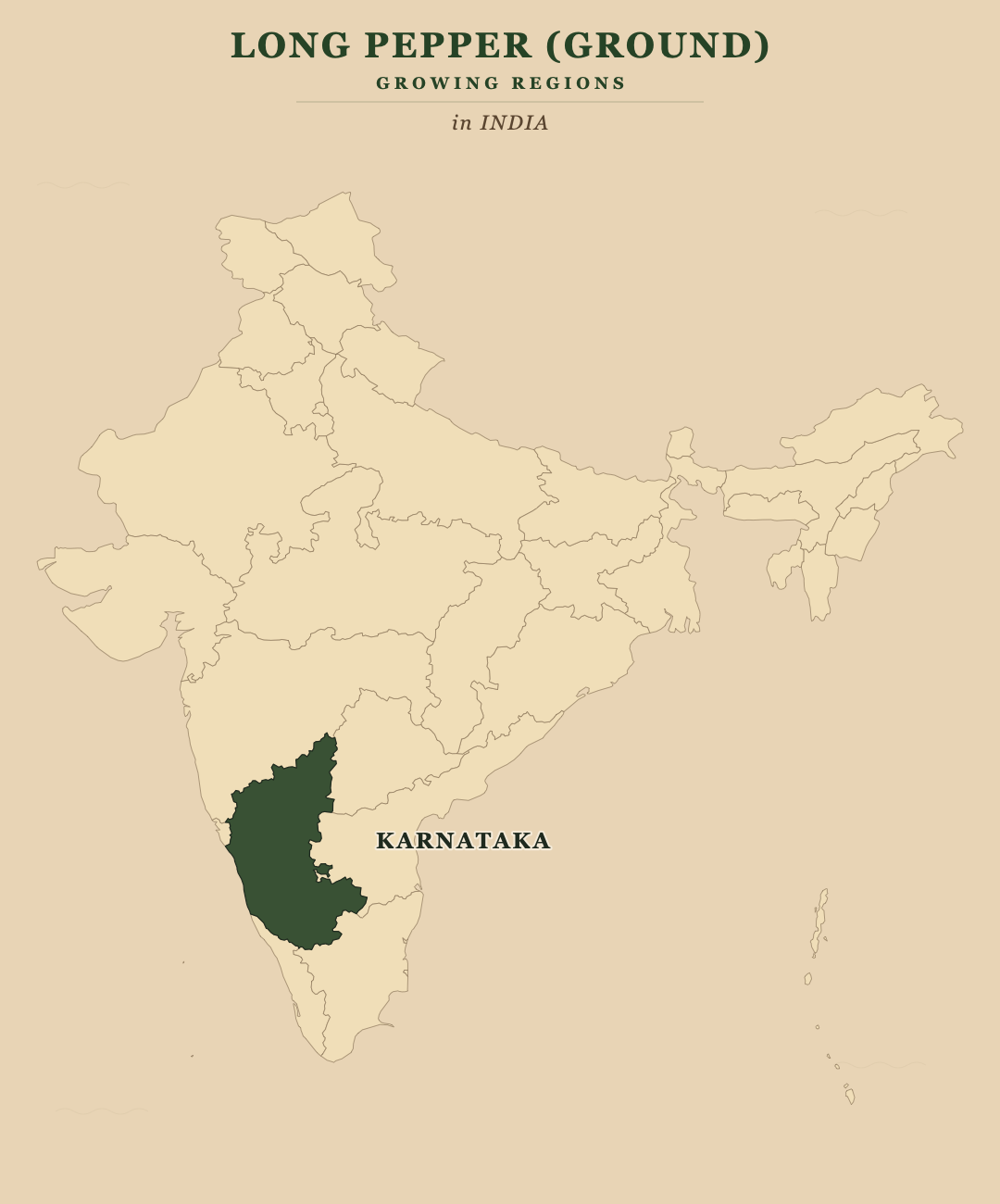
Long Pepper (ground) is primarily cultivated in India (northeast, Deccan peninsula), Indonesia, Thailand, with secondary growing regions in Nepal, Sri Lanka, Bangladesh.
Spice Story
Long pepper got there first. Two thousand years before the British East India Company sailed for Malabar, long pepper was already being traded from the Indian port of Muziris across the Red Sea to Rome — where it commanded around three times the price of black pepper because of its greater pungency and complexity. [source] In Sanskrit it was pippali, the word that survived into both pepper and piperine. The medieval European market eventually preferred its rounder, more familiar cousin — black pepper had displaced long pepper across most of Europe by the fourteenth century [source] — and long pepper retreated to South Asian and Indonesian kitchens, where it never went out of fashion. Its return to Western use, including in contemporary gin, is genuinely a rediscovery, not a debut.
Gin Creativity
Long pepper is a substitute for black pepper only in the loosest sense — the warmth is similar but the architecture is completely different. A full sachet pushes a gin firmly into spiced, almost mulled-wine territory; a half-sachet works beautifully as a back-palate complement to juniper, adding length and warmth without crowding the front. Pair it with cardamom and nutmeg for a winter botanical bill, or with coriander and pink grapefruit peel for something more spice-route and aromatic. Vapour infusion is friendlier than long maceration — the volatile aromatics emerge clean.
Blending Science
Main flavour compounds
 Piperinepungent pepper heat
 Chavicinepungent pepper heat
 Beta-Caryophyllenewarm woody, peppery
 Pinenefresh pine, top note
The dominant character comes from two related alkaloids. Piperine is the slow-burning, persistent warmth — the same compound responsible for the heat in black pepper, but present at only 1–2% in long pepper compared to 5–10% in black pepper. [source] The sharper, more immediate bite comes from chavicine, a geometric isomer of piperine that converts slowly to piperine over time — which is why ground long pepper loses its edge after a few months. [source] Behind these, beta-caryophyllene adds a warm-spice depth that sits between clove and dry wood, and trace pinene lifts the whole into a faintly resinous top note that bridges to juniper.
Food Partners
- Slow-braised beef and lamb: Long pepper's warmth survives long cooks where black pepper turns harsh. Add at the start of a stew, not the end.
- Spiced honey cake: The dark-fruit and nutmeg notes lift baking spice without overpowering.
- Mulled wine: A traditional Roman use — try replacing half the black pepper in your mulling spice with crushed long pepper.
- Pickled stone fruit: Especially plums and apricots. The sweetness sets off the catkin's earthy heat.
- Aged cheese: Hard sheep's-milk cheeses and long pepper share a common warmth.
Cocktails To Try

- Negroni, spiced: Crush half a catkin into the stir; the bitter and the warm find each other.
- Hot toddy: Whisky or gin, honey, lemon, one crushed long pepper catkin. The traditional Indian pippali tonic, reframed.
- Mulled gin: Use long pepper in place of black pepper alongside cinnamon, clove and orange peel for a winter mulled gin.
- Vintage-style martini: A trace amount of long pepper in the rinse echoes the spice-route gins of the early 20th century.
Release The Flavour
- Crack, don't grind: A whole catkin crushed coarsely releases oils slowly across an extraction. Pre-ground long pepper has usually lost its chavicine.
- Time: Long extractions deepen the warming alkaloids; short ones favour the volatile aromatic top notes.
- Heat: Gentle warmth is fine — long pepper is more heat-tolerant than juniper or citrus.
- Use fresh: Buy whole, store in a sealed jar away from light, grind or crack just before use.
Discover more
From the same region

Pairs well with
Same flavour family
Surprise me

Sources & Citations
- scientific_name:www.theginguild.com/ginopedia/gin-botanicals/long-pepper/
- also_known_as (Pippali, Sanskrit):www.livingrootsusa.com/blogs/blog/rlong-pepper-ancient-ro...
- region_primary (India + SE Asia; Piper retrofractum split):gernot-katzers-spice-pages.com/engl/Pipe_lon.html
- cultivation (NE India, Indonesia, Thailand):gernot-katzers-spice-pages.com/engl/Pipe_lon.html
- commercial_preparation (gin maceration / vapour infusion):www.theginguild.com/ginopedia/gin-botanicals/long-pepper/
- roman_trade_history (Muziris, 3x black pepper price):www.livingrootsusa.com/blogs/blog/rlong-pepper-ancient-ro...
- medieval_displacement (black pepper, 12th-14th c.):en.wikipedia.org/wiki/Long_pepper
- piperine_content (1-2% vs black pepper 5-10%):en.wikipedia.org/wiki/Piperine
- chavicine (sharp-flavour isomer; converts on aging):culinarylore.com/food-history:long-pepper-history-and-lore/
- ayurvedic_use:www.livingrootsusa.com/blogs/blog/rlong-pepper-ancient-ro...
- main_flavour_compounds (CSV-sourced):inputs/source.csv — Long Pepper row
