
BLUE CYPRESS

- Botanical name
- Callitris intratropica
- Also known as
- Northern cypress pine, Australian Blue Cypress, Intropica cypress
- Main flavour compound
- Guaiol
- Part used
- Heartwood (dried, distilled or chipped)
- Method of cultivation
- Long-lived evergreen conifer of the Cupressaceae family, native to the tropical north of Australia. Wild trees can reach 30 metres tall and live for over 200 years. Modern commercial supply comes from unmanaged plantations established in the 1950s in the Northern Territory, plus sustainable wild harvest under state government oversight on Tiwi country.
- Commercial preparation
- For the essential oil trade, the timber and bark are coarsely chipped and steam-distilled — the inclusion of the resinous bark is what gives Blue Cypress oil its remarkable blue colour. For gin botanical use, the heartwood is shaved or chipped finely and added directly to the still as a vapour-infusion botanical; resin pockets within the wood release essential oils slowly.
- Non-culinary uses
- Perfumery base note (one of the few natural blue-coloured essential oils); insect repellent (independent studies have confirmed strong mosquito-repellent activity); incense; traditional bush medicine; the timber itself is valued for furniture and construction in Northern Australia.
Blue Cypress — Callitris intratropica — is a long-lived evergreen conifer native to the monsoon tropics of Northern Australia, in the Cupressaceae family of true cypresses. In the wild it reaches 30 metres and can live for over 200 years, putting it among the longer-lived trees of any Australian forest. [source] The heartwood is dense, fragrant, and oil-rich, and the bark carries the deep blue resinous compounds (especially guaiazulene-type sesquiterpenes) that give the essential oil its remarkable colour. It is one of only a small handful of essential oils in the world that is naturally blue without any additives — German chamomile and yarrow are the others.
Wood chips or shavings
The standard distilling form — used in vapour infusion or long maceration.
Sawdust
Faster extraction but harder to strain cleanly.
Region of cultivation
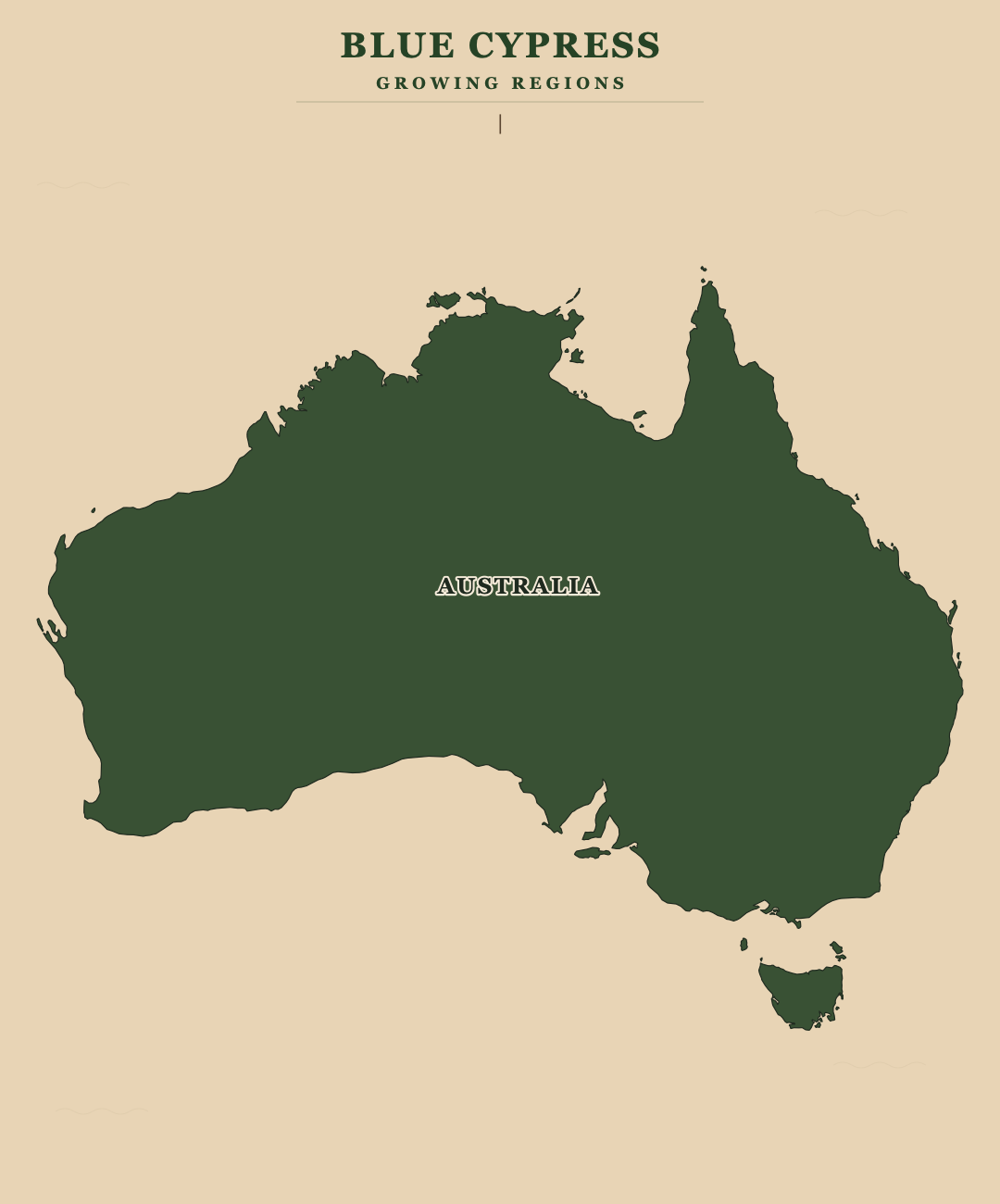
Blue Cypress is native to Australia, Australia — Northern Territory (especially Tiwi Islands), with secondary growing regions in Northern Queensland, Western Australia (Kimberley). |
Spice Story
Blue Cypress has been used by Aboriginal peoples for tens of thousands of years across its native range, particularly by the Tiwi people of Bathurst and Melville Islands in the Northern Territory, both as a medicinal plant and as an incense burned in ceremony. [source] The modern essential oil industry traces to plantations established in the 1950s on Tiwi country, which were originally planted as timber but were later recognised as a unique source of pharmaceutical-grade essential oil. Today most commercial Blue Cypress oil comes from these plantations, supplemented by sustainable wild harvest under state oversight. The oil's mosquito-repellent properties have been confirmed in formal independent research, and its use in craft gin is recent but growing — a small number of Australian distilleries have begun including it as a signature native woody note.
Gin Creativity
Blue Cypress is a powerful, distinctive woody note — use it carefully. A full sachet pushes a gin firmly into resinous, almost incense-like territory; a half-sachet adds a quiet but unmistakeable woody depth that elevates a botanical bill without dominating. It pairs naturally with sandalwood for a "fragrant wood" profile, or with pepperberry and anise myrtle for a fully Australian native blend. Avoid combining with very heavy floral botanicals — the resinous backbone of Blue Cypress overwhelms delicate florals.
Blending Science
Main flavour compounds
 Guaiol—
 Bulnesol—
 Eudesmol—
 Columellarine—
Pairs well with
- Sandalwood
- Pepperberry
- Anise Myrtle
- Juniper
- Frankincense
Blue Cypress is unusual among woody essential oils because its dominant compounds are sesquiterpene alcohols rather than terpene hydrocarbons. Guaiol carries a soft, slightly sweet woody-resin note that's the dominant identifier of the oil. Bulnesol adds a creamier, almost balsamic depth. Eudesmol layers a drier woody character. Columellarine is a relatively rare compound found in significant concentration only in this species — it contributes a faintly smoky undertone. [source] These compounds are heavier and less volatile than most botanical aromatics, so Blue Cypress is best used in vapour infusion or long maceration — short cold steeps don't extract enough character. The blue colour does not transfer to alcoholic extracts in noticeable amounts; it's primarily a feature of the steam-distilled oil.
Food Partners
- Smoked meats: Blue Cypress's resinous-smoky character supports smoking deeply.
- Native bush spice rubs: Pair with pepperberry, anise myrtle, native thyme.
- Dark honey: Particularly leatherwood honey from Tasmania, which has its own resinous character.
- Aged cheese: Hard sheep's-milk cheeses with a Blue Cypress-infused gin reduction.
- Roast root vegetables: Especially parsnip and carrot, where the woody note adds savoury depth.
Cocktails To Try

- Australian Negroni: Blue Cypress-infused gin, Campari, dry Australian vermouth.
- Bush Old Fashioned: Blue Cypress gin, bush-honey syrup, native lemon-myrtle bitters.
- Smoke Martini: A signature crystalline Martini with a Blue Cypress-rinsed glass.
Release The Flavour
- Long extraction: The heavy sesquiterpenes need time — 48+ hours for full development.
- Heat-friendly: Both vapour and warm maceration work well.
- Chip finely: Maximises surface area for slow extraction.
- Less is more: A few shavings go a long way; the character builds across a blend.
Discover more
Pairs well with
Same flavour family

Surprise me

Sources & Citations
- scientific_name (Callitris intratropica, Cupressaceae):essentiallyaustralia.com.au/product/australian-blue-cypre...
- native range and tree size (up to 30m, 200+ year life):essentiallyaustralia.com.au/product/australian-blue-cypre...
- plantation history (1950s establishment):essentiallyaustralia.com.au/product/australian-blue-cypre...
- Indigenous use (Tiwi people, Bathurst and Melville Islands):essentiallyaustralia.com.au/product/australian-blue-cypre...
- oil_chemistry (guaiol, bulnesol, eudesmol, columellarine):essentiallyaustralia.com.au/product/australian-blue-cypre...
- mosquito_repellent_research:pmc.ncbi.nlm.nih.gov/articles/PMC10484250/
- main_flavour_compounds (CSV-sourced):inputs/source.csv — Blue Cypress row
