
SANDALWOOD

- Botanical name
- Santalum album (Indian) / Santalum spicatum (Australian)
- Also known as
- Mysore sandalwood (premium Indian), Waang (Noongar), Dutjahn
- Main flavour compound
- Alpha-Santalol
- Part used
- Dried heartwood (chipped or distilled)
- Method of cultivation
- Two main commercial sandalwoods: **Indian Sandalwood** (*Santalum album*), native to southern India (Mysore, Kerala, Andhra Pradesh) and South-East Asia, traditionally the premium grade with 70–90% santalol content — but severely overexploited in the wild and now grown in commercial plantations including significant production in Kununurra, Western Australia. **Australian Sandalwood** (*Santalum spicatum*), endemic to semi-arid southwest Australia, with 20–40% santalol content. The Forests Products Commission in WA sustainably manages both species in plantation.
- Commercial preparation
- Heartwood is chipped or steam-distilled. Cultivated *Santalum album* takes 15–20 years to reach commercial maturity (compared to 30–50 years in the wild); cultivated *Santalum spicatum* is similar. Plantation cultivation in WA's Kununurra and southwest regions is now a significant ethical alternative to wild-sourced Indian sandalwood.
- Non-culinary uses
- Foundational perfumery base note (one of the great natural creamy-woody fragrance materials); cosmetics; aromatherapy; traditional Hindu, Buddhist and Jain religious ceremony across India, China, Japan and South-East Asia for thousands of years.
"Sandalwood" in commerce refers to one of two main species: Indian Sandalwood (Santalum album), native to southern India and South-East Asia, traditionally the premium grade — and Australian Sandalwood (Santalum spicatum), endemic to the semi-arid southwest of Western Australia. Both are hemiparasitic trees of the Santalaceae family. The two species are chemically distinct: Indian album contains 70–90% santalols (the defining sandalwood compounds), Australian spicatum contains 20–40%. [source] Both yield the prized creamy-woody-sweet aromatic, but the Indian species has historically been considered the absolute premium grade.
Wood chips
The standard form — slow extraction.
Powdered/sawdust
Faster extraction.
Region of cultivation
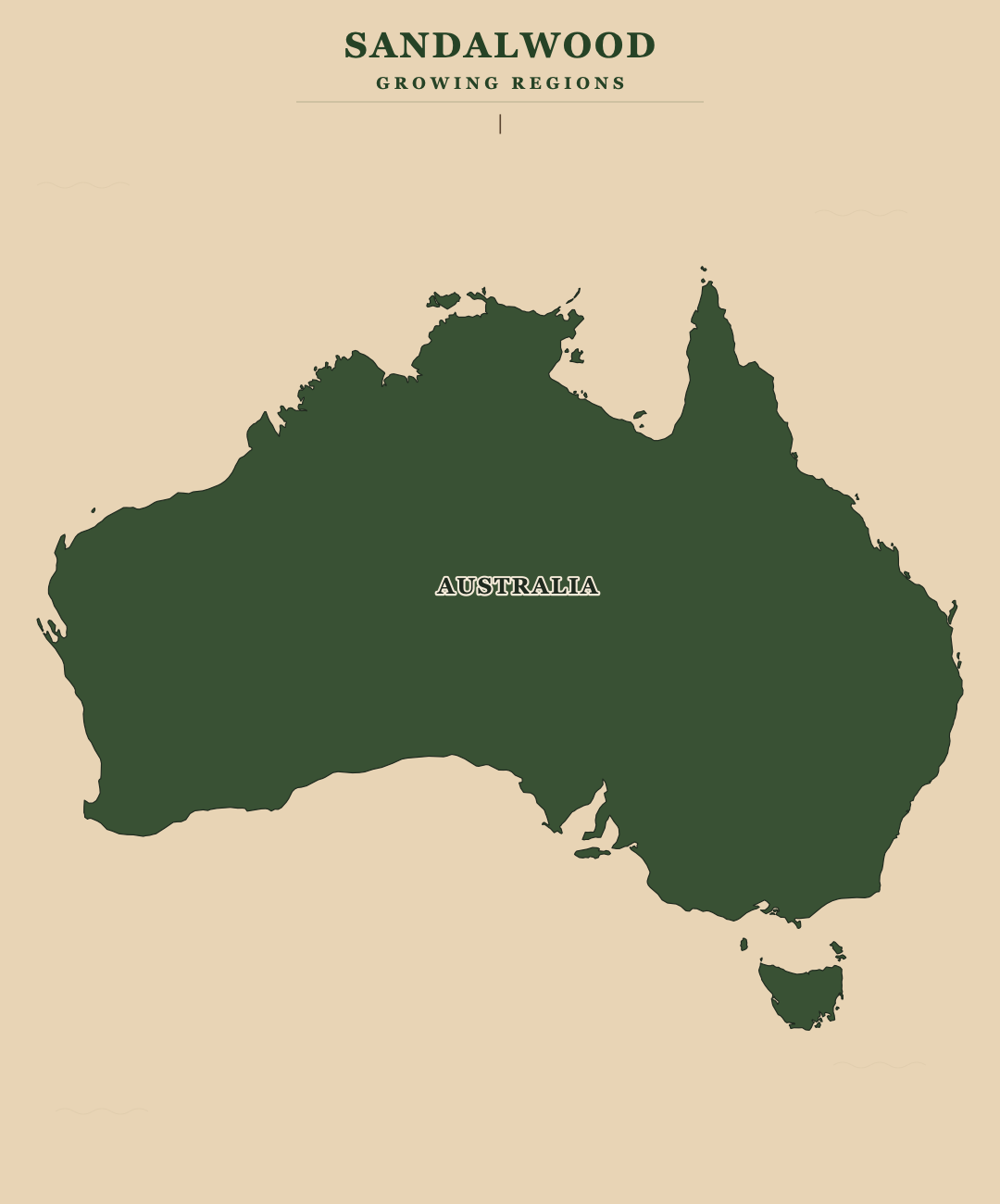
Sandalwood is native to Australia, India (S. album — historic); Western Australia (both species, cultivated), with secondary growing regions in Indonesia, Pacific Islands (other Santalum species). |
Spice Story
Sandalwood has one of the longest and most culturally significant commercial histories of any aromatic plant. Indian Santalum album has been used in Hindu, Buddhist and Jain religious ceremony across South and South-East Asia for thousands of years, and was a foundational perfumery and incense material across the wider region. The 20th-century essential-oil industry massively overexploited wild Indian sandalwood, leading to severe population decline and the species now being listed as Vulnerable. [source] In response, two important sustainable sources have emerged: Western Australian plantation cultivation of both Santalum album (in Kununurra) and Santalum spicatum (in the southwest). Modern ethical sandalwood gin should use sustainably-managed plantation material rather than wild-sourced Indian material. In gin, sandalwood is one of the foundational woody base notes.
Gin Creativity
Sandalwood brings creamy-sweet woody character that no other botanical replicates. A small amount (quarter to half sachet) is plenty — sandalwood adds structural depth and length rather than a prominent top note. Pair with Buddha Wood for a layered Australian wood profile, or with rose petal and frankincense for a Persian-leaning blend.
Blending Science
Main flavour compounds
 Alpha-Santalol—
 Beta-Santalol—
 Sesquiterpene alcohols—
Pairs well with
- Buddha Wood
- Blue Cypress
- Rose petal
- Jasmine
- Frankincense
Alpha-santalol and beta-santalol are the defining compounds — sesquiterpene alcohols responsible for the characteristic creamy-sweet woody aromatic. Other sesquiterpene alcohols add body and depth. Indian Santalum album has the highest concentration; Australian Santalum spicatum is drier and less creamy but more sustainable. Heat-stable; long extraction (48+ hours) develops the full character.
Food Partners
- Indian sweets and confectionery — sandalwood-rose-pistachio combinations.
- Ceremonial and meditative spice blends — Indian agarbatti incense traditions.
- Aged spirits and digestifs — sandalwood as base-note depth.
- Dark caramel desserts — sandalwood and burnt sugar.
- Soft cheese with honey — chèvre with sandalwood-honey reduction.
Cocktails To Try

- Sandalwood Old Fashioned — sandalwood gin, demerara, orange bitters.
- Persian Negroni — sandalwood-and-rose gin, Campari, vermouth.
- Ceremonial G&T — sandalwood gin, native tonic, native garnish.
Release The Flavour
- Long extraction — 48+ hours for santalol development.
- Chip finely — increases surface area.
- Verify sustainability — Indian wild sandalwood is endangered; use plantation-sourced material only.
- Source matters — Australian-cultivated Santalum album is the ethical premium grade.
Discover more
From the same region

Pairs well with
Same flavour family
Surprise me

Sources & Citations
- scientific_names (Santalum album and spicatum, Santalaceae):en.wikipedia.org/wiki/Santalum_album
- santalol_content (Indian 70-90%, Australian 20-40%):cosmeticsbusiness.com/australian-vs-indian-sandalwood-wha...
- wild_overharvesting_indian_sandalwood:tisserandinstitute.org/santalum-album-oil-rejuvenated/
- kununurra_wa_indian_sandalwood_cultivation:napproducts.com/blogs/news/two-sandalwoods-one-sustainabl...
- noongar_traditional_use:napproducts.com/blogs/news/two-sandalwoods-one-sustainabl...
- main_flavour_compounds (CSV-sourced):inputs/source.csv — Sandalwood row
