
ROSE

- Botanical name
- Rosa × damascena (Damask) / Rosa centifolia (Cabbage)
- Also known as
- Damask rose, Bulgarian rose, Centifolia, Cabbage rose, Rose of May
- Main flavour compound
- Citronellol
- Part used
- Dried petal (also rose hip and rose-water are separate commercial products)
- Method of cultivation
- Two main commercial species in perfumery and the spice trade: **Rosa × damascena** (Damask rose) — grown principally in Bulgaria's Valley of Roses around Kazanlak and Karlovo, in Turkey's Isparta region, and in Iran — and **Rosa centifolia** (Cabbage rose or Rose of May) — grown principally in Grasse, France. Both species are deciduous shrubs of the Rosaceae family. Bulgarian and Turkish cultivation centres in particular have hundreds of years of continuous production history.
- Commercial preparation
- Flowers are hand-picked in the cool of early morning (before heat damages volatile compounds). For dried-petal commerce, petals are gently separated from the calyx and air-dried at low temperature. For essential oil, the fresh flowers are immediately steam-distilled (producing rose otto) or solvent-extracted (producing rose absolute). Yield is famously low: about 3,000–5,000 kg of flowers per kg of rose otto, making rose oil one of the most expensive commodities in the world.
- Non-culinary uses
- Foundational ingredient in fine perfumery — rose is one of the great natural floral notes of Western fragrance, and a foundational note in many of the world's most famous perfumes; rose water in Middle Eastern, Persian, Turkish and Indian cooking; cosmetics; aromatherapy.
"Rose" in the spice and perfumery trade is most often Rosa × damascena (the Damask rose) or Rosa centifolia (the Cabbage rose). Both are deciduous shrubs of the Rosaceae family, grown principally in three regions: Bulgaria's Rose Valley around Kazanlak (Damask), Turkey's Isparta region (Damask), and France's Grasse region (Centifolia, sometimes called Rose of May). [source] Each region has hundreds of years of continuous production history; the flowers are picked at dawn before heat dissipates the volatile compounds. The yield from steam distillation is famously low — about 3,000–5,000 kg of flowers per kg of rose oil — which is why rose oil is among the most expensive commodities in commerce.
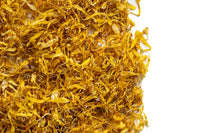
Whole dried petal
The standard form — visually striking, slow-releasing.
Loose dried florets
Faster extraction.
Region of cultivation
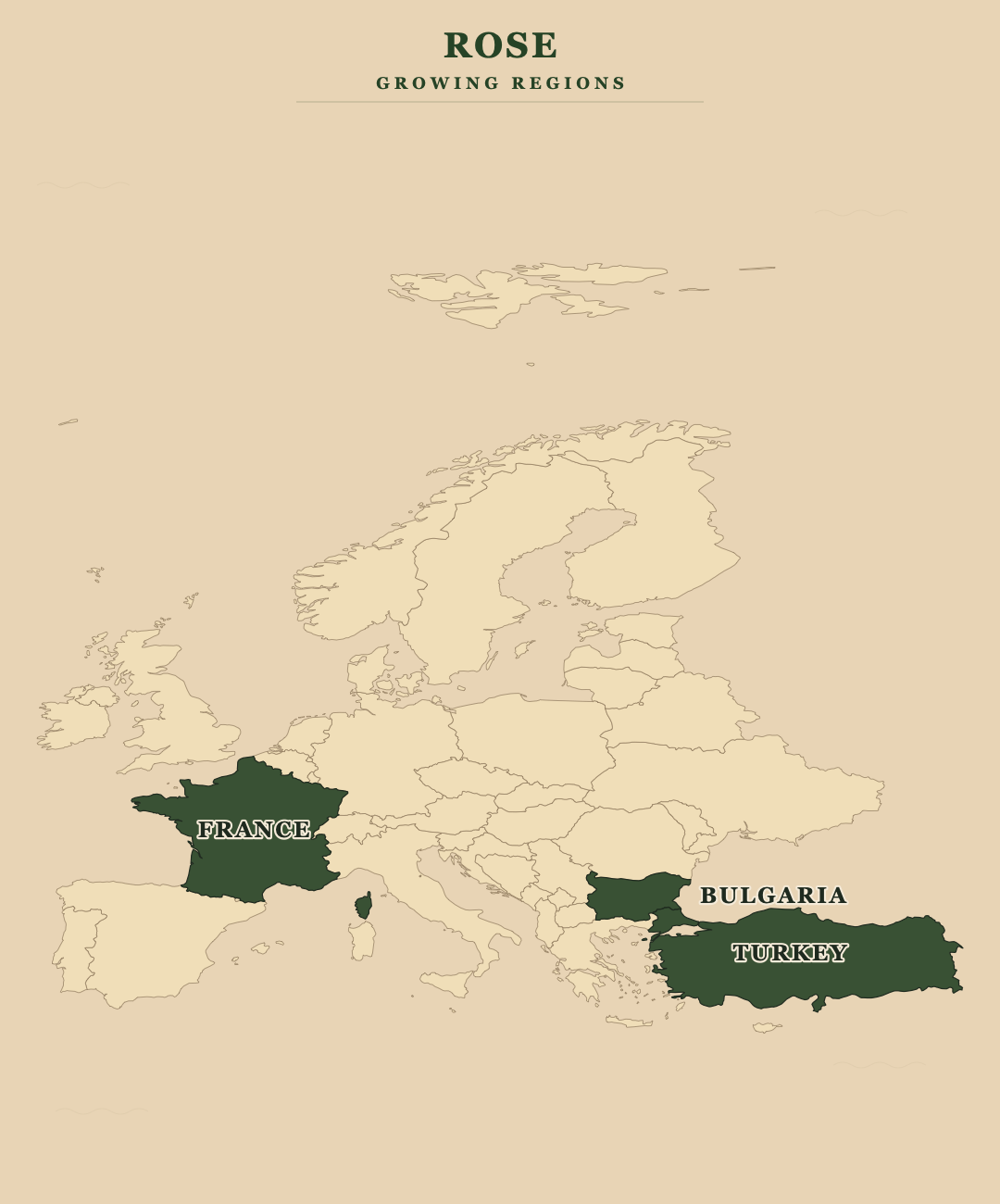
Rose is primarily cultivated in Bulgaria (Rose Valley), Turkey (Isparta), Iran, France (Grasse), with secondary growing regions in Morocco, India, China, USA.
Spice Story
Rose has been one of the most economically and culturally important floral plants in human history. Rose water, distilled from rose petals, has been a foundational ingredient in Persian, Turkish, Indian, Arabic and Mediterranean cooking for at least 2,000 years. Bulgarian production developed in the 17th century under Ottoman administration, and the Valley of Roses around Kazanlak remains the global benchmark for premium Damask rose otto. Turkish Isparta production rivals Bulgaria in volume. Iranian production has the longest continuous history. In Western perfumery, Grasse Centifolia has been a foundational floral since the 16th century. In gin, rose petal provides one of the most foundational floral aromatics available.
Gin Creativity
Rose brings deep floral character with honey-sweet body and velvet aromatic complexity. A full sachet pushes a gin firmly into clearly floral territory; a half-sachet provides quiet rose lift that integrates with juniper. Pair with cardamom and pistachio for a Persian profile, or with bergamot and lavender for a Mediterranean garden gin.
Blending Science
Main flavour compounds
 Citronellollemon-rosy
 Geraniolrose, soft floral
 Phenylethanol—
 Nerolfresh rose, sweet
 Damascones—
Citronellol dominates rose's chemistry — providing the soft rose-citrus character. Geraniol layers a fresh-rose lift. Phenylethanol contributes the honey-sweet body. Nerol adds a deeper rose-floral note. Damascones (especially beta-damascenone) are the trace compounds responsible for the most characteristic "rose" smell — present at very low concentrations but with extraordinarily low detection thresholds. [source] Cool extraction preserves the bright floral top.
Food Partners
- Middle Eastern desserts — baklava, kunafa, Turkish delight.
- Persian fesenjan — rose-and-pomegranate chicken.
- Rose-and-pistachio confections — Iranian/Turkish gaz.
- Soft fresh cheese — ricotta with rose syrup.
- Stone-fruit dishes — rose with peach and apricot.
Cocktails To Try

- Persian Sour — rose gin, pistachio orgeat, lemon, egg white.
- Pink Gin & Tonic — rose gin, pink tonic, fresh petals.
- Rose Negroni — rose gin, Campari, sweet vermouth.
Release The Flavour
- Cool extraction — preserves the bright floral top.
- Brief contact — 30 minutes to 2 hours.
- Source matters — Bulgarian Kazanlak and French Grasse production are the absolute premium grades.
- Whole petals — hold up better than loose florets.
Discover more
From the same region
Pairs well with
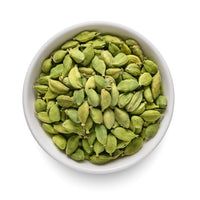
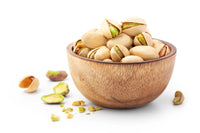
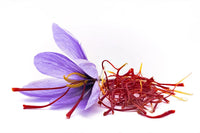
Same flavour family
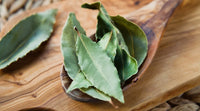
Surprise me

Sources & Citations
- scientific_names (Rosa damascena, Rosa centifolia, Rosaceae):en.wikipedia.org/wiki/Rosa_%C3%97_damascena
- bulgarian_valley_of_roses:www.electimuss.com/blogs/journal/the-multifarious-rose-th...
- turkey_isparta_iran_production:www.bellinispdx.com/blogs/news/all-about-rosa-damascena
- grasse_france_centifolia:nyc.ph/blogs/perfume/damask-centifolia-gallica-the-defini...
- damascones_signature_compounds:www.ncbi.nlm.nih.gov/pmc/articles/PMC7835869/
- main_flavour_compounds (CSV-sourced):inputs/source.csv — Rose row
