
CALENDULA FLOWER

- Botanical name
- Calendula officinalis
- Also known as
- Pot marigold, Mary's gold, Common marigold, Scotch marigold, Ruddles
- Main flavour compound
- Triterpene saponins
- Part used
- Dried flower petals (and sometimes the whole flower head)
- Method of cultivation
- Annual or short-lived perennial herb of the Asteraceae family (daisy family), originating in southern Europe and the eastern Mediterranean. Easy to grow from seed in temperate climates; self-seeds prolifically. Plants reach 30–60 cm tall, with deep-orange to yellow daisy-like flowers blooming continuously from spring through autumn.
- Commercial preparation
- Flower heads are picked at peak bloom on dry mornings, the petals stripped from the central disc, and dried at low temperatures in the dark to preserve the deep orange-yellow colour. The dried petals are sold loose or sometimes whole-flower for visual appeal.
- Non-culinary uses
- Cosmetics and skincare (calendula salves and oils are foundational in natural skincare); traditional medicine across European herbalism, Indian Ayurveda and Arabic systems for wound healing, skin complaints and digestion; natural fabric dye (yellow); cake and confectionery decoration. The Latin name comes from *calendae* — "first day of the month" — reflecting the plant's near-perpetual bloom.
Calendula — Calendula officinalis — is a hardy annual of the daisy family, native to southern Europe and the eastern Mediterranean. The plant reaches knee height with sticky, slightly hairy leaves and deep-orange to yellow daisy-like flowers that bloom continuously from spring through the first hard frost. The Latin name derives from calendae — "first day of the month" — a reference to the plant's near-perpetual blooming. [source] The common name "marigold" comes from "Mary's Gold," after the Christian tradition of dedicating golden flowers to the Virgin Mary, and is the source of the alternative names Mary's Gold and Scotch marigold — though "marigold" is also confusingly used for the unrelated Tagetes species, which is a different plant entirely.
Loose dried petals
The standard form — colour-rich, easy to portion, soft texture.
Whole dried flower head
Used decoratively in display jars or for visual appeal in cold compound gin.
Region of cultivation
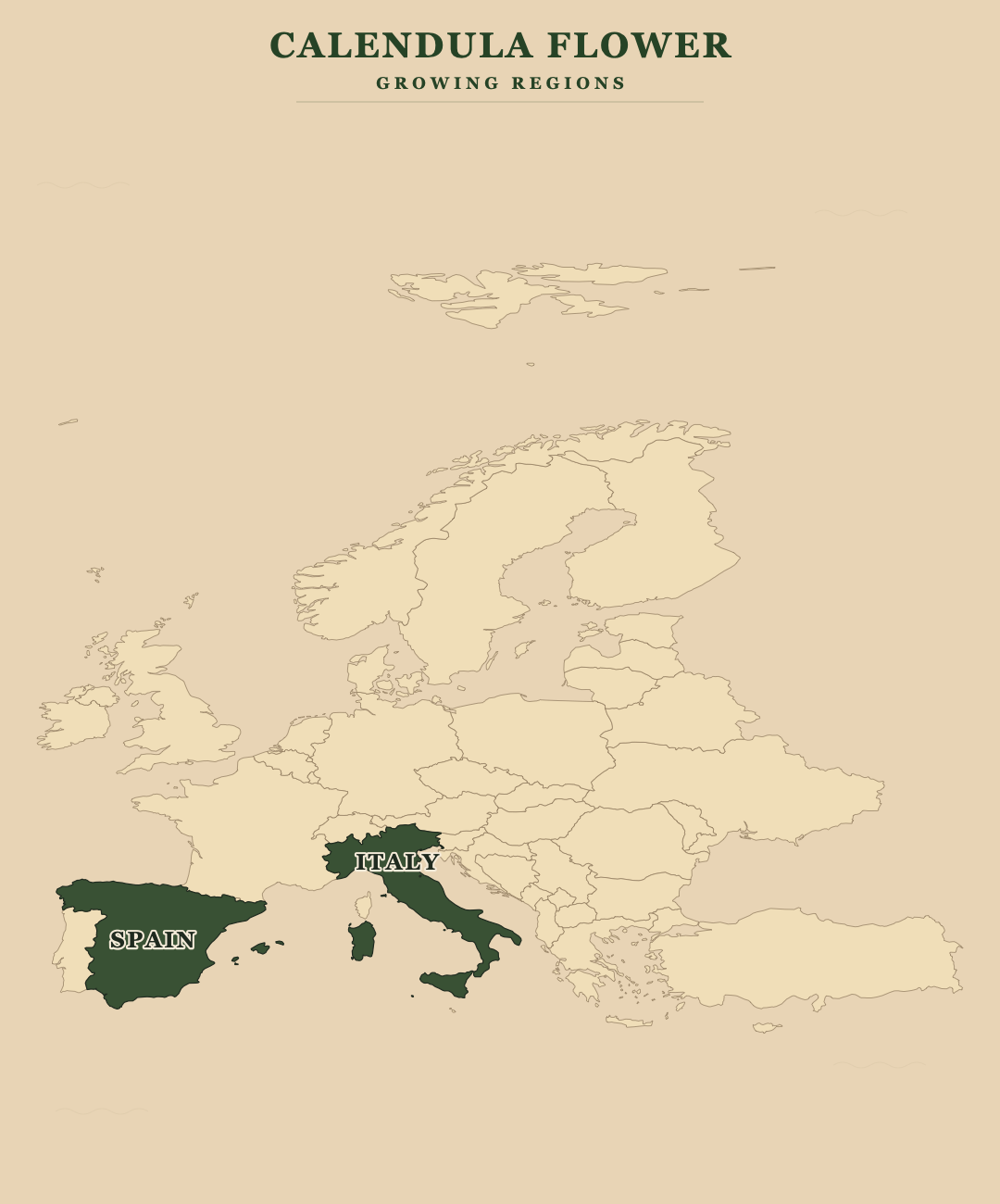
Calendula Flower is primarily cultivated in Southern Europe, Mediterranean, with secondary growing regions in Worldwide cottage gardens — UK, North America, Australia, India.
Spice Story
Calendula has been cultivated as a medicinal and dyestuff plant for at least 2,000 years across the Mediterranean. The Egyptians used it to flavour and colour breads; the Greeks and Romans used the petals to dye cloth and as a saffron substitute in cooking when the real thing was unaffordable. [source] Through the medieval and early modern period it became a staple of European cottage gardens, both as an everyday ornamental and as the foundational ingredient in "marigold water" — a topical preparation for skin wounds that survives today as calendula salve. Its use in gin is largely modern and visual: the petals add a soft saffron-coloured drift to a compound gin without significantly changing its flavour, making it one of the best botanicals for visually-led contemporary gin where appearance and taste both matter.
Gin Creativity
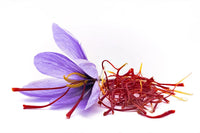
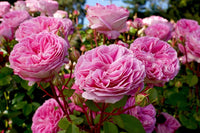
Calendula is a visual and gentle-aromatic botanical, not a flavour-led one. A full sachet adds a soft golden tint to a compound gin and a quietly floral aromatic; a half-sachet works as visual signal only, with little detectable flavour. It pairs particularly well with saffron (the two share carotenoid colour chemistry) and rose petal for a "garden gin" profile, or with bee pollen and coriander for something more confidently herbaceous. Avoid pairing with very heavy floral botanicals — calendula's quiet character disappears under jasmine or rose.
Blending Science
Main flavour compounds
 Triterpene saponins—
 Flavonoids (rutin, quercetin)—
 Carotenoids (lutein)—
Pairs well with
Calendula's chemistry is unusual for a "flavour" botanical — most of the active compounds are non-volatile and contribute body, colour and astringency rather than aroma. Triterpene saponins are the dominant active compounds, contributing the mild bittersweet body. Flavonoids (rutin, quercetin) provide soft astringent depth without prominent flavour. Carotenoids (especially lutein) are the source of the deep orange-yellow colour but are fat-soluble rather than alcohol-soluble — they don't transfer fully to a finished spirit without warm extraction. The result is that calendula is more a visual and structural botanical than a flavour one: it adds colour, soft body, and a gentle floral background. Cool maceration captures the petal-colour; warm extraction pulls more carotenoid into solution.
Food Partners
- Saffron-rich rice dishes: Calendula's traditional use as "poor man's saffron" — paella, risotto, biryani.
- Lemon-and-honey desserts: The petals scattered over honey-glazed cakes or panna cotta.
- Soft cheese: Fresh ricotta or chèvre with calendula petals and good olive oil.
- Fresh garden salads: Visual signal and gentle floral note across mixed leaves.
- Yellow fish broths: Bouillabaisse and similar — calendula and saffron together.
Cocktails To Try

- Garden Gin Spritz: Calendula-and-rose-infused gin, prosecco, soda, edible-flower garnish.
- Saffron Gin Sour: Calendula and saffron co-infused gin, lemon, honey, egg white.
- Sun-tinted Martini: Calendula-infused gin (golden) with crystal-clear vermouth — a visual study.
Release The Flavour
- Cool extraction: Preserves the colour; warm extraction can muddy the gold.
- Brief contact: 1–2 hours is enough for visual character; longer doesn't add much.
- Strain finely: Petal fragments leach colour into bottled gin over time if left in suspension.
- Use generously for colour: A full sachet produces a clearly visible golden tint; half doesn't.
Discover more
From the same region

Same flavour family
Surprise me

Sources & Citations
- scientific_name and family:en.wikipedia.org/wiki/Calendula_officinalis
- origin (southern Europe / eastern Mediterranean):clinicsearchonline.org/article/calendula-calendula-offici...
- common_names_etymology (Mary's gold, Latin calendae):en.wikipedia.org/wiki/Calendula_officinalis
- historical_medicinal_use (Egyptian, Greek, Roman, Middle Eastern, Indian):clinicsearchonline.org/article/calendula-calendula-offici...
- chemistry (triterpene saponins, flavonoids, carotenoids):www.sciencedirect.com/science/article/abs/pii/S2950199724...
- main_flavour_compounds (CSV-sourced):inputs/source.csv — Calendula Flower row
