
NETTLE

- Botanical name
- Urtica dioica
- Also known as
- Stinging nettle, Common nettle
- Main flavour compound
- Chlorophyll
- Part used
- Dried leaf (the sting is destroyed by drying or distillation)
- Method of cultivation
- Hardy perennial herb of the Urticaceae family, native across Europe, much of Asia and parts of North Africa, naturalised worldwide. The plant grows 1–2 metres tall, with characteristic deeply-toothed leaves covered in fine stinging hairs. Drying or alcohol extraction destroys the stinging hairs and the histamine-irritant compounds they contain, making dried nettle leaf safe to handle and consume.
- Commercial preparation
- Leaves are harvested in summer at peak growth (using gloves), gently dried in shaded conditions, and either sold whole or cracked. Sustainable wild-harvest dominates the supply chain; minimal cultivation is needed.
- Non-culinary uses
- Traditional medicine across European, Greek and Arabic herbal systems for allergies, joint complaints and as a general spring tonic; sustainable fibre crop (similar to flax); traditional dye plant; foundational ingredient in many European spring soups and dishes.
Stinging Nettle — Urtica dioica — is a hardy perennial of the Urticaceae family, native across Europe, much of Asia and parts of North Africa, naturalised worldwide. The plant grows 1–2 metres tall, with deeply-toothed dark green leaves and characteristic stinging hairs that release histamine and formic acid when touched (producing the familiar "nettle sting"). [source] Drying — or alcohol extraction — completely destroys the stinging hairs and the irritant compounds they contain, making dried nettle leaf safe to handle and consume.
Whole dried leaf
The standard form — crumble lightly before use.
Cracked
Faster extraction.
Region of cultivation
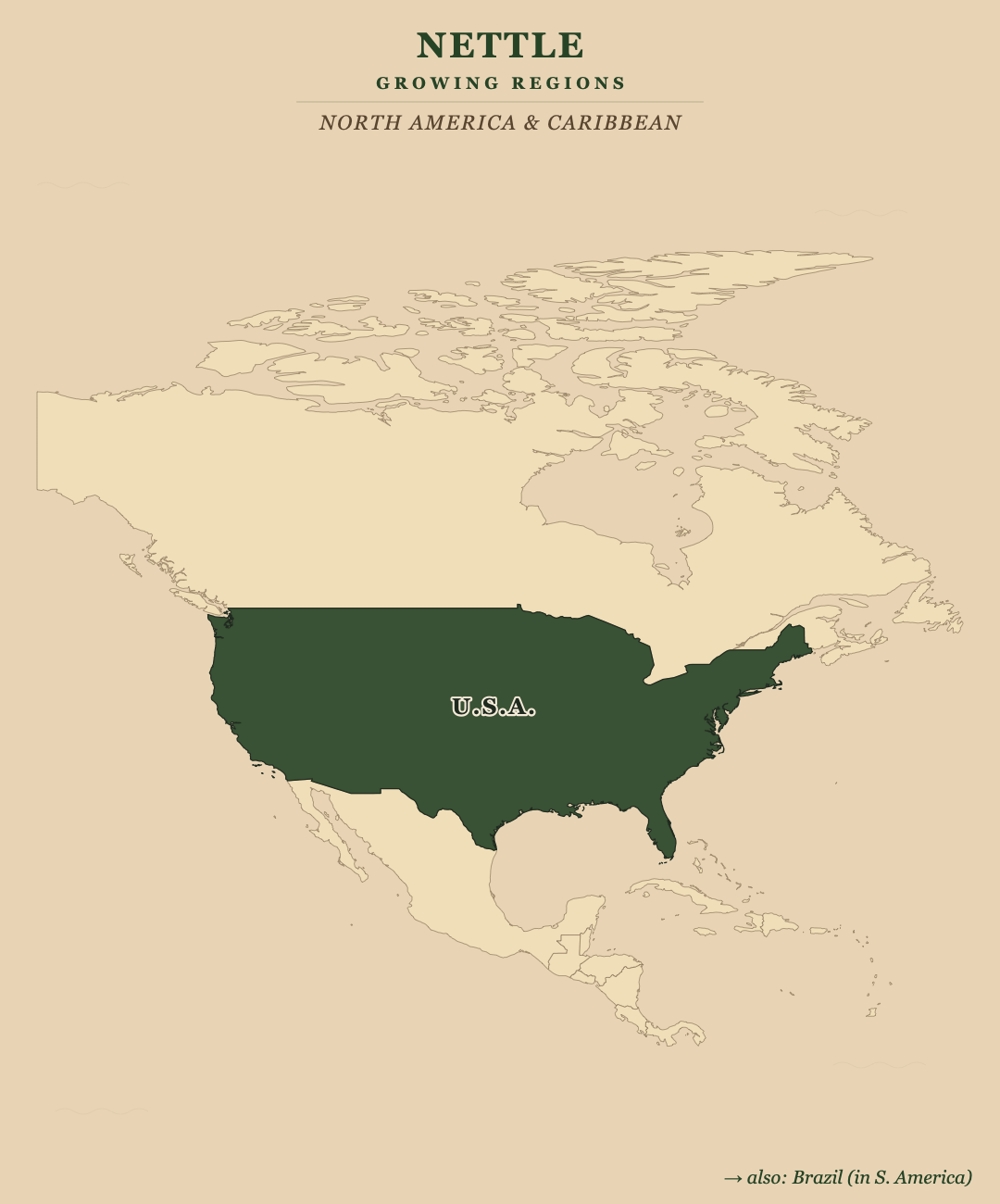
Nettle is primarily cultivated in Europe, North Africa, Asia, North America, with secondary growing regions in Australia (introduced), South America.
Spice Story
Nettle has been used as both food and medicine across Europe, the Mediterranean and Asia for at least 2,000 years. It is foundational to many spring vegetable dishes — Polish zupa pokrzywowa, Greek hortopita, Italian nettle gnocchi, English nettle soup — and has long been considered a "spring tonic" plant rich in iron, calcium and Vitamin C. Modern craft gin has rediscovered nettle as a botanical: dried and distilled, the leaf imparts a fresh, slightly earthy character with subtle herbal and vegetal notes, providing a green peppery depth that pairs particularly well with elderflower, chamomile and traditional juniper. [source]
Gin Creativity
Nettle brings clean green-mineral character with a faintly peppered edge. A full sachet pushes a gin into clearly herbaceous-vegetal territory; a half-sachet provides quiet green depth that integrates with juniper. Pair with elderflower and chamomile for a "garden gin" profile, or with juniper and lemon peel for a contemporary London Dry with quietly herbaceous body.
Blending Science
Main flavour compounds
 Chlorophyll—
 Phenolic acids—
 Volatile aldehydes—
 Flavonoids—
Pairs well with
- Elderflower
- Chamomile
- Lemon balm
- Juniper
- Citrus peel
Chlorophyll provides the green visual character (and a faintly grassy note) in cold extraction. Phenolic acids contribute soft astringent depth. Volatile aldehydes provide the green-leaf aromatic familiar from cucumber and borage. Flavonoids contribute background body. Cool extraction preserves the bright green character; warm extraction develops a deeper, slightly stewed note.
Food Partners
- Spring nettle soups — every European tradition has one.
- Risotto and pasta — Italian spring dishes.
- Cream-of-nettle soups — Polish and Russian spring cooking.
- Cool summer salads — nettle-leaf vinaigrette.
- Cheese boards — nettle-rolled cheese (Cornish Yarg).
Cocktails To Try

- Garden G&T — nettle gin, tonic, fresh edible-flower garnish.
- Spring Sour — nettle gin, lemon, honey, egg white.
- Hedgerow Negroni — nettle gin, Campari, sweet vermouth.
Release The Flavour
- Cool extraction — preserves green character.
- Brief contact — 1–4 hours captures freshness.
- Source from clean wild stands — quality is highly variable.
- Whole dried leaf — holds character much better than cracked.
Discover more
From the same region
Pairs well with
Same flavour family
Surprise me

Sources & Citations
- scientific_name (Urtica dioica, Urticaceae):en.wikipedia.org/wiki/Urtica_dioica
- native_european_asian_north_african_range:en.wikipedia.org/wiki/Urtica_dioica
- drying_destroys_stinging_hairs:www.sciencedirect.com/science/article/pii/S0254629916339448
- gin_use_modern_innovative:www.theginguild.com/ginopedia/gin-botanicals/nettle/
- flavour_profile_in_gin:www.theginguild.com/ginopedia/gin-botanicals/nettle/
- main_flavour_compounds (CSV-sourced):inputs/source.csv — Nettle row
