
OREGANO

- Botanical name
- Origanum vulgare
- Also known as
- Wild marjoram, European oregano, Greek oregano (subsp. *hirtum*)
- Main flavour compound
- Carvacrol
- Part used
- Dried leaf and flowering top
- Method of cultivation
- Aromatic perennial herb of the Lamiaceae (mint) family, native to the hills of the Mediterranean and Western Asia. The plant grows 30–80 cm tall, with small grey-green leaves and pink-purple flowers in late summer. The most aromatic commercial subspecies is *Origanum vulgare* subsp. *hirtum* (Greek oregano), which can yield essential oil up to 8% by dry weight. Cultivated commercially across the Mediterranean — Greece, Turkey, Italy, Spain and increasingly elsewhere.
- Commercial preparation
- Plants are cut at peak bloom (when oil content is highest), gently dried, and either sold whole or cracked. Mediterranean wild-harvest is considered premium grade for both flavour intensity and aromatic complexity.
- Non-culinary uses
- Foundational ingredient across Mediterranean cooking — Greek, Italian, Turkish, Spanish; essential oil is widely used in natural cosmetics and aromatherapy (carvacrol has documented antimicrobial activity); traditional medicine.
Oregano — Origanum vulgare — is an aromatic perennial herb of the mint family, native to the dry sun-baked hillsides of the Mediterranean and Western Asia. The plant grows 30–80 cm tall, with small grey-green leaves and clusters of pink-purple flowers in late summer. The most aromatic commercial subspecies is Origanum vulgare subsp. hirtum (Greek oregano), which produces an essential oil up to 8% by dry weight with carvacrol content reaching 95%. [source] Oregano is closely related to marjoram (Origanum majorana) — same genus, different species, dramatically different flavour profiles. Oregano is sharper, more savoury, more aggressively herbaceous; marjoram is softer and more floral.
Whole dried leaf and flower
The standard form — crumble lightly to release the oils.
Cracked
Faster extraction.
Region of cultivation
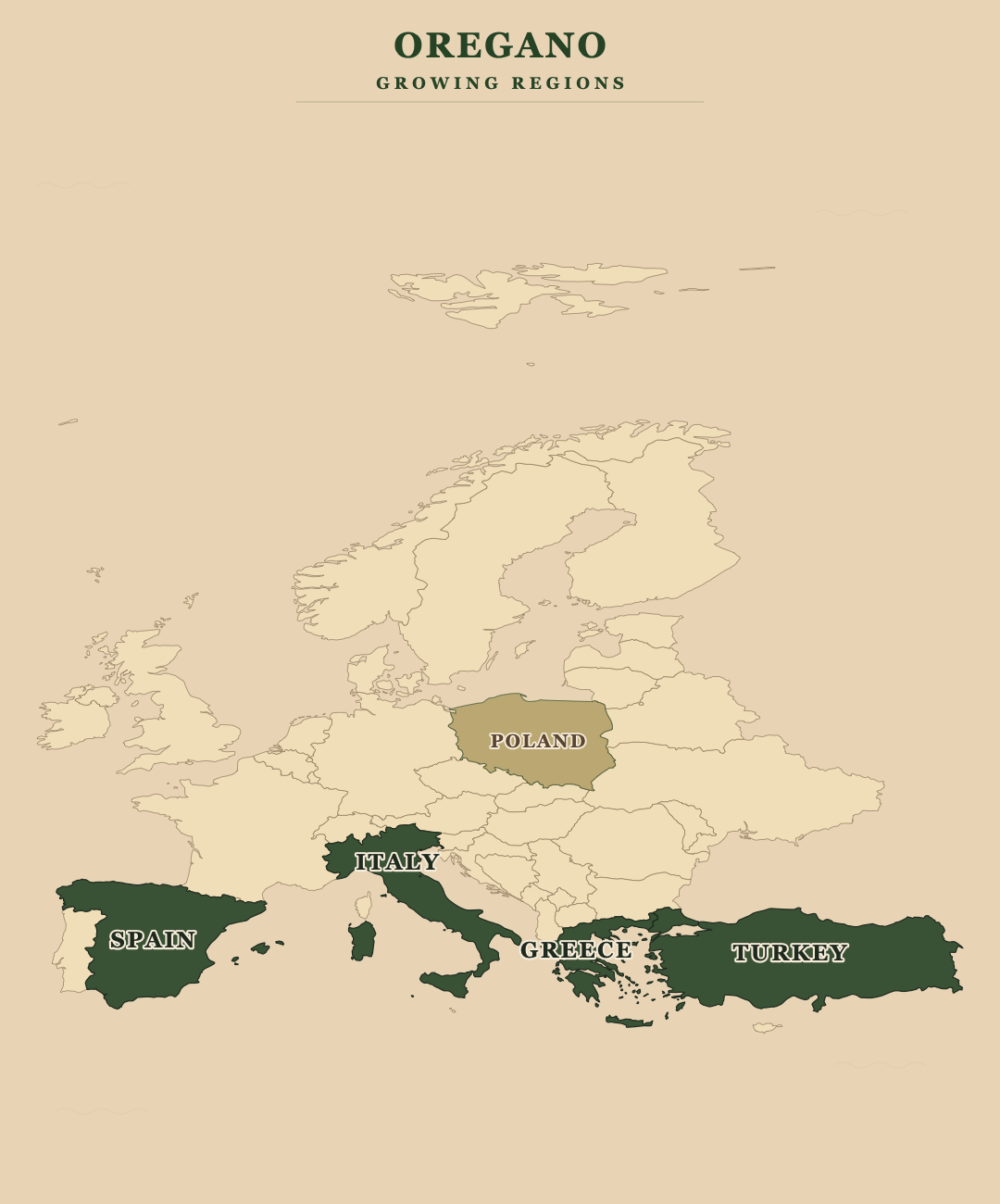
Oregano is primarily cultivated in Greece, Turkey, Italy, Spain, with secondary growing regions in Mexico (different species, *Lippia graveolens*), Eastern Europe, North Africa.
Spice Story
Oregano is one of the foundational Mediterranean culinary herbs. The Greek name Origanum combines oros (mountain) + ganos (joy) — "joy of the mountain," reflecting the plant's preferred hillside habitat. Oregano has been used since classical Greek and Roman times, but its modern global dominance came with the 20th-century spread of Italian pizza — pizza without oregano is unimaginable in Naples. Greek and Turkish oregano (subsp. hirtum) is the highest-quality grade; Mexican "oregano" is actually a different plant (Lippia graveolens) with similar carvacrol content but different supporting chemistry. In gin, oregano is an unusual but distinctive contemporary botanical providing sharp Mediterranean herbal character.
Gin Creativity
Oregano brings sharp pungent-herbaceous character with a warm earthy background. A full sachet pushes a gin firmly into Mediterranean-herb territory; a half-sachet provides quiet herbaceous depth that integrates with juniper. Pair with thyme and bay leaf for a layered Mediterranean profile, or with lemon peel and rosemary for an Italian-style gin.
Blending Science
Main flavour compounds
 Carvacrol—
 Thymolthyme, antiseptic
 P-Cymene—
 Gamma-Terpinenefresh pine, top note
Carvacrol is the dominant compound — up to 95% of the essential oil in premium Greek oregano (O. vulgare subsp. hirtum). [source] Carvacrol provides the warm-pungent character and the documented antimicrobial properties. Thymol is the secondary compound, sometimes dominant in certain chemotypes — sharper and more medicinal than carvacrol. P-cymene layers a slight bitter herbaceous depth. Gamma-terpinene is the precursor compound. Heat-stable; both vapour and warm maceration work cleanly.
Food Partners
- Pizza and pasta sauces — the canonical Italian use.
- Greek lamb dishes — souvlaki, kleftiko.
- Italian tomato cooking — oregano in marinara.
- Roast vegetables — oregano on roast capsicum and eggplant.
- Marinated cheeses and olives — Mediterranean antipasti.
Cocktails To Try

- Mediterranean G&T — oregano gin, tonic, fresh oregano sprig.
- Italian Negroni — oregano-and-rosemary gin, Campari, vermouth.
- Pizza Bloody Mary — oregano gin, tomato, lemon, olive garnish.
Release The Flavour
- Crumble lightly — releases the volatile carvacrol.
- Heat-friendly — survives both vapour and maceration.
- Time — 24–48 hours for full development.
- Source matters — Greek subsp. hirtum is the most aromatic.
Discover more
From the same region

Same flavour family
Surprise me

Sources & Citations
- scientific_name (Origanum vulgare, Lamiaceae):en.wikipedia.org/wiki/Oregano
- mediterranean_origin:www.britannica.com/plant/oregano
- carvacrol_dominant_compound (up to 95% in hirtum subsp.):www.sciencedirect.com/topics/agricultural-and-biological-...
- subspecies_hirtum_high_oil_content:www.sciencedirect.com/topics/agricultural-and-biological-...
- main_flavour_compounds (CSV-sourced):inputs/source.csv — Oregano row
