
THYME

- Botanical name
- Thymus vulgaris
- Also known as
- Common thyme, Garden thyme, French thyme, English thyme
- Main flavour compound
- Thymol (20-54%)
- Part used
- Dried leaf
- Method of cultivation
- Small evergreen perennial shrub of the Lamiaceae (mint) family, native to the western Mediterranean. The plant grows 15–30 cm tall, with small grey-green leaves and pale pink to lilac flowers in summer. *Thymus vulgaris* prefers well-drained calcareous soils and full sun — classic Mediterranean conditions. Multiple chemotypes exist with different dominant compounds — thymol-type (the standard commercial culinary type) and various carvacrol, linalool and geraniol chemotypes.
- Commercial preparation
- Leaves are harvested at peak season (just before flowering when oil content is highest), gently dried, and either sold whole or cracked. Major commercial production centres on France (Provence), Spain, Italy, Morocco and Tunisia.
- Non-culinary uses
- Foundational kitchen herb across Mediterranean and broader European cooking; essential oil for natural cosmetics and household products (thymol is a powerful natural antimicrobial); traditional medicine for respiratory and digestive complaints. The Romans used thyme to flavour cheese and liqueurs.
Thyme — Thymus vulgaris — is a small evergreen perennial shrub of the mint family, native to the western Mediterranean. The plant grows 15–30 cm tall, with tiny grey-green leaves and pale pink-to-lilac flowers in summer; it thrives on the sun-baked rocky calcareous hillsides of southern France, Spain, Italy and North Africa. Multiple chemotypes exist within the species, but the standard commercial culinary thyme is the thymol-type — with thymol at 20–54% of essential oil. [source]
Whole dried leaf
The standard form — crumble lightly to release the oils.
Cracked
Faster extraction.
Region of cultivation
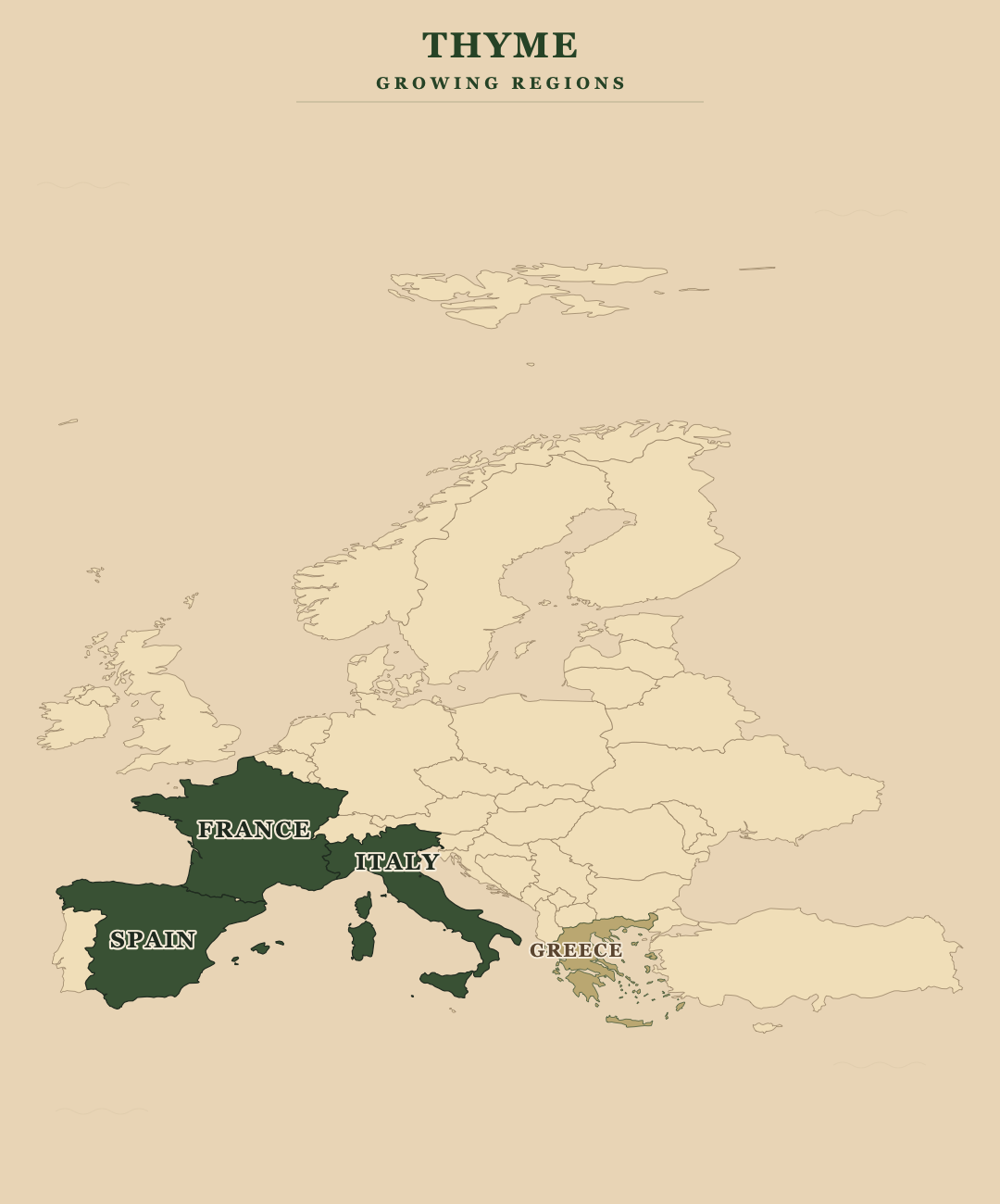
Thyme is primarily cultivated in France (Provence), Spain, Italy, Morocco, Tunisia, with secondary growing regions in Greece, Egypt, USA, Australia.
Spice Story
Thyme has been one of the foundational Mediterranean culinary and medicinal herbs since classical times. The Romans used it to flavour cheese and to perfume their baths; medieval European herbalists made thyme syrups for coughs (a use that survives in modern cough syrups, often featuring thyme extract). Thyme is one of the three classical French bouquet garni herbs (alongside bay leaf and parsley), and is foundational to Mediterranean lamb cooking, Provençal stews, and the herbes de Provence blend. In gin, thyme is one of the most foundational contemporary herbaceous botanicals — particularly in Mediterranean garden gins and contemporary craft expressions.
Gin Creativity
Thyme brings earthy-warm herbaceous character with a slightly pine-edged backbone. A full sachet pushes a gin firmly into Mediterranean-herb territory; a half-sachet provides quiet herbaceous depth that integrates with juniper. Pair with rosemary and sage for a Provençal herb-garden profile, or with bay leaf and lemon peel for a contemporary blend.
Blending Science
Main flavour compounds
 Thymol (20-54%)thyme, antiseptic
 Carvacrol—
 P-Cymene—
 Gamma-Terpinenefresh pine, top note
Thymol is the defining compound — 20–54% of the essential oil in standard culinary thyme, providing the characteristic warm-savoury-medicinal character and significant antimicrobial activity. Carvacrol is the closely-related compound that dominates in some chemotypes (and in oregano). P-cymene is the precursor; gamma-terpinene contributes background depth. Heat-stable; both vapour and warm maceration work cleanly.
Food Partners
- Roast lamb and chicken — the canonical Mediterranean pairing.
- Bouquet garni — bay leaf + thyme + parsley for slow-braising.
- Mediterranean roast vegetables — thyme with olive oil and garlic.
- Honey-and-thyme desserts — Provençal miel de thym.
- Goat's cheese with herbs — Provençal classic.
Cocktails To Try

- Mediterranean G&T — thyme gin, tonic, fresh thyme sprig.
- Provençal Sour — thyme-and-honey gin, lemon, egg white.
- Garden Negroni — thyme gin, Campari, vermouth.
Release The Flavour
- Crumble gently — releases the volatile oils.
- Heat-friendly — survives both vapour and warm maceration.
- Time — 24–48 hours for full development.
- Source matters — Provençal and Spanish high-altitude thyme is the premium grade.
Discover more

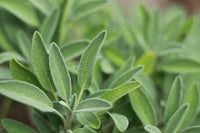
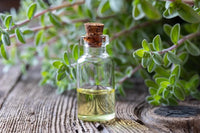
Same flavour family
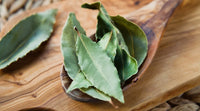
Surprise me

Sources & Citations
- scientific_name (Thymus vulgaris, Lamiaceae):en.wikipedia.org/wiki/Thymus_vulgaris
- western_mediterranean_native_range:en.wikipedia.org/wiki/Thymus_vulgaris
- thymol_content_20-54_percent:pubmed.ncbi.nlm.nih.gov/29785774/
- roman_cheese_and_liqueur_flavouring:botanical.com/botanical/mgmh/t/thygar16.html
- main_flavour_compounds (CSV-sourced):inputs/source.csv — Thyme row
