
DATE

- Botanical name
- Phoenix dactylifera
- Also known as
- Date palm fruit, Medjool, Deglet Nour, Tamr (Arabic)
- Main flavour compound
- Glucose and fructose (sweetness)
- Part used
- Dried fruit (whole or chopped)
- Method of cultivation
- Single-stemmed palm of the Arecaceae family, native to the region from the Persian Gulf and Mesopotamia (modern Iraq) to the western Arabian Peninsula and Pakistan. One of the oldest cultivated plants in human history — archaeological evidence dates cultivation back over 5,000 years, with continuous Mesopotamian, Egyptian and Arabian use throughout antiquity. Modern commercial production centres on Egypt, Saudi Arabia, Iran, Iraq, Algeria, Tunisia and the UAE.
- Commercial preparation
- Fruit is hand-harvested as it ripens through the late stages of *khalal* (crisp), *rutab* (soft and partially dried) and *tamr* (fully dried). For the dried-fruit trade, fruit is harvested at *tamr* stage or slightly earlier and finish-dried in shaded racks. Premium varieties (Medjool, Deglet Nour) are sorted by size and packed whole; lower grades are pitted, chopped or paste-pressed.
- Non-culinary uses
- Traditional Islamic religious significance (dates are the traditional food to break Ramadan fast); fermented into traditional date wines and arak in some regions; the leaves are used for basketry and roofing; the trunk for construction across the Middle East and North Africa.
The date palm — Phoenix dactylifera — is a tall single-stemmed palm of the Arecaceae family, growing 15–25 metres tall, with a sturdy fibrous trunk and a crown of long pinnate leaves. The plant is dioecious (separate male and female trees), and only the females bear fruit; commercial orchards plant rows of females and intersperse male pollinator trees, or pollinate by hand. Each fruiting cluster produces dozens of finger-shaped fruit that ripen on the tree through several distinct stages — green and astringent at first, then yellow and crisp (khalal), then partially sweetened and soft (rutab), then fully dried and intensely sweet (tamr). [source] The fully-dried tamr stage is what we know as the "dried date" of the spice trade — about 61–68% sugar by mass. [source]
Whole pitted dried date
The standard form for distilling — chop coarsely before use to expose more surface area.
Date paste
Faster extraction but harder to filter cleanly.
Region of cultivation
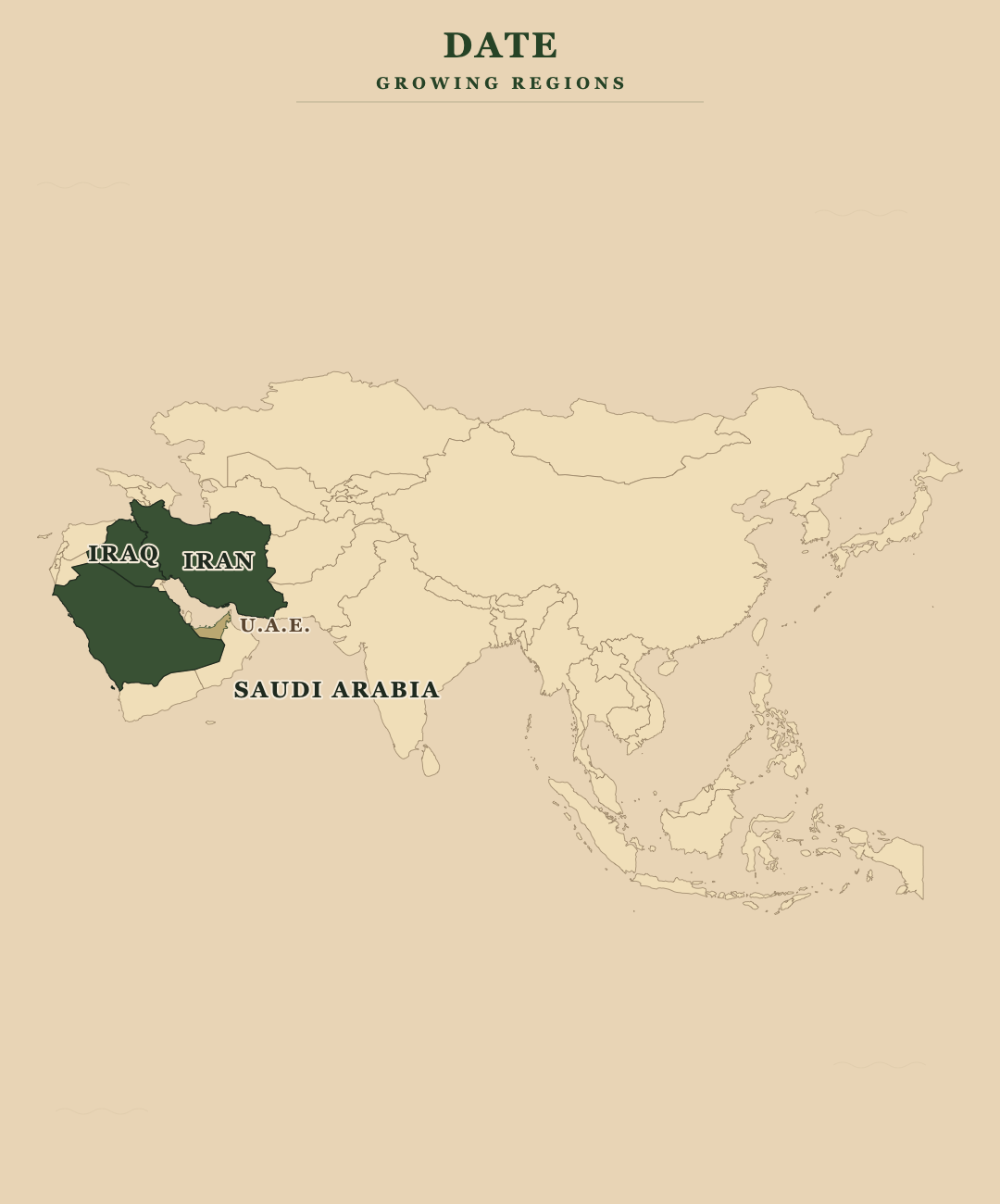
Date is primarily cultivated in Egypt, Saudi Arabia, Iran, Iraq, with secondary growing regions in Algeria, Tunisia, UAE, USA (California).
Spice Story
Dates have been cultivated for over 5,000 years, and are one of humanity's oldest agricultural staples. Archaeological evidence from Mesopotamia and the Nile Valley shows continuous date cultivation since the third millennium BCE. [source] The fruit became the foundational sweet of pre-sugar civilisations across the Middle East and North Africa — sweetening drinks and confectionery, fermenting into traditional date wines, providing dense storable calories in desert environments. Dates retain enormous religious and cultural significance across the Islamic world: they are the traditional food eaten to break the Ramadan fast, a tradition dating to the Prophet Muhammad. In gin, dried dates appear as an unusual contemporary botanical, particularly in Middle Eastern-inflected craft expressions and "dessert" gin styles where the goal is genuine sweet-fruit body rather than added sugar.
Gin Creativity
Dates bring sweetness and dense fruit-caramel body to a gin without requiring added sugar. A full sachet pushes a gin firmly into dessert-and-after-dinner territory; a half-sachet adds quiet sweet-fruit complexity that integrates with juniper and warming spices for a Middle Eastern profile. They pair particularly well with cardamom and rose petal for an Arabic-inspired blend, or with vanilla and orange peel for a softer dessert-style gin. Avoid combining with very heavy citrus — date's sweetness and citrus brightness can muddle.
Blending Science
Main flavour compounds
 Glucose and fructose (sweetness)—
 Tannins—
 Furanones (caramelised notes from drying)caramel, sweet
Pairs well with
Dates' flavour chemistry is dominated by sugars rather than volatile aromatics. Glucose and fructose make up around 61–68% of the dried fruit, contributing the dense sweetness that defines the spice. Tannins provide soft astringency that prevents the sweetness from reading purely sugary. Furanones — caramelisation-derived compounds — develop during the slow drying process as the natural sugars react with amino acids, producing the deep caramel-honey character that distinguishes a good date from a flat one. The aromatic volatile content is relatively low compared to a spice or citrus peel; what dates contribute is body, sweetness and a subtle caramel-fruit background rather than a prominent top note. Long warm extraction develops the deep sweet body; cool extraction is faster but produces a lighter result.
Food Partners
- Stuffed dried-fruit confections: Iraqi kleicha (date-stuffed pastries), Moroccan makroud, Arabic date-paste sweets.
- Lamb tagines with dried fruits: Date and lamb is a Moroccan classic — sweet-savoury slow cooking.
- Sticky date pudding: The English-Australian dessert that needs no introduction.
- Cheese boards: Especially blue cheese and aged hard cheeses — date and cheese is a foundational pairing.
- Spiced Middle Eastern coffee: Cardamom-and-date is a defining Gulf flavour combination.
Cocktails To Try

- Date Old Fashioned: Date-and-cinnamon gin, demerara, orange bitters.
- Levantine Negroni: Date and cardamom gin, Campari, sweet vermouth.
- Date Caramel Sour: Date-gin, lemon, honey, egg white.
Release The Flavour
- Warm extraction: Develops the deep caramel-sweet body.
- Chop before use: Whole dates extract slowly; chopped or pasted dates extract faster.
- Filter carefully: Date pulp can cloud the spirit; fine filtration helps.
- Time: 48 hours minimum for full development; longer extractions deepen the sweetness.
Discover more
From the same region

Pairs well with
Same flavour family
Surprise me

Sources & Citations
- scientific_name and family (Phoenix dactylifera, Arecaceae):en.wikipedia.org/wiki/Date_palm
- cultivation_history (5000+ years):greendiamond.co/date_palm/
- native_range (Persian Gulf/Mesopotamia/Arabian Peninsula):greendiamond.co/date_palm/
- sugar_content (61-68% by mass when dried):www.britannica.com/plant/date-palm
- cultural_significance_middle_east:greendiamond.co/date_palm/
- main_flavour_compounds (CSV-sourced; CSV records different compounds — supplementing with the documented sugar/furanone profile):inputs/source.csv — Date row
