
ALMOND

- Botanical name
- Prunus dulcis
- Also known as
- Sweet almond, Mediterranean almond
- Main flavour compound
- Benzaldehyde
- Part used
- Dried kernel (the seed inside the shell, not the surrounding fruit)
- Method of cultivation
- Orchard-cultivated deciduous tree of the Rosaceae family — the same family as cherry and plum. Trees bloom in late winter, the fruit develops through spring, and the kernels mature inside leathery green hulls that split open at harvest. California now grows roughly 80% of the world's supply; Mediterranean orchards (Spain, Italy, Morocco) remain the historic heartland.
- Commercial preparation
- After harvest the hulls are removed mechanically, shells are cracked, and the kernels are sorted by size. For distilling, both sweet and bitter almonds appear — bitter almonds carry the strongest benzaldehyde character and must be processed carefully because of their amygdalin (cyanide-precursor) content.
- Non-culinary uses
- Cosmetics (almond oil), perfumery (heliotrope and cherry-blossom accords lean on benzaldehyde), confectionery, traditional medicine. Almond milk has been documented in European kitchens since at least the medieval period.
The almond is a small, beautiful tree — Prunus dulcis, of the Rosaceae family, cousin to cherry, plum and peach. It is one of the first trees of the year to bloom; in February or March, Mediterranean almond orchards become a pink-white snowfall of blossom before any leaves arrive. The fruit develops inside a leathery green hull that splits open as it dries, revealing the familiar wooden shell and, inside that, the kernel. The almond is, technically, a drupe seed — closer to a peach pit than a true nut. [source]
Whole blanched
Mild, sweet, marzipan-leaning. Best for adding body and softness rather than overt aroma.
Sliced or slivered
More surface area, faster extraction — useful in shorter cool infusions.
Region of cultivation
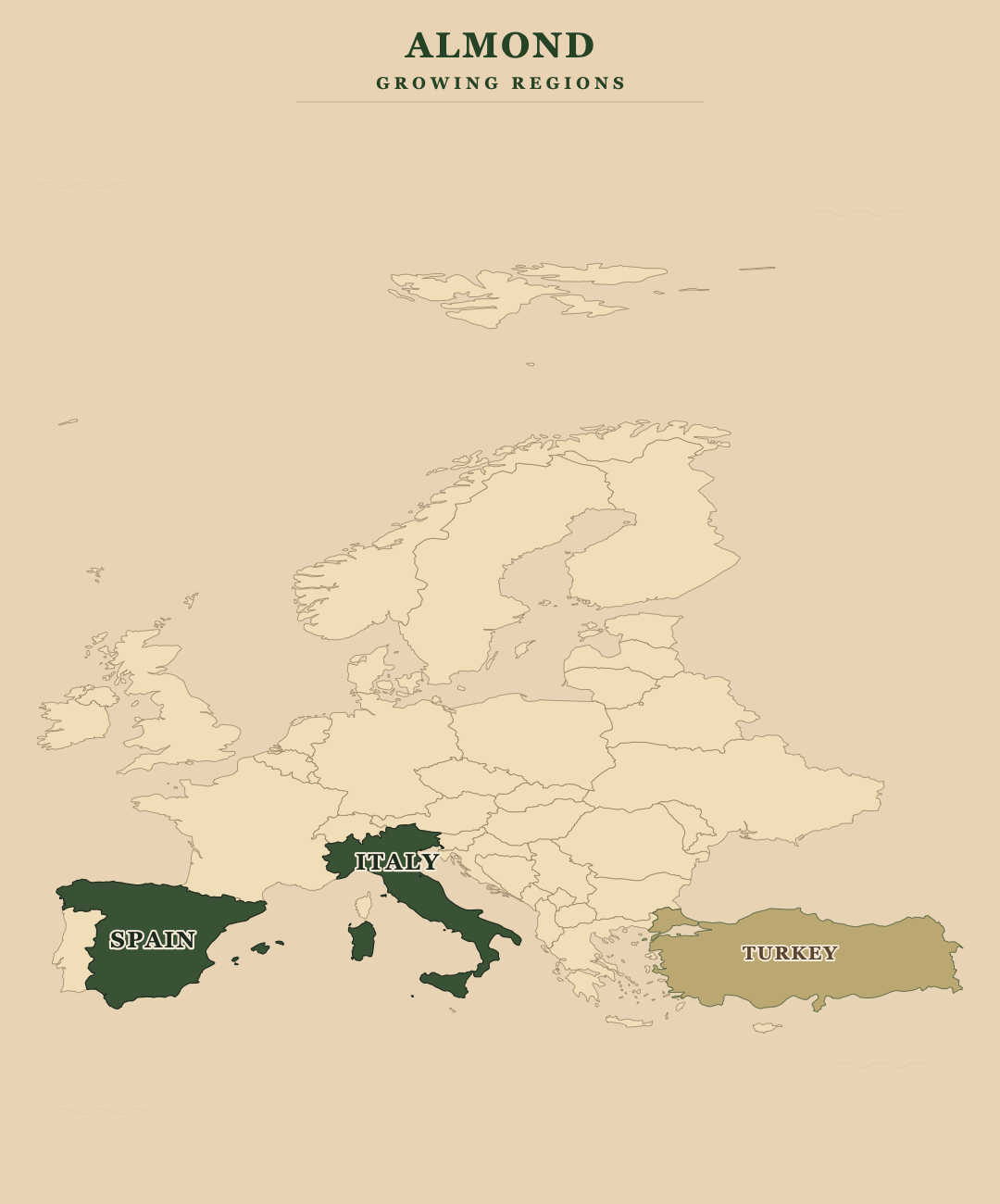
Almond is primarily cultivated in California, Spain, Italy, Morocco, with secondary growing regions in Australia (Riverland, Sunraysia), Iran, Turkey.
Spice Story
Almonds were among the first cultivated tree crops, domesticated in the Levant and Central Asia and carried across the Mediterranean by Phoenician and Greek traders. By Roman times they were a staple, and through the medieval period almond milk was an everyday substitute for dairy in fasting kitchens across Christian Europe. Two varieties matter to the home distiller: sweet almonds (the everyday eating kind), and bitter almonds — the wild type, full of amygdalin, which releases benzaldehyde and tiny amounts of prussic acid when crushed and exposed to moisture. [source] That benzaldehyde is the signature marzipan note used in everything from amaretti biscuits to cherry-leaning gin liqueurs. California now grows roughly 80% of the world's almonds, but the Mediterranean — Spain, Italy, Morocco — remains the spiritual home of the crop.
Gin Creativity
Almond brings softness, body and a faint floral-marzipan lift rather than overt aroma. A full sachet rounds out a sharper botanical bill and works particularly well alongside citrus and stone-fruit notes; a half-sachet adds subtle weight without identifiably saying "almond". Pair with vanilla and orange peel for a soft, after-dinner profile, or with cherry and rose for something more confident. The benzaldehyde note develops slowly, so don't expect to taste it after a quick infusion.
Blending Science
Main flavour compounds
 Benzaldehyde—
 Phenylalanine—
 Quercetin—
Pairs well with
The signature marzipan-floral note comes from benzaldehyde, the same compound responsible for the smell of cherry pits and apricot kernels. In whole, dry almonds the precursor amygdalin sits stable; it only releases benzaldehyde when the kernel is broken, in contact with water, and acted on by the kernel's own enzymes. [source] Phenylalanine contributes a faintly malty sweetness, and quercetin — a flavonoid concentrated in the skin — adds a soft astringent edge. For distilling, a brief warm steep before the main run helps the benzaldehyde develop.
Food Partners
- Marzipan and frangipane: The classic confectionery use — benzaldehyde and sugar.
- Stone fruit (cherry, apricot): Genetically related, chemically related. Always work together.
- Dark chocolate: Adds bitter contrast that lets the almond's nutty sweetness sing.
- Honey and ricotta: A Sicilian pairing — try it dolloped onto warm toast.
- Saffron rice pudding: Persian sholeh zard, where almond, saffron and rose meet.
Cocktails To Try

- Amaretto Sour: The original showcase of almond-bitter-sweet balance — try with gin instead of bourbon.
- Orgeat-based cocktails (Mai Tai, Japanese): Orgeat is an almond syrup; substitute a few drops in a gin sour.
- Gin and almond milk: A surprising long drink — almond milk, gin, honey, lemon, a grating of nutmeg.
Release The Flavour
- Crush gently: Whole kernels need to be at least cracked for benzaldehyde to develop.
- Time: Almond character builds slowly; allow 24 hours minimum for a noticeable note.
- Heat: Gentle warmth speeds extraction; high heat browns the kernel and changes the character entirely.
- Sweet vs bitter: A handful of bitter almonds in a sweet-almond infusion can push the marzipan note from suggestion to centrepiece — but check local regulations on bitter-almond use.
Discover more
From the same region
Pairs well with
Same flavour family
Surprise me

Sources & Citations
- scientific_name (Prunus dulcis, Rosaceae family):www.britannica.com/plant/almond
- cultivation (Mediterranean origin, California dominance ~80%):www.britannica.com/plant/almond
- benzaldehyde (amygdalin hydrolysis chemistry):pubs.acs.org/doi/10.1021/acs.jafc.8b06606
- amygdalin in bitter almonds (3-9%):www.sciencedirect.com/topics/agricultural-and-biological-...
- main_flavour_compounds (CSV-sourced):inputs/source.csv — Almond row
- non_culinary_uses (perfumery heliotrope/cherry-blossom):www.britannica.com/plant/almond
