
CASHEW

- Botanical name
- Anacardium occidentale
- Also known as
- Cashew nut, Acaju
- Main flavour compound
- Methyl esters (volatile butyric and hexanoic)
- Part used
- Roasted dried kernel (the curved "nut" — technically the seed of the cashew apple)
- Method of cultivation
- Evergreen tree of the Anacardiaceae family (the sumac and mango family), native to north-eastern Brazil. Now commercially cultivated mainly in Vietnam, India, Côte d'Ivoire, Tanzania, Brazil and the Philippines. The tree grows to about 6–14 metres and produces a distinctive two-part fruit: the "cashew apple" (a swollen, juicy peduncle that humans can eat fresh) and the actual seed, which hangs below it in a hard, kidney-shaped shell.
- Commercial preparation
- Raw cashews are toxic — the shell contains the same urushiol resin that gives poison ivy its potency. Processing always involves heating to destroy the urushiol: traditional roasting over open fire, modern steam-cooking, or chemical solvent extraction. Once the shell is removed, the kernels are graded by size and integrity (W240, W320, splits, pieces) and either packed raw-roasted or further processed.
- Non-culinary uses
- The cashew nut shell liquid (CNSL) is industrially valuable — used in friction materials, coatings, and as a precursor to specialty polymers; cashew gum from the trunk is a traditional food additive across South America; the cashew apple is fermented into traditional Brazilian beverages.
Cashew — Anacardium occidentale — is an evergreen tree of the Anacardiaceae family, related to mango, sumac and (more concerningly) poison ivy. Native to the dry north-east of Brazil, it has spread to become a major cash crop across tropical South and South-East Asia and West Africa. The tree itself is striking and unusual: it produces a two-part "fruit" where the fleshy red or yellow part is actually a swollen flower-stem (the "cashew apple") and the kidney-shaped nut hangs below it in a thick, urushiol-rich shell. The cashew apple is edible fresh and is fermented into traditional Brazilian beverages; the kernel inside the shell is what most of the world calls "cashew."
Whole roasted kernel
The standard form — soft texture, mild flavour, releases sweetness over a long infusion.
Pieces or splits
More surface area for faster extraction; slightly more buttery character.
Region of cultivation
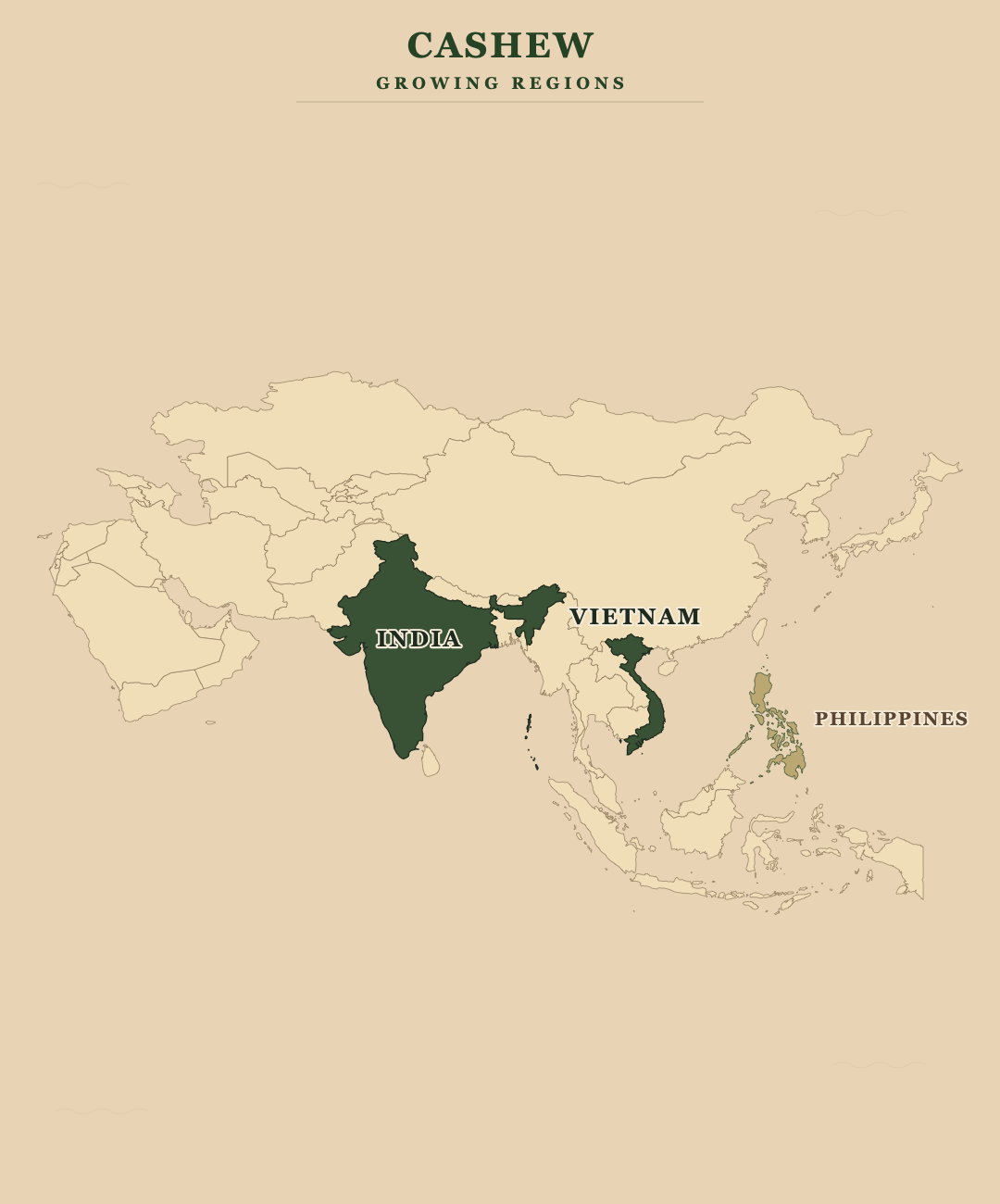
Cashew is primarily cultivated in Vietnam, India, Côte d'Ivoire, Brazil, with secondary growing regions in Tanzania, Philippines, Nigeria, Mozambique.
Spice Story
The indigenous Tupi peoples of north-eastern Brazil were the first to consume both the apple and the kernel, having worked out how to handle the toxic shell long before European contact. [source] Portuguese colonists began commercial export by the 1550s and introduced the plant to Goa between 1560 and 1565, from where it spread across India, Sri Lanka and the Asian tropics. Today India and Vietnam dominate global processing, and the kernel — once a coastal Brazilian curiosity — has become one of the most-eaten nuts in the world. The use of cashew in gin is unusual and contemporary: a small number of craft distillers have begun including roasted cashews as a softening, body-building botanical that adds a quiet creamy roundness without the marzipan-floral character of almond.
Gin Creativity
Cashew brings softness and body — not a vivid aromatic, but a subtle creamy roundness that can transform the texture and finish of a botanical bill. A full sachet adds quiet buttery depth and a faint sweetness; a half-sachet works as a structural background note that softens sharper spices. It pairs particularly well with vanilla and coconut for a tropical-dessert profile, or with cardamom and cinnamon for a South Asian-leaning blend. Cashew works best as a textural element rather than a flavour headline — it makes other botanicals taste rounder rather than imposing its own character.
Blending Science
Main flavour compounds
 Methyl esters (volatile butyric and hexanoic)—
 Fatty acids (oleic, linoleic)—
 Tannins (in the shell, not in the kernel)—
Cashew's flavour profile is dominated by lipid chemistry rather than volatile aromatics. Oleic acid (around 60% of the kernel oil) and linoleic acid contribute the soft buttery body. Methyl esters (butyric and hexanoic) provide what little volatile aromatic the kernel has — a quiet, soft nuttiness rather than the more dramatic benzaldehyde character of almond. Tannins in the cashew nut shell liquid are not present in the processed kernel — they were chemically destroyed during the roasting step. The relatively low volatile content means cashew extracts slowly and contributes most of its character as fatty body and texture rather than identifiable aroma; this also means cashew-infused gin is more prone to clouding from extracted oils, requiring careful filtration.
Food Partners
- South Indian curries: Cashew-based gravies (korma style) — try a cashew-gin reduction in the sauce.
- Coconut and pandan desserts: Tropical pairing — cashew adds body to coconut's sharpness.
- Roast chicken with stone-fruit: Cashew-gin glaze over roast chicken with apricots or peaches.
- Caramel and praline: Sweet Maillard chemistry that doubles cashew's natural richness.
- Soft fresh cheeses: Burrata, fresh ricotta — cashew-gin reduction as a drizzle.
Cocktails To Try

- Orgeat-style Sour: Cashew-gin in a Mai Tai or similar tropical cocktail.
- Cashew Cream Sour: Vegan-friendly alternative to the egg-white sour — cashew-infused gin, lemon, honey, blended cashew "cream."
- Tropical Old Fashioned: Cashew-and-coconut gin, demerara syrup, orange bitters.
Release The Flavour
- Long extraction: Cashew's character builds slowly — 24–48 hours for full development.
- Filter carefully: The high oil content tends to cloud the spirit; cold filtration helps.
- Roast level matters: Lightly roasted kernels taste cleaner; heavily roasted ones taste burnt and dominate other botanicals.
- Pair with body-building botanicals: Cashew supports rather than leads — pair with assertive headline aromatics.
Discover more
From the same region

Pairs well with
Same flavour family
Surprise me

Sources & Citations
- scientific_name and family (Anacardiaceae):en.wikipedia.org/wiki/Cashew
- native_range (northeastern Brazil):www.britannica.com/plant/cashew
- Tupi_indigenous_use_and_Portuguese_export:rewyndsnacks.com/blogs/blog/history-of-cashew-origin-from...
- introduction_to_India_via_Goa_1560-1565:rewyndsnacks.com/blogs/blog/history-of-cashew-origin-from...
- urushiol_resin_in_shell (toxic; requires roasting):www.britannica.com/plant/cashew
- cashew_apple_and_seed_morphology (accessory fruit):www.mdpi.com/2304-8158/13/15/2357
- main_flavour_compounds (CSV-sourced):inputs/source.csv — Cashew row
