
COCONUT (CHIPS)

- Botanical name
- Cocos nucifera
- Also known as
- Coconut palm fruit, Niyog (Filipino)
- Main flavour compound
- Gamma-Nonalactone
- Part used
- Dried meat (the endosperm of the coconut, shaved and dried)
- Method of cultivation
- Single-stemmed tropical palm of the Arecaceae family, native to the south Pacific from Papua New Guinea and Indonesia to northern Australia. The most economically important plant in the palm family, providing food, oil, fibre, fuel and building materials across the tropical world. Modern production is dominated by the Philippines, Indonesia and India. A mature tree produces fruit continuously rather than in a single harvest season.
- Commercial preparation
- The mature fruit is split, the brown husk removed, and the white meat shaved from the inside of the shell. For coconut chips specifically (distinguished from finer-grain desiccated coconut), the meat is sliced thinner and wider, then dried at low temperatures — sometimes toasted lightly before drying for deeper flavour. Quality is graded on whiteness, thickness uniformity and absence of rancidity.
- Non-culinary uses
- Coir fibre from the husk for ropes, mats and erosion-control matting; coconut shells used as biofuel and traditional crafts; copra (dried coconut meat) is the world's largest source of vegetable lauric acid for soap and cosmetic manufacture; the water is a major beverage industry.
The coconut palm — Cocos nucifera — is a tall single-stemmed tropical palm of the Arecaceae family, reaching 25–30 metres tall, with a feathery crown of pinnate leaves and clusters of large fibrous fruits at the base of the crown. Each fruit consists of a thick green-to-brown fibrous husk surrounding the familiar hard "shell" and the white meaty endosperm inside; the central cavity holds the sweet coconut water. The tree is native to the south Pacific — from Papua New Guinea and Indonesia through the Philippines to northern Australia — and has spread by sea-current dispersal across most of the world's tropical coastlines over thousands of years. [source] It is by some measures the most economically important plant in the palm family, providing food, oil, fibre, fuel and shelter across the tropics.
Raw dried chips
The standard form — mild, sweet, soft cream character.
Toasted chips
Deeper Maillard-derived character; nuttier, more caramelised.
Region of cultivation
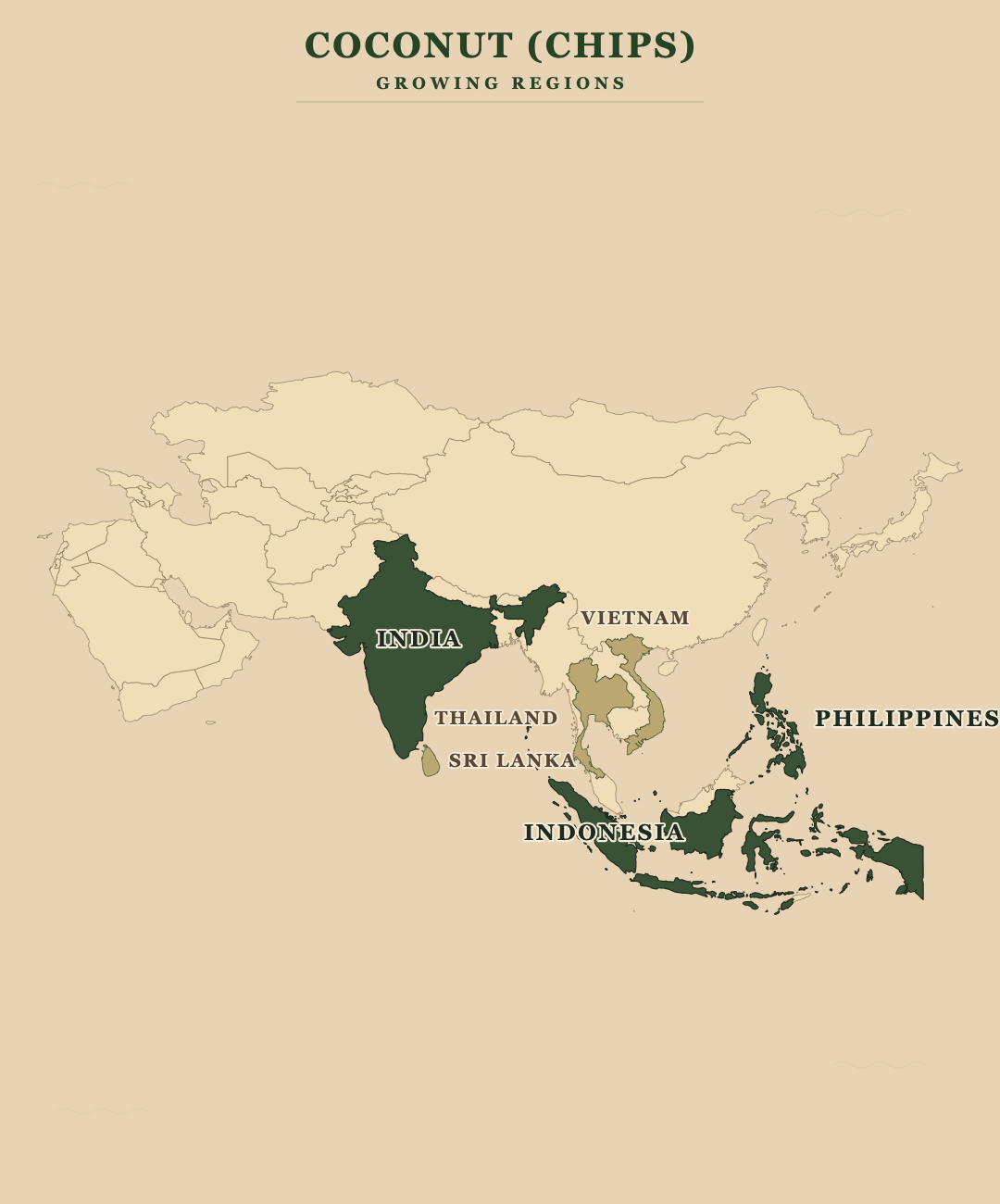
Coconut (chips) is primarily cultivated in Philippines, Indonesia, India, with secondary growing regions in Sri Lanka, Thailand, Vietnam, Papua New Guinea.
Spice Story
Coconut is a foundational ingredient in nearly every tropical cuisine — South Indian, Sri Lankan, Thai, Malaysian, Indonesian, Filipino, Polynesian, Caribbean, West African. The dried meat (copra) has been a major commodity for centuries, originally for vegetable oil and soap-making and now also for the desiccated and shredded forms used in baking and confectionery. The use of coconut in spirits is most famous through tropical rum-based cocktails (piña colada, painkiller, coconut-banana drinks) and through the contemporary craft of coconut fat-washing — where coconut oil is melted into a spirit, allowed to absorb, then chilled and removed leaving the fatty-flavour compounds behind. In gin specifically, dried coconut chips appear as a contemporary tropical botanical, particularly in Caribbean, Pacific, and contemporary craft expressions where the goal is genuinely tropical character without leaving the gin category.
Gin Creativity
Coconut brings softness and sweetness with a quietly tropical character. A full sachet pushes a gin into clearly tropical territory — coconut-vanilla, slightly sweet — best suited to long drinks and tropical cocktails. A half-sachet adds quiet creamy body that integrates without dominating; toasted chips give more character than raw. It pairs particularly well with vanilla and lime peel for a coconut-rum-style profile, or with cardamom and pandan for a South Asian-leaning tropical blend. Avoid combining with very bitter botanicals (hops, very dry tonic blends) — coconut's softness gets buried.
Blending Science
Main flavour compounds
 Gamma-Nonalactone—
 Octanoic acid—
 Lauric acid—
 Furanones (toasted notes)caramel, sweet
Coconut's flavour comes from a mix of fatty acids and lactones rather than a single dominant aromatic. Gamma-nonalactone is the dominant aromatic — a sweet, creamy compound that defines what humans recognise as "coconut character." It's the same compound used in synthetic coconut flavourings and tropical perfumes. Octanoic acid and lauric acid are medium-chain fatty acids that contribute the soft creamy body; they are not aromatic per se but provide the textural fullness that distinguishes real coconut from chemical coconut flavouring. Furanones develop during toasting and contribute the deeper, nuttier-caramelised notes of toasted coconut chips. The fatty content means coconut-infused gin clouds easily; cold filtration is essential for a clear finished spirit.
Food Partners
- Coconut curries: Thai green and red curries, South Indian moilee, Sri Lankan curries.
- Caribbean rum-style cocktails: Coconut and tropical fruit are inseparable.
- Coconut macaroons and tropical desserts: Coconut, vanilla, sometimes chocolate.
- Roast pork with tropical fruit: Hawaiian kalua pig with pineapple and coconut.
- Fresh seafood ceviche: Coconut milk and lime in white-fish ceviche traditions.
Cocktails To Try

- Coconut Daiquiri (gin): Coconut-gin in place of rum, fresh lime, sugar.
- Tropical Negroni: Coconut-lime gin, Campari, sweet vermouth.
- Painkiller, ginified: Coconut-gin, pineapple, orange, coconut cream, nutmeg garnish.
Release The Flavour
- Cool to gentle warmth: Cool preserves the bright lactones; gentle warmth develops the fatty body.
- Filter carefully: Coconut oils cloud the spirit; cold filtration or extended settling helps.
- Toast for depth: A quick oven toast of dried chips before use deepens the character significantly.
- Time: 24–48 hours for full development.
Discover more
From the same region
Pairs well with
Same flavour family
Surprise me

Sources & Citations
- scientific_name (Cocos nucifera, Arecaceae):www.fruit-crops.com/coconut-cocos-nucifera/
- native_range (south Pacific from PNG/Indonesia to northern Australia):www.iplantz.com/plant/456/cocos-nucifera/
- major_producers (Philippines, Indonesia, India):www.josemjournal.com/2022/04/coconut-tree-cocos-nucifera-...
- economic_versatility (food, fuel, fibre, cosmetic):www.josemjournal.com/2022/04/coconut-tree-cocos-nucifera-...
- main_flavour_compounds (CSV-sourced):inputs/source.csv — Coconut row
