
ROOIBOS

- Botanical name
- Aspalathus linearis
- Also known as
- Red Bush, Red Tea (informal), Bossie tea
- Main flavour compound
- Aspalathin
- Part used
- Dried, fermented twiggy stems and small leaves
- Method of cultivation
- Fynbos legume of the Fabaceae family, endemic to a small mountainous region of South Africa — particularly the Cederberg, Gifberg, Sandveld and Suid Bokkeveld. Rooibos is the only one of 278 *Aspalathus* species specifically cultivated for tea. The plant grows as a low woody shrub up to 2 metres tall, with fine needle-like leaves. Plants take 18–24 months to reach first harvest, and remain productive for 4–6 years before needing replanting.
- Commercial preparation
- Fine twigs and leaves are cut, bruised, and left to ferment in piles for several hours — during which time the originally-green plant material turns red-brown and develops the characteristic sweet-woody-floral aromatic. The fermented product is then sun-dried. Unfermented "green rooibos" is also produced (with higher antioxidant content but a sharper, less sweet flavour).
- Non-culinary uses
- Foundational South African tea (sold globally as a caffeine-free herbal alternative to black tea); cosmetics (aspalathin extract); traditional Khoisan and South African medicine.
Rooibos — Aspalathus linearis — is a fynbos legume of the Fabaceae family, endemic to a small mountainous region of South Africa: the Cederberg, Gifberg, Sandveld and Suid Bokkeveld. The plant is the only one of 278 Aspalathus species specifically cultivated for tea, and remains a near-monopoly product of this single small region — attempts at cultivation elsewhere have generally failed. [source] The plant grows as a low woody shrub up to 2 metres tall, with fine needle-like leaves and small yellow pea-shaped flowers in spring.
Fermented (red) rooibos
The standard form — soft, sweet, mellow.
Green (unfermented) rooibos
Sharper, less sweet, higher antioxidant content.
Region of cultivation
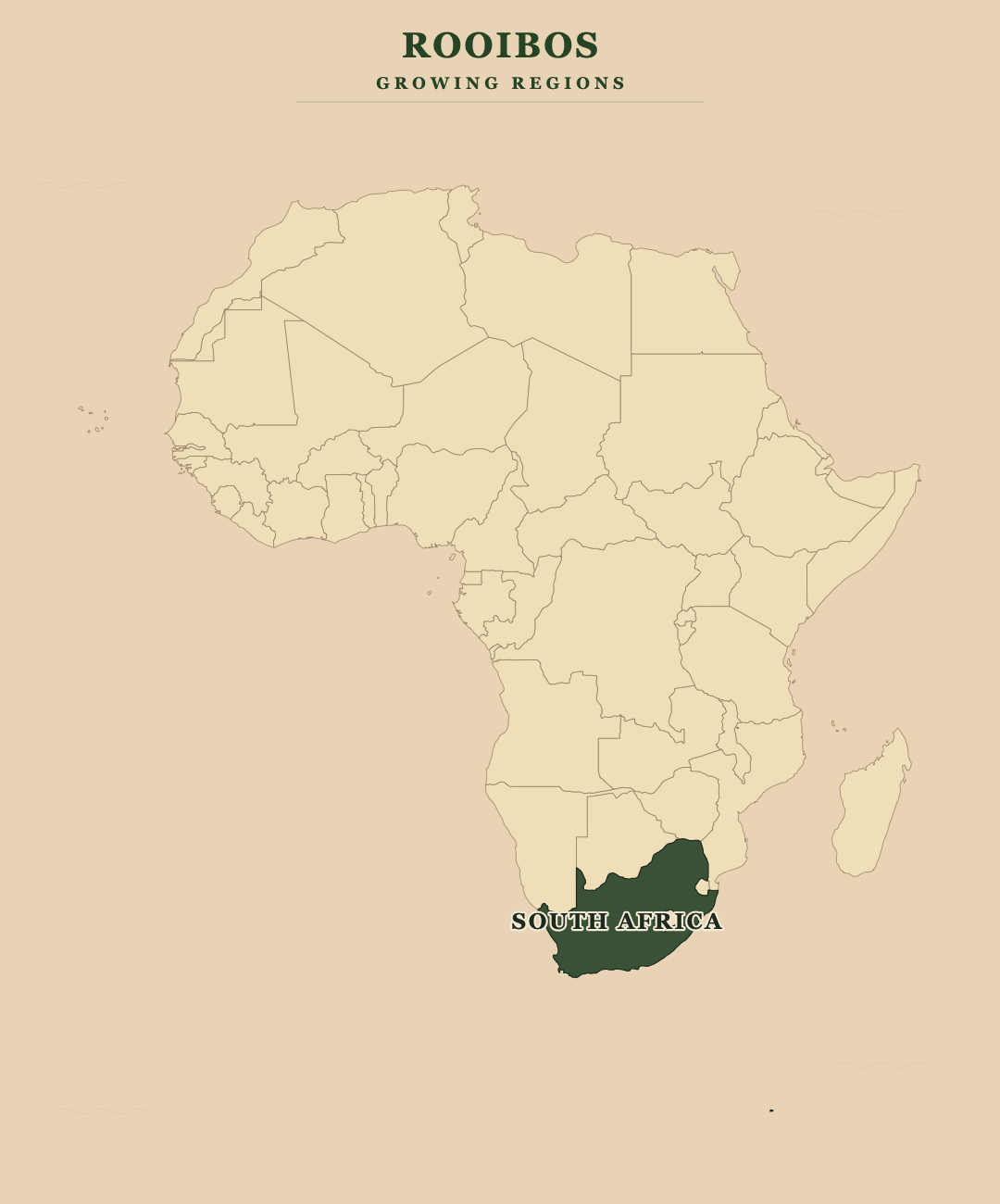
Rooibos is primarily cultivated in South Africa — Cederberg and surrounding fynbos mountains, with secondary growing regions in Limited production attempts elsewhere have generally failed; rooibos remains a true South African monopoly.
Spice Story
Rooibos is a relative newcomer to global commerce — the Khoisan peoples of the Cederberg have used it as a traditional tea for centuries, but commercial cultivation only began in earnest in the 1930s, driven by Russian-immigrant entrepreneur Benjamin Ginsberg who developed the modern commercial cultivation and fermentation techniques. The fermentation step is what transforms originally-green rooibos into the familiar red-brown product — during fermentation, the plant's aspalathin is oxidised, producing the characteristic red colour and the sweet-woody-floral aromatic. [source] In gin, rooibos provides a soft sweet-earthy character similar to but distinct from honey bush.
Gin Creativity
Rooibos brings soft sweet-earthy character with a quietly woody background. A full sachet pushes a gin into clearly tea-leaning territory; a half-sachet provides quiet earthy-sweet depth. Pair with Honey Bush for a fynbos profile, or with vanilla and honey for a softer wellness-leaning blend.
Blending Science
Main flavour compounds
 Aspalathin—
 Nothofagin—
 Quercetin—
 Phenolic acids—
Pairs well with
- Honey Bush
- Vanilla
- Honey
- Citrus peel
- Cardamom
Aspalathin is the defining compound — a unique flavonoid produced almost exclusively by Aspalathus linearis, responsible for both the antioxidant activity and (after oxidation during fermentation) the characteristic red colour. Nothofagin is a related flavonoid. Quercetin and other phenolic acids contribute background astringent depth. Cool extraction preserves the bright tea character; warm extraction develops the deeper body.
Food Partners
- Honey-and-rooibos desserts — natural sweet pairing.
- Cool summer drinks — rooibos iced tea is a South African staple.
- Soft cheese — chèvre with rooibos-honey syrup.
- Cape cuisine slow-cooked dishes — bobotie, bredie.
- Tea-flavoured ice creams — rooibos ice cream.
Cocktails To Try

- Rooibos Sour — rooibos gin, honey, lemon, egg white.
- Cape Cod Negroni — rooibos gin, Campari, vermouth.
- Fynbos G&T — rooibos gin, floral tonic.
Release The Flavour
- Cool to gentle warmth — preserves the bright character.
- Brief contact — 2–6 hours captures freshness.
- Whole twigs — hold character much longer than cracked.
- Fermented (red) grade — sweeter; green grade is sharper.
Discover more
Pairs well with
Same flavour family
Surprise me

Sources & Citations
- scientific_name (Aspalathus linearis, Fabaceae):en.wikipedia.org/wiki/Rooibos
- cederberg_fynbos_endemic:www.britannica.com/plant/rooibos
- only_aspalathus_for_tea:www.britannica.com/plant/rooibos
- 18-24_month_first_harvest_4-6_year_productive_life:www.rooibostee.shop/en/useful-information/rooibos/rooibos...
- aspalathin_signature_compound:www.hortherbpublisher.com/index.php/jtsr/article/html/3914/
- fermentation_red_colour_development:www.thes-traditions.com/en/content/the-rooibos-plant
- main_flavour_compounds (CSV-sourced):inputs/source.csv — Rooibos row
