
HONEY BUSH

- Botanical name
- Cyclopia (genus, ~20 species)
- Also known as
- Honeybush, Heuningbos (Afrikaans)
- Main flavour compound
- Mangiferin
- Part used
- Dried fermented leaves and stems
- Method of cultivation
- Genus of about 20 species of flowering plants in the Fabaceae (legume) family, endemic to the Fynbos Biome of the Cape Floral Kingdom in South Africa. Honey Bush grows as a low-to-medium woody shrub up to 2 metres tall, with three-lobed leaves and small bright-yellow pea-shaped flowers (the genus is named for the "cyclops" eye-like patterning on its flowers). About 80% of honey bush is still wild-harvested from fynbos; commercial cultivation is expanding but slow.
- Commercial preparation
- Foliage is cut in late summer (which gives the best flavour development) and traditionally fermented and sun-dried to produce the antioxidant-rich, sweet herbal tea that is the plant's primary commercial product. After harvest the plant needs a 12-month regrowth period before it can be cut again.
- Non-culinary uses
- Tea (the foundational commercial use); cosmetics (Cyclopia extracts are studied for skin benefits and used in some South African skincare); ornamental fynbos garden plant.
Honey Bush — genus Cyclopia, with about 20 species — is endemic to the Cape Floral Kingdom of South Africa, growing in the unique fynbos biome of the Western Cape. The plant is a low-to-medium woody shrub up to about 2 metres, with three-lobed legume-family leaves and bright-yellow pea-shaped flowers; the genus name Cyclopia refers to the "cyclops"-like eye markings on its flowers. The plant gets its English common name from the strong honey-like aroma of the flowers and (when properly fermented) the dried leaves. About 80% of commercial honey bush is still wild-harvested from fynbos stands; plantation cultivation is small but expanding. [source]
Cut-and-fermented dried leaf-and-stem
The standard form — soft, slightly sweet on the nose even before extraction.
Loose ground
Faster extraction; commonly used for tea bags.
Region of cultivation
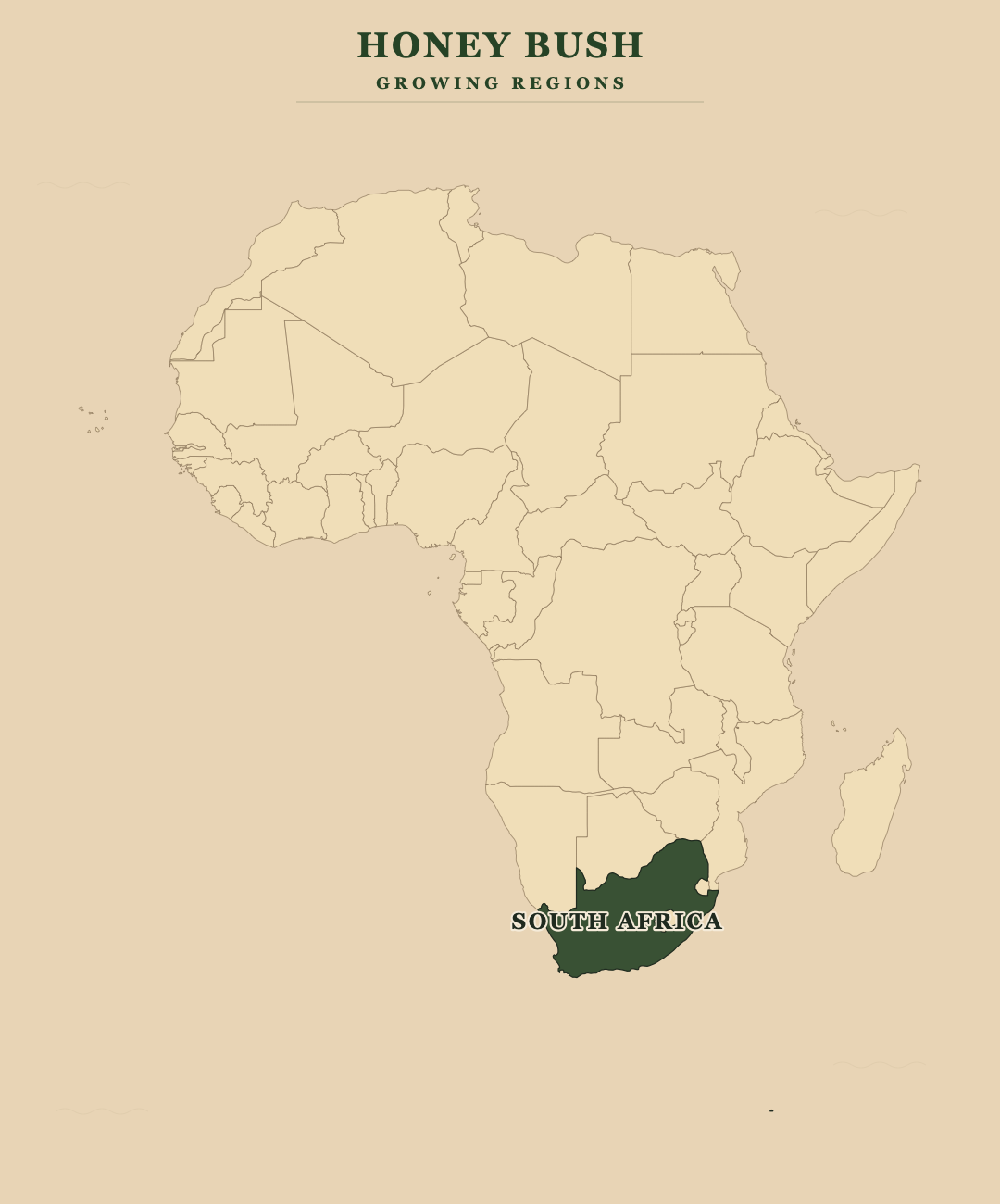
Honey Bush is primarily cultivated in South Africa — Cape Floral Kingdom only, with secondary growing regions in No significant production outside South Africa.
Spice Story
Honey Bush is the lesser-known cousin of rooibos (also a fynbos legume, Aspalathus linearis), and shares many of its caffeine-free, antioxidant-rich, sweet-floral characteristics. The plant has been used by Khoisan and later European-South African communities for centuries as a tea, and modern commercial production is centred in the Western Cape. Late-summer harvest produces the deepest flavour, and traditional processing involves fermenting the cut foliage before sun-drying — a critical step that develops the honey-floral aromatic character. [source] In gin, honey bush is a relatively new contemporary botanical, providing a soft sweet-floral character distinct from rooibos.
Gin Creativity
Honey Bush brings soft honey-floral sweetness without added sugar. A full sachet pushes a gin into clearly tea-leaning territory with a sweet floral body; a half-sachet adds quiet honey depth that pairs naturally with juniper. Pair with rooibos for a fynbos-leaning South African profile, or with chamomile and honey for a softer floral blend.
Blending Science
Main flavour compounds
 Mangiferin—
 Hesperidin—
 Volatile floral compounds (developed in fermentation)—
The character is built around polyphenols and volatile aromatics. Mangiferin is a xanthonoid present in significant amounts — it contributes the bitter undertone that prevents honey bush from being purely sweet. Hesperidin (a flavonoid) adds soft astringent depth. The honey-floral aromatic character develops during fermentation rather than being present in fresh leaf; the fermentation produces sweet-floral volatile compounds that distinguish honey bush from any other tea. Cool extraction preserves the bright top; warm extraction develops the deeper body.
Food Partners
- Sweet honey desserts — natural sweet-on-sweet pairing.
- Soft white cheese — chèvre with honey bush syrup.
- Stone-fruit jams — apricot and peach.
- Cool summer salads — honey bush vinaigrette over baby greens.
- Yoghurt and granola — honey bush infused yoghurt.
Cocktails To Try

- Honey Bush G&T — honey-bush gin, floral tonic, fresh lemon.
- Cape Cod Negroni — honey-bush gin, Campari, vermouth.
- Fynbos Sour — honey-bush gin, honey syrup, lemon, egg white.
Release The Flavour
- Cool to gentle warmth — preserves the floral character.
- Brief contact — 2–6 hours captures sweetness.
- Fermented-grade only — unfermented honey bush has none of the signature character.
- Source matters — premium late-summer-harvest grades are distinctly sweeter.
Discover more
Same flavour family
Surprise me

Sources & Citations
- scientific_name (Cyclopia genus, Fabaceae):en.wikipedia.org/wiki/Cyclopia_(plant)
- endemic_to_cape_floral_kingdom_fynbos:en.wikipedia.org/wiki/Cyclopia_(plant)
- 80_percent_wild_harvested:acsess.onlinelibrary.wiley.com/doi/10.1002/csc2.20752
- late_summer_harvest_12_month_regrowth:acsess.onlinelibrary.wiley.com/doi/10.1002/csc2.20752
- fermentation_for_flavour_development:acsess.onlinelibrary.wiley.com/doi/10.1002/csc2.20752
- main_flavour_compounds (CSV-sourced):inputs/source.csv — Honey Bush row
