
VANILLA

- Botanical name
- Vanilla planifolia
- Also known as
- Bourbon vanilla (Madagascar/Réunion), Mexican vanilla (Veracruz), Tahitian vanilla (V. tahitensis — different species)
- Main flavour compound
- Vanillin (1.5-2.5% of dry weight)
- Part used
- Dried, cured fruit pod (vanilla bean)
- Method of cultivation
- Climbing orchid of the Orchidaceae family — uniquely the only orchid grown for a food product. *Vanilla planifolia* is native to Mexico, where it is naturally pollinated by the *Melipona* bee. Cultivation outside Mexico (in Madagascar, Réunion, Tahiti, Uganda, Indonesia and Papua New Guinea) requires hand pollination — a labour-intensive technique discovered around 1841 by Edmond Albius, a young enslaved man on Réunion Island, using a simple stick and thumb. Plants take 3–5 years to fruit; each flower opens for a single day and must be hand-pollinated within hours. Madagascar produces about 80% of world supply.
- Commercial preparation
- Green vanilla pods are picked (when they first start to turn yellow), then go through a months-long curing process — alternating sweating in fabric, sun-drying, and slow ageing — that develops the characteristic vanillin and the complex caramel-floral aromatic profile. Total cultivation-to-cured-bean time can be 5–8 years.
- Non-culinary uses
- Foundational confectionery flavouring across global cuisine; one of the most expensive natural products by weight after saffron; perfumery (vanillin is a foundational warm-sweet base note); cosmetics; aromatherapy.
Vanilla — Vanilla planifolia — is a climbing orchid of the Orchidaceae family, uniquely the only orchid grown commercially for a food product. The plant is a long vining liana, climbing through tropical rainforest understorey on host trees, with succulent fleshy leaves and small pale yellow-green flowers. Each flower opens for a single day. In its native Mexico, Vanilla planifolia is pollinated by the small native Melipona bee; outside Mexico, every commercial vanilla flower must be hand-pollinated — a technique discovered around 1841 by Edmond Albius, a young enslaved man on Réunion Island, using a thin stick and the pressure of his thumb. [source] Madagascar now produces about 80% of global vanilla supply.
Whole dried pod (vanilla bean)
The standard form — split lengthways and scrape the seeds, then add both seeds and pod to extraction.
Vanilla extract
Alcoholic extract; the convenient form but quality varies widely.
Region of cultivation
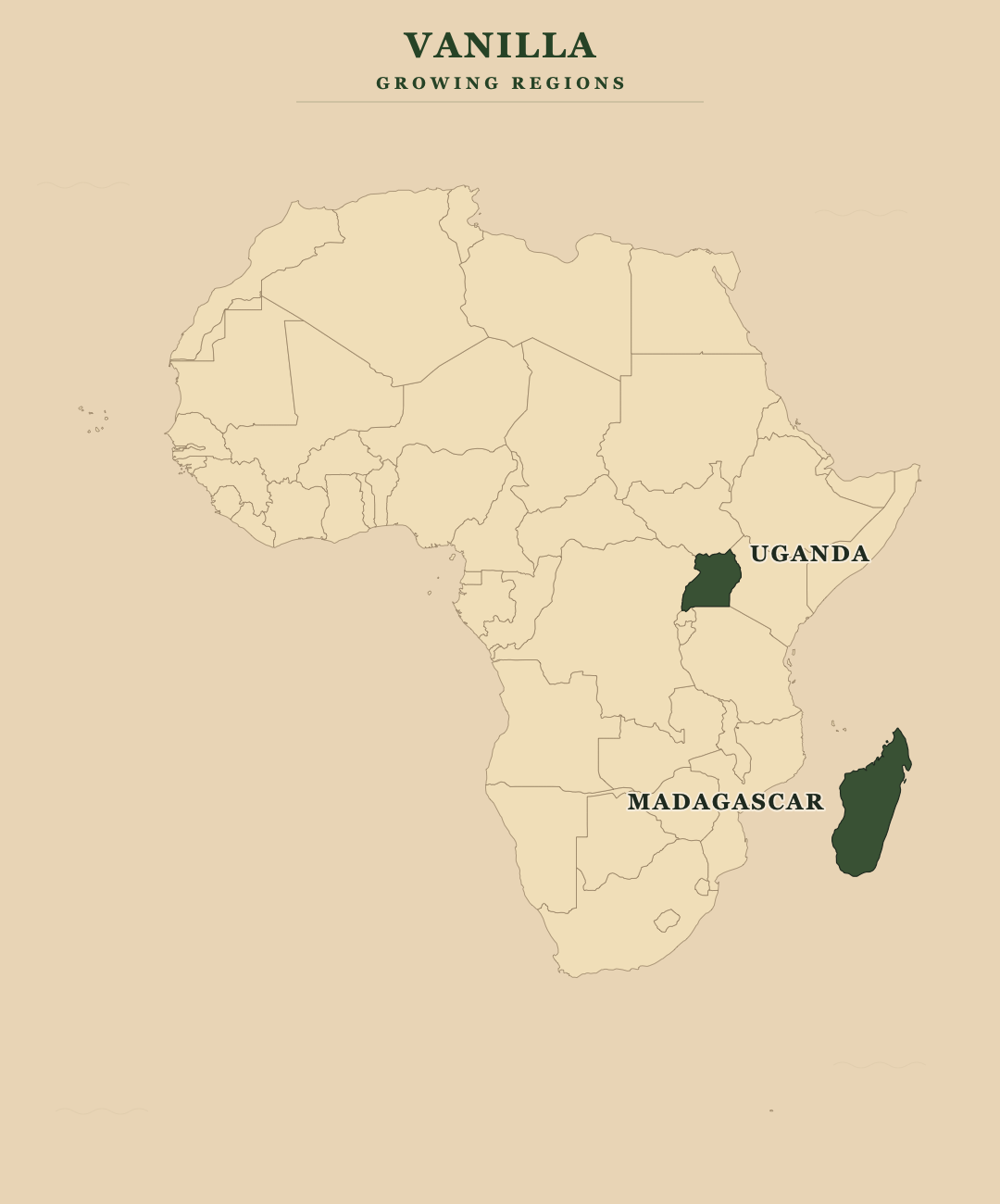
Vanilla is primarily cultivated in Madagascar (~80% world supply), Indonesia, Uganda, with secondary growing regions in Mexico (Veracruz — historic and culturally important), Tahiti (V. tahitensis), Papua New Guinea, India.
Spice Story
Vanilla was first cultivated by the Totonac peoples of what is now Veracruz, Mexico, who passed knowledge of the spice to the Aztecs (who flavoured chocolate with it). Hernán Cortés brought vanilla back to Europe in 1519. For 300 years, Mexican vanilla was the only commercial source — until Edmond Albius's 1841 hand-pollination technique made cultivation possible across the tropical world. Madagascar, French Réunion ("Bourbon vanilla" is named after Réunion's old French name "Île Bourbon"), Indonesia, Uganda, Papua New Guinea, India and Tahiti are all now significant producers. The total time from planting to cured bean is 5–8 years, which is why vanilla is one of the most expensive natural products by weight after saffron. In gin, vanilla is one of the most foundational warming-sweet contemporary botanicals.
Gin Creativity
Vanilla brings deep sweet-creamy character that softens and rounds almost any botanical bill. A full sachet pushes a gin firmly into clearly vanilla territory (appropriate for dessert-style cocktails); a half-sachet adds soft sweet depth that integrates beautifully with juniper. Pair with cinnamon and cardamom for a Christmas-spice profile, or with rose petal and citrus peel for a softer floral blend.
Blending Science
Main flavour compounds
 Vanillin (1.5-2.5% of dry weight)vanilla, sweet-creamy
 Anisaldehyde—
 P-Hydroxybenzaldehyde—
 Volatile esters—
Pairs well with
- Cinnamon
- Cardamom
- Tonka
- Rose petal
- Citrus peel
Vanillin is the defining compound — typically 1.5–2.5% of the dry-bean weight, providing the recognisable vanilla character. Anisaldehyde and p-hydroxybenzaldehyde are related phenolic aldehydes contributing additional warm aromatic depth. Volatile esters developed during the long curing process give vanilla its complex caramel-floral character distinct from synthetic vanillin. Cool extraction preserves the bright top; warm extraction develops the deeper caramel-floral body.
Food Partners
- Vanilla ice cream and custards — the canonical use.
- Crème brûlée — vanilla in cream is foundational.
- Vanilla-and-stone-fruit desserts — vanilla-poached pears, vanilla-roasted peaches.
- Vanilla-rum-based cocktails — vanilla and rum are a classical pairing.
- Chocolate-vanilla pastry — vanilla layers over chocolate.
Cocktails To Try

- Vanilla Old Fashioned — vanilla gin, demerara, orange bitters.
- Vanilla Espresso Martini — vanilla gin, espresso, coffee liqueur.
- Vanilla-Rose Spritz — vanilla-and-rose gin, prosecco, soda.
Release The Flavour
- Split and scrape — both seeds and pod contribute character.
- Time — vanilla extracts slowly; 24+ hours minimum.
- Heat-friendly — warm extraction develops the deepest character.
- Source matters — Madagascar Bourbon, Mexican, and Tahitian vanillas each have distinct character profiles.
Discover more
From the same region

Pairs well with
Same flavour family
Surprise me

Sources & Citations
- scientific_name (Vanilla planifolia, Orchidaceae):en.wikipedia.org/wiki/Vanilla_planifolia
- mexican_native_origin:levanillier.com/vanilla-planifolia-origin-cultivation-fla...
- melipona_bee_natural_pollinator:levanillier.com/vanilla-planifolia-origin-cultivation-fla...
- edmond_albius_1841_hand_pollination:levanillier.com/vanilla-planifolia-origin-cultivation-fla...
- madagascar_80_percent_world_supply:www.atlasobscura.com/articles/madagascar-vanilla
- vanillin_1.5-2.5_percent_dry_weight:levanillier.com/vanilla-planifolia-origin-cultivation-fla...
- main_flavour_compounds (CSV-sourced):inputs/source.csv — Vanilla row
