
PELARGONIUM ROOT

- Botanical name
- Pelargonium sidoides
- Also known as
- Umckaloabo (Zulu), South African geranium, Black geranium
- Main flavour compound
- Coumarins (umckalin)
- Part used
- Dried root (thick dark brown taproot)
- Method of cultivation
- Perennial herb of the Geraniaceae family, endemic to Lesotho and South Africa. The plant grows in a low rosette pattern, forms thick dark-brown underground taproots up to 15 cm long, with mildly aromatic crinkled grey-green heart-shaped velvety leaves and small dark-red to almost-black flowers. The plant tolerates arid conditions and frost but becomes dormant in prolonged drought.
- Commercial preparation
- Roots are dug from cultivated or wild-harvested plants, washed, sliced, and dried at low temperature. The traditional extraction method is alcohol tincture — used widely in European herbal medicine as the cold-and-cough remedy *Umckaloabo*.
- Non-culinary uses
- Foundational ingredient in modern European herbal medicine for upper-respiratory complaints (the commercial Umckaloabo extract is widely sold across Germany, Austria and other EU markets); traditional Zulu and Sotho medicinal use; cosmetics.
Pelargonium Root — Pelargonium sidoides — is the dried taproot of a small South African herbaceous perennial of the Geraniaceae family. (Important: this is NOT the same as rose geranium / Pelargonium graveolens — same genus, very different plant.) The plant grows in low rosettes, with grey-green velvety heart-shaped leaves and small dark-red almost-black flowers. The roots are thick, dark brown, and up to 15 cm long. The plant is endemic to Lesotho and the Eastern Cape of South Africa, where it grows in arid to dry climatic conditions. [source]
Dried sliced root
The standard form — slow-extracting in alcohol.
Powdered
Faster extraction; harder to filter.
Region of cultivation
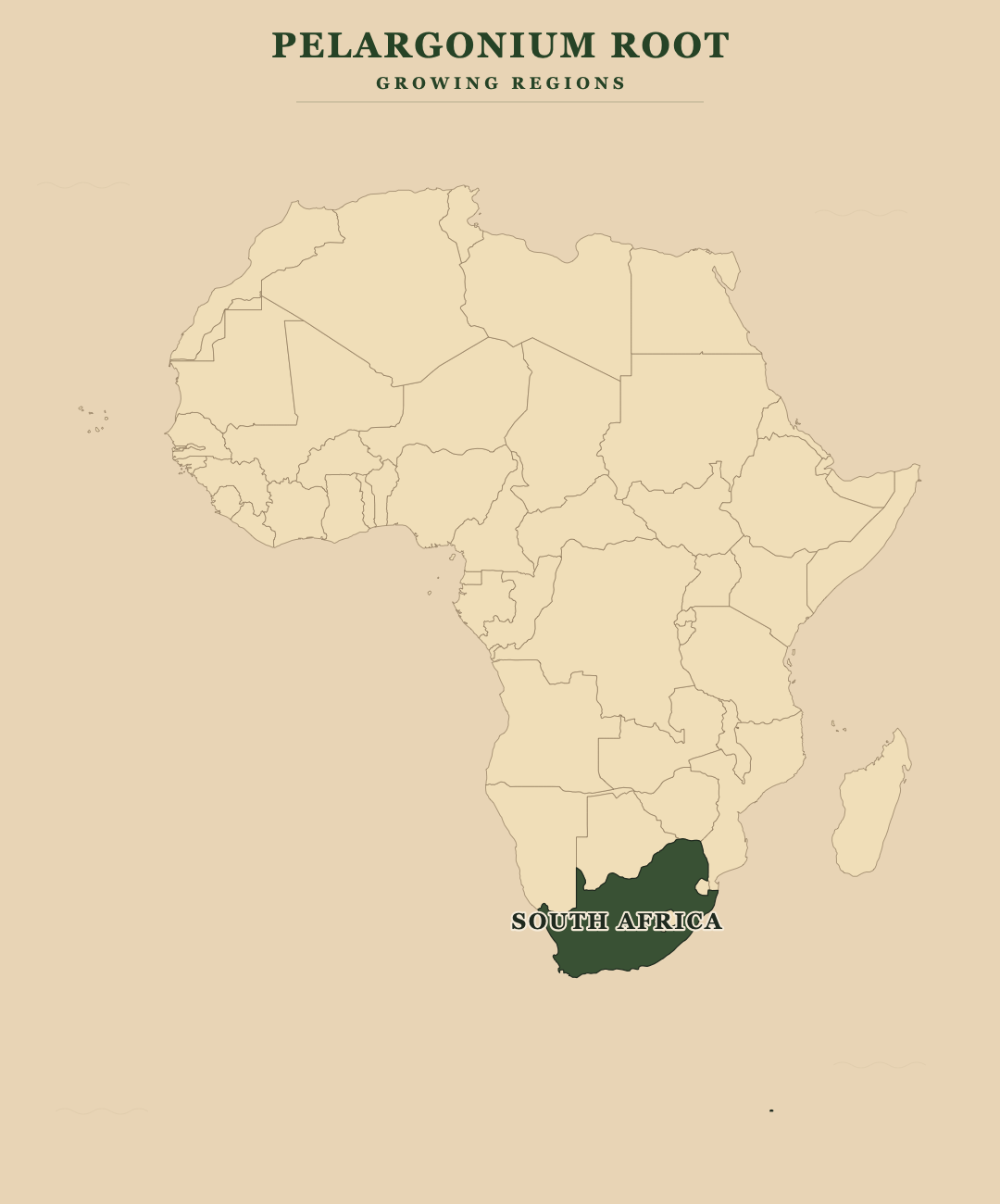
Pelargonium Root is primarily cultivated in South Africa (Eastern Cape, Lesotho), with secondary growing regions in Cultivated commercially in Germany for Umckaloabo extract.
Spice Story
Pelargonium Root has been used by Zulu and Sotho traditional healers for many generations — the Zulu name Umckaloabo derives from words meaning "heavy cough." A British man named Charles Henry Stevens encountered the herb in the late 19th century while recovering from tuberculosis in South Africa, and brought knowledge of it back to Europe — where it has since become one of the foundational herbal remedies for upper-respiratory infections in German and broader European herbal medicine. In gin, Pelargonium Root is an uncommon contemporary botanical providing earthy-bitter depth.
Gin Creativity
Pelargonium Root brings earthy-bitter depth with a slight aromatic edge. A quarter to half sachet is plenty — full sachet use risks tipping a gin into medicinal territory. Pair with honey and ginger for a warming "tonic gin" profile.
Blending Science
Main flavour compounds
 Coumarins (umckalin)—
 Phenolic acids—
 Tannins—
Pairs well with
The chemistry is dominated by non-volatile compounds. Coumarins (especially umckalin, named after the plant's Zulu name) provide soft sweet-vanilla-edged depth. Phenolic acids and tannins contribute the bitter astringent body. The compounds extract slowly into alcohol; long warm extraction is needed.
Food Partners
- Traditional herbal tonics — Pelargonium-honey throat remedies.
- Honey-spiked digestifs — modern bitter aperitif preparations.
- Slow-cooked South African dishes — Pelargonium as background depth.
- Bitter aperitifs — Pelargonium as gentian-style alternative.
- Strong tea — Pelargonium in winter herbal teas.
Cocktails To Try

- Tonic Bitters — Pelargonium gin, honey, lemon, hot water.
- Bitter Negroni variant — Pelargonium gin (small amount), Campari, vermouth.
- South African Sour — Pelargonium gin, rooibos syrup, lemon.
Release The Flavour
- Long warm extraction — slow-extracting tannins and coumarins.
- Use sparingly — bitter character can dominate.
- Source matters — sustainable South African material; some commercial Pelargonium is wild-harvested unsustainably.
Discover more
Pairs well with
Same flavour family
Surprise me

Sources & Citations
- scientific_name (Pelargonium sidoides, Geraniaceae):en.wikipedia.org/wiki/Pelargonium_sidoides
- endemic_to_lesotho_south_africa:en.wikipedia.org/wiki/Pelargonium_sidoides
- umckaloabo_zulu_name:en.wikipedia.org/wiki/Pelargonium_sidoides
- respiratory_traditional_use:www.gaiaherbs.com/blogs/seeds-of-knowledge/pelargonium-si...
- cultivation_and_root_morphology:pza.sanbi.org/pelargonium-sidoides
- main_flavour_compounds (CSV-sourced):inputs/source.csv — Pelargonium Root row
