
GINGER

- Botanical name
- Zingiber officinale
- Also known as
- Common ginger, Adrak (Hindi), Jiang (Chinese), Shoga (Japanese)
- Main flavour compound
- Gingerol (fresh)
- Part used
- Dried rhizome (sliced or chopped)
- Method of cultivation
- Herbaceous perennial of the Zingiberaceae family, native to Maritime South-East Asia (likely Indonesia or southern China; the wild ancestor is not certain). Cultivated for over 2,000 years across South and South-East Asia, and now grown commercially across India (largest producer), China, Nepal, tropical Africa, the Caribbean and Australia. Takes 8–10 months from planting to harvest.
- Commercial preparation
- Mature rhizomes are dug up, washed, peeled, sliced or chopped, and either sun-dried or kiln-dried until brittle. Quality is graded on fibre content, pungency, and absence of mould. India is the world's largest producer of ginger.
- Non-culinary uses
- Foundational role in traditional Chinese medicine, Ayurveda and Unani for digestion, circulation and respiratory complaints; widespread use in confectionery and baking; the essential oil is used in perfumery for warm-spice accords.
Ginger — Zingiber officinale — is a tall herbaceous perennial of the ginger family, growing from a horizontal underground rhizome to about 1 metre with long lance-shaped leaves. The plant is native to Maritime South-East Asia and has been cultivated for over 2,000 years; today India is the largest producer, followed by China, Nigeria, Indonesia and Nepal. [source] The rhizome — what we eat and distil — grows just below the soil surface, branching laterally and continuing to expand for 8–10 months before harvest. Fresh ginger has a sharper, more citrus-edged character; drying dehydrates the dominant compound gingerol into shogaol, which is structurally similar but more pungent and warm.
Dried sliced rhizome
The standard form — slow extraction but clean character.
Powdered
Faster extraction; loses character within months.
Region of cultivation
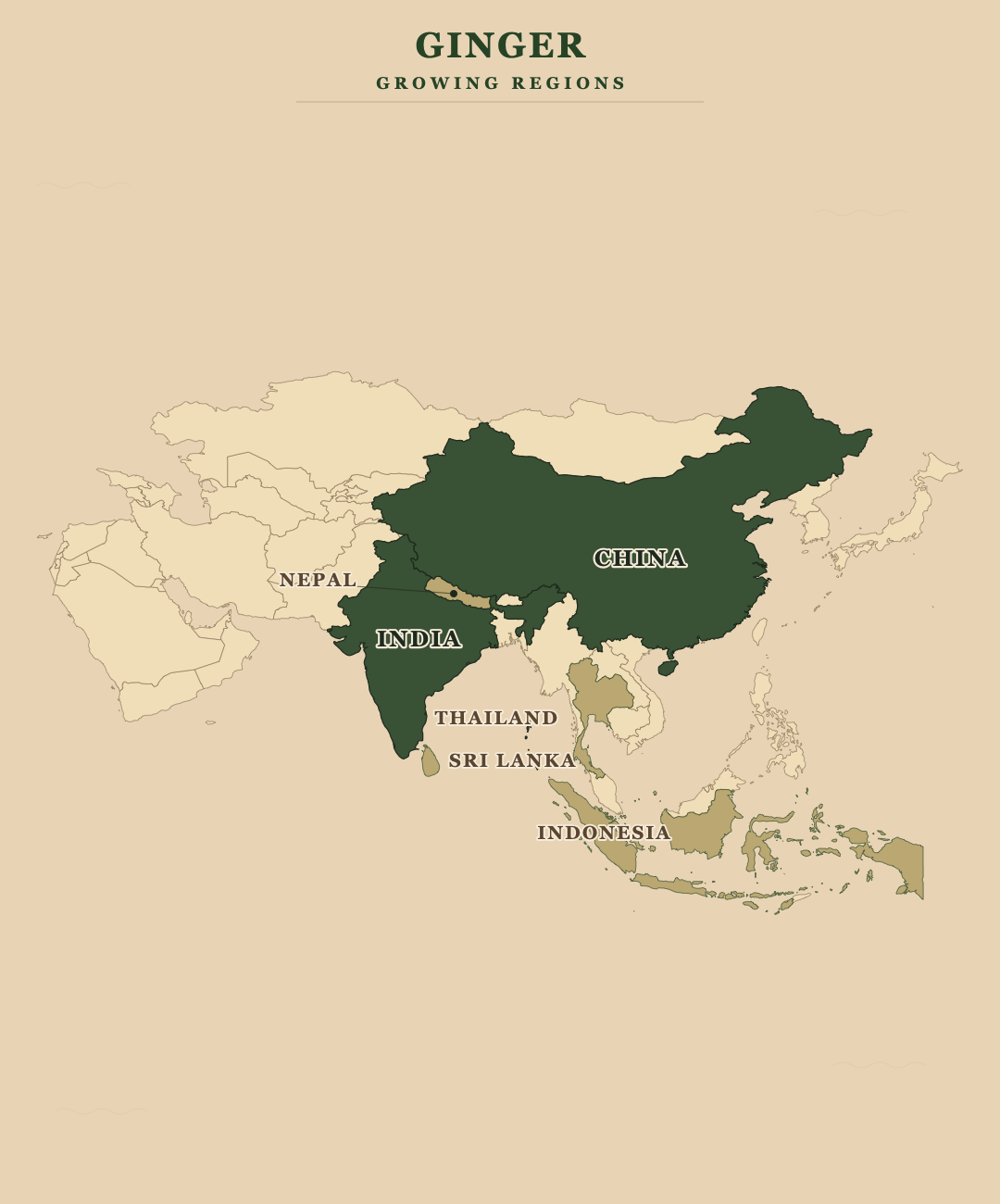
Ginger is primarily cultivated in India (largest producer), China, Nigeria, with secondary growing regions in Indonesia, Nepal, Thailand, Sri Lanka, Australia.
Spice Story
Ginger is one of the oldest spices in continuous human use — used in Indian Ayurveda from at least the 5th century BCE, traded along Asian spice routes by the Roman period, and adopted into European medieval cookery as one of the foundational warming spices alongside cinnamon and clove. Today it remains foundational across South-East Asian, Indian, Chinese, Caribbean, African and Middle Eastern cuisines. In gin, ginger is a contemporary spicy-warm botanical, present in everything from chai-style craft gins to spiced winter expressions to the foundational ginger-gin highballs.
Gin Creativity
Ginger brings sharp warmth with a citrus-edged top note. A full sachet pushes a gin firmly into spicy territory; a half-sachet adds gentle warm-spice depth that integrates with juniper. Pair with lemon and lime peel for a contemporary ginger-citrus blend, or with cardamom and coriander for a chai profile.
Blending Science
Main flavour compounds
 Gingerol (fresh)—
 Shogaol (dried — gingerol dehydrates)—
 Zingerone—
 Beta-Phellandrenecitrus-mint, peppery
Pairs well with
- Lemon peel
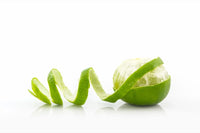
- Lime peel
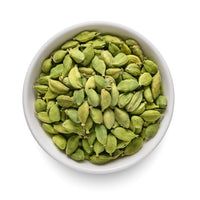
- Cardamom
- Coriander seed
- Honey
The dominant pungent compounds change with drying. Gingerol is the fresh-ginger compound — sharp, slightly citrus-edged. During drying, gingerol dehydrates into shogaol, which is structurally similar but more pungent and warmer. [source] Zingerone is a third related compound that forms during slow drying, contributing a sweeter back-palate warmth. Beta-phellandrene is a terpene contributing the citrus-edged top note. Heat-stable; both vapour and warm maceration work cleanly.
Food Partners
- Asian curries and stir-fries — ginger-and-garlic base.
- Christmas baking — gingerbread, gingersnaps, pumpkin pie.
- Pickled ginger — Japanese gari alongside sushi.
- Ginger beer and ginger ale — sharper, more authentic with real ginger gin.
- Slow-braised pork and beef — Chinese and Korean classics.
Cocktails To Try

- Moscow Mule (with ginger gin) — ginger gin in place of vodka, lime, ginger beer.
- Penicillin (gin variant) — ginger gin, honey, lemon, smoky finish.
- Ginger Old Fashioned — ginger gin, demerara, orange bitters.
Release The Flavour
- Slice thin — increases surface area for slow-extracting rhizome.
- Heat is friendly — both vapour and warm maceration work.
- Time — 24–48 hours for full development.
- Pair with citrus — ginger and lemon/lime are made for each other.
Discover more
From the same region
Pairs well with
Same flavour family
Surprise me

Sources & Citations
- scientific_name (Zingiber officinale, Zingiberaceae):hort.extension.wisc.edu/articles/ginger-zingiber-officinale/
- cultivation_history_2000_years:hort.extension.wisc.edu/articles/ginger-zingiber-officinale/
- india_largest_producer:hort.extension.wisc.edu/articles/ginger-zingiber-officinale/
- harvest_8-10_months:hort.extension.wisc.edu/articles/ginger-zingiber-officinale/
- gingerol_to_shogaol_conversion_on_drying:www.sciencedirect.com/science/article/abs/pii/S0031942215...
- main_flavour_compounds (CSV-sourced):inputs/source.csv — Ginger row
