
FENUGREEK SEED (WHOLE)

- Botanical name
- Trigonella foenum-graecum
- Also known as
- Methi (Hindi — the leaf), Methi dana (the seed), Hilbeh (Arabic)
- Main flavour compound
- Sotolon
- Part used
- Dried hard seed (small, ridged, angular yellow-tan)
- Method of cultivation
- Annual herb of the Fabaceae family (the pea/legume family), native to the eastern Mediterranean and Western Asia, now cultivated extensively across India (the largest producer), Egypt, Morocco, Iran, Afghanistan and across temperate-to-warm zones worldwide. Plants grow 30–60 cm tall, with three-lobed leaves resembling small clover and small pale-yellow flowers that mature into long pods containing 10–20 hard angular seeds.
- Commercial preparation
- Plants are pulled or cut at maturity, dried, threshed, and the seeds cleaned. The seeds are typically roasted briefly to develop the famous maple-sweet character — raw fenugreek is more bitter and less aromatic. India dominates the world market and provides most commercial-grade seed.
- Non-culinary uses
- The fresh leaves are eaten as a vegetable (*methi*) across India; commercial source of artificial maple-syrup flavouring (sotolon is the key compound); traditional medicine across Ayurvedic, Unani and Western herbal systems; the seed mucilage is used in some cosmetic formulations.
Fenugreek — Trigonella foenum-graecum — is a small annual herb of the legume family, growing knee-high with three-lobed clover-like leaves and small pale-yellow flowers. The Latin epithet foenum-graecum — "Greek hay" — references the plant's long history as a fodder crop across the eastern Mediterranean. What the spice trade uses is the hard, small, ridged angular seed produced inside the slim pods. The seed has a distinctive flavour found nowhere else in the spice rack: a sweet, almost burnt-sugar maple character on top of a faintly bitter green body. [source]
Whole roasted seed
The standard form — toast briefly in a dry pan before use to deepen the sweet character.
Ground
Convenient but loses character within months as sotolon oxidises.
Region of cultivation
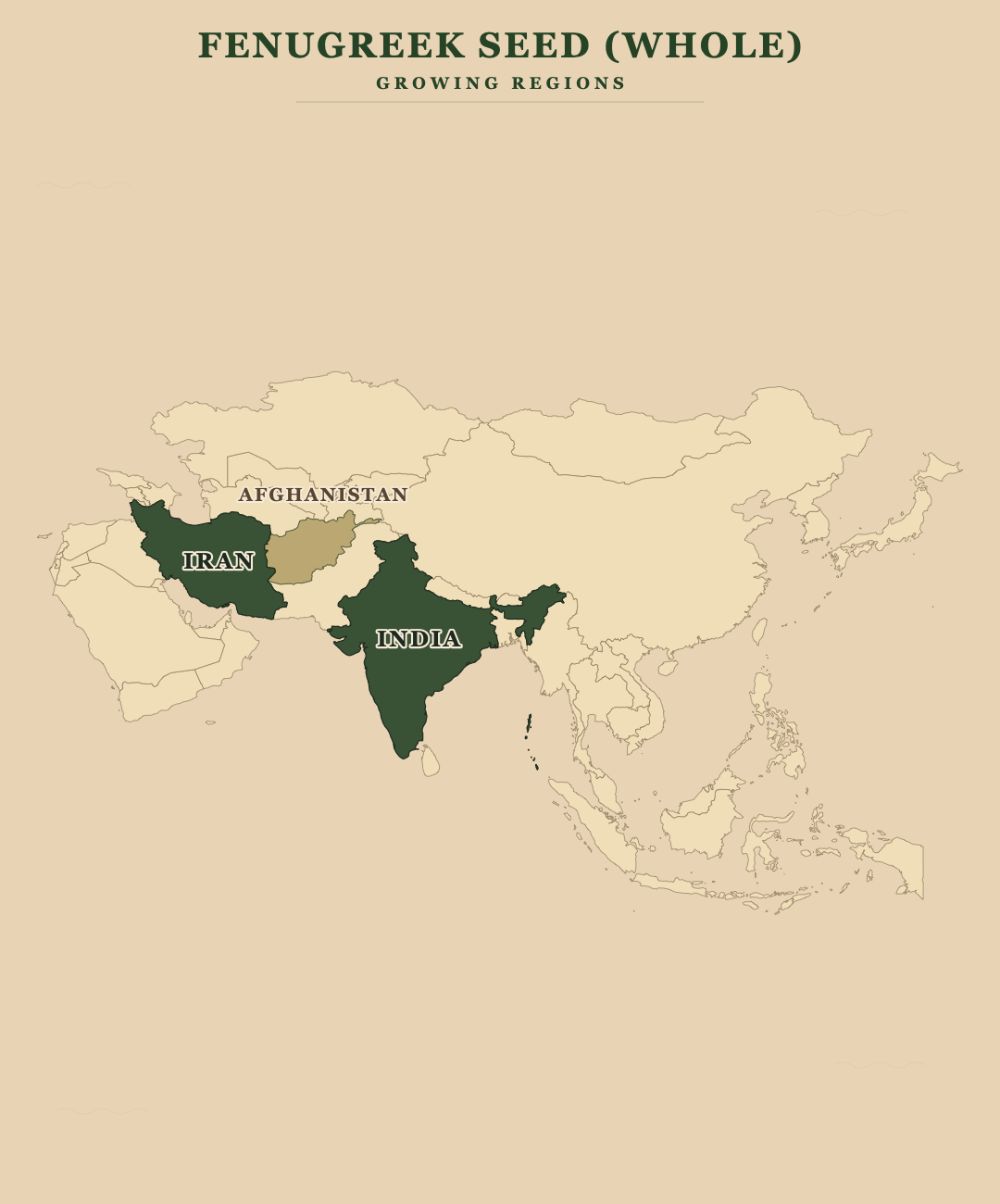
Fenugreek Seed (whole) is primarily cultivated in India (largest producer), Egypt, Morocco, Iran, with secondary growing regions in Afghanistan, Ethiopia, Argentina, Turkey, France.
Spice Story
Fenugreek has been cultivated since antiquity across the Mediterranean and Western Asia — Egyptian tombs have yielded fenugreek seed, and the spice appears in classical Greek and Roman texts. The seed and leaf are foundational to Indian, Ethiopian and Yemeni cuisines. The seed's most famous use in the modern Western world is commercial: sotolon, the compound responsible for fenugreek's distinctive flavour, is the same compound that gives maple syrup its character — and fenugreek extract is the standard base for artificial maple-syrup flavouring used in commercial pancake syrups and confectionery. [source] In gin, fenugreek seed is an unusual but distinctive contemporary botanical that brings genuine sweet-earthy depth without added sugar.
Gin Creativity
Fenugreek brings sweet-maple character with a slight bitter green undertone. A full sachet pushes a gin firmly into Indian-spice or dessert territory; a quarter to half sachet adds a quiet sweet body that integrates with juniper. Pair with coriander seed and curry leaf for a clearly Indian-style gin, or with cardamom and saffron for a Persian-leaning profile. Avoid combining with very bright florals — the maple-bitter character buries them.
Blending Science
Main flavour compounds
 Sotolon—
 Diosgenin (saponin)—
 Trigonelline—
Pairs well with
Sotolon is the defining compound — a lactone that smells distinctly of maple syrup and curry-spice depth at the same time. Sotolon is so potent that humans can detect it at parts-per-billion concentrations, and high fenugreek intake genuinely affects body odour (the "fenugreek sweat" phenomenon is real). [source] Diosgenin (a saponin steroid) contributes the bitter body but is non-volatile. Trigonelline is an alkaloid contributing further bitter depth. Brief dry-pan toasting before extraction develops the sotolon character significantly through Maillard chemistry.
Food Partners
- South Indian curries — fenugreek seed in mustard-seed tadka.
- Yemeni hilbeh paste — the defining North African / Arabian peninsula use.
- Spice-rubbed roast meats — fenugreek deepens a dry rub.
- Maple-style desserts — fenugreek-infused syrup over pancakes is genuinely transformative.
- Bread spice blends — Ethiopian injera and similar.
Cocktails To Try

- Maple Old Fashioned — fenugreek-gin, maple syrup, orange bitters.
- Spiced Negroni — fenugreek-and-cardamom gin, Campari, vermouth.
- Indian Bloody Mary — fenugreek-gin, tomato, lemon, curry leaf garnish.
Release The Flavour
- Toast first — develops the sotolon character significantly.
- Time — 24–48 hours for full development.
- Less is more — sotolon is potent; small amounts transform a blend.
- Whole seed — holds character much longer than ground.
Discover more
From the same region
Pairs well with
Same flavour family

Surprise me

Sources & Citations
- scientific_name (Trigonella foenum-graecum, Fabaceae):en.wikipedia.org/wiki/Fenugreek
- sotolon_maple_flavour:en.wikipedia.org/wiki/Fenugreek
- india_largest_producer:en.wikipedia.org/wiki/Fenugreek
- commercial_use_in_artificial_maple_flavouring:en.wikipedia.org/wiki/Fenugreek
- main_flavour_compounds (CSV-sourced):inputs/source.csv — Fenugreek Seed row
