
CARROT (PIECES)

- Botanical name
- Daucus carota
- Also known as
- Common carrot, Garden carrot, Daucus carota subsp. sativus
- Main flavour compound
- Beta-Carotene
- Part used
- Dried root pieces (taproot, peeled and chipped)
- Method of cultivation
- Biennial vegetable of the Apiaceae family — the same family as carrot's wilder cousins coriander, parsley, fennel and dill — native to Central Asia (Afghanistan and Iran). Grown worldwide as an annual root vegetable. The familiar orange colour is a Dutch innovation from the 17th century; the original cultivated carrots were purple, red or yellow. For the spice trade, mature carrots are washed, peeled, sliced and slowly dehydrated.
- Commercial preparation
- Carrots are washed, peeled (optional), sliced into chips or batons, and dehydrated at low temperature to preserve sweetness and aroma. Higher heat caramelises the natural sugars and produces a deeper but less fresh-tasting product. The dried pieces are sold loose for cooking, herbal teas, and distilling.
- Non-culinary uses
- Carrot seed oil is used in cosmetics and perfumery; the leaves and seeds (the latter sometimes called "carrot fruit oil") have a long history in herbal medicine; beta-carotene from carrot is the source of natural vitamin A and a food colourant.
The garden carrot — Daucus carota subsp. sativus — is a biennial vegetable of the Apiaceae family, grown almost everywhere as an annual root crop. The familiar orange colour is more recent than most people realise: the original cultivated carrots, traced to Afghanistan and Iran, were dark purple, red or yellow due to anthocyanin pigments, and orange carrots are a 17th-century Dutch development. [source] The plant produces fine, ferny first-year foliage above a slowly-thickening taproot that we harvest as a vegetable; if left a second year, the same plant sends up a flowering stalk topped with the lacy white umbels often called "Queen Anne's Lace" — the wild form of the same species.
Dried chips/pieces
The standard form — slow-extracting, releases sweetness across a long infusion.
Powdered
Faster extraction but harder to portion; tends to cloud the spirit.
Region of cultivation
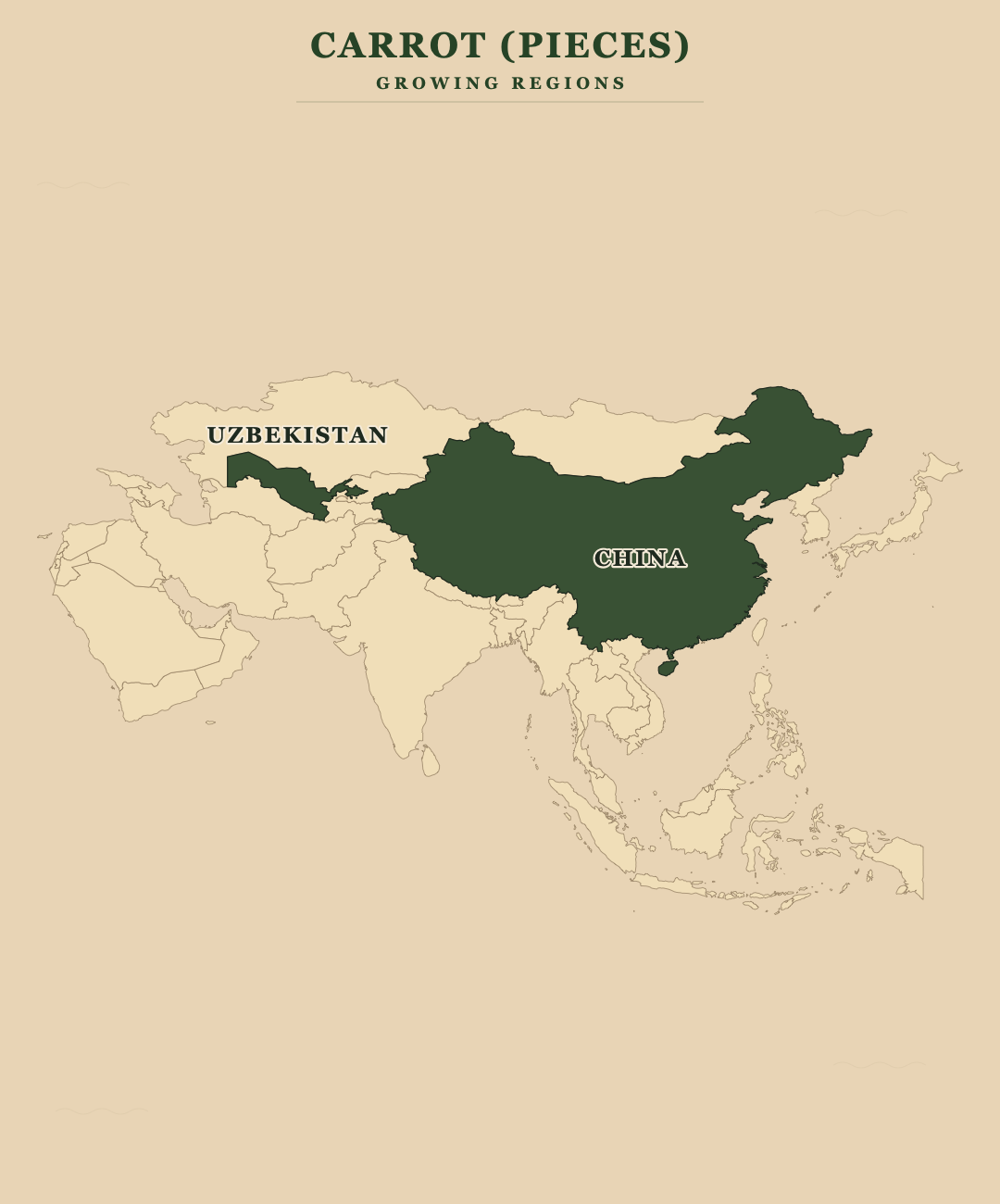
Carrot (pieces) is primarily cultivated in China, USA, Russia, Uzbekistan, with secondary growing regions in Netherlands, Poland, Australia.
Spice Story
Carrots have been cultivated for more than 2,000 years, with their origins in Central Asia. Wild carrots travelled westward to Asia Minor by the 10th–11th century, Spain by the 12th, and northwestern Europe by the 15th. [source] Initially they were grown for their aromatic leaves and seeds — the orange root we now associate with the word "carrot" only became standard during the 17th-century Dutch breeding work that selected for sweetness, size and colour together. Carrot seed and root oils have a long history in perfumery and confectionery: carrot fruit oil has been used to flavour liqueurs and as an ingredient in cosmetics for generations. [source] In gin, dried carrot is a less-conventional botanical that has begun to appear in farm-to-bottle craft expressions where the goal is genuine kitchen-garden character.
Gin Creativity
Carrot brings a quiet sweet-earthy depth — never the headline of a botanical bill, but a useful supporting layer that adds body and a gentle natural sweetness. A full sachet produces a clearly carrot-and-root character; a half-sachet adds a soft earthy background that pairs naturally with coriander seed and orange peel for a "root garden" gin. It works particularly well alongside ginger and cardamom for a chai-leaning blend, or with fennel and honey for a sweet-vegetable profile. Avoid combining with very bright florals — carrot's quiet character disappears.
Blending Science
Main flavour compounds
 Beta-Carotene—
 Pinenefresh pine, top note
 Limoneneclean citrus lift
 Carotol—
Pairs well with
Carrot's aroma is built from a complex mix of terpenes rather than a single dominant compound. Alpha-pinene layers a faint resinous note, limonene adds a soft citrus brightness, and carotol — a sesquiterpene alcohol distinctive to Daucus carota — contributes the deep, slightly woody-earthy character that gives carrot its grounded register. [source] Beta-carotene is the carotenoid pigment responsible for the orange colour; it is fat-soluble and contributes to colour transfer in warm alcoholic extraction but is not aromatic itself. The natural sugars in the dried root contribute soft body and slight sweetness on the finish. Warm extraction develops the sweet body and pulls more of the carotenoid colour into solution.
Food Partners
- Carrot cake spice mixes: Cinnamon, cardamom, ginger, carrot — sweet baking territory.
- Root vegetable soups: Especially carrot-and-ginger or carrot-and-orange — natural pairings.
- Roast root vegetable platters: Carrot-gin reduction over roast parsnip, beetroot, swede.
- Citrus-glazed roast meats: Duck à l'orange with a carrot-and-coriander gin glaze.
- Honey-spiced dressings: Carrot gin, honey, lemon, olive oil over winter salad.
Cocktails To Try

- Carrot Mule: Carrot-and-ginger gin, lime, ginger beer.
- Garden Bloody Mary: Carrot gin instead of vodka, with classic Bloody Mary spice.
- Root Vegetable Sour: Carrot-and-cardamom gin, honey, lemon, egg white.
Release The Flavour
- Warm extraction: Develops the sweet body and pulls colour into the spirit.
- Time: 24–48 hours for full development.
- Filter carefully: Carrot fragments may continue to leach colour after bottling.
- Pair with citrus: Carrot integrates better with citrus than with other root vegetables.
Discover more
From the same region
Pairs well with
Same flavour family

Surprise me

Sources & Citations
- scientific_name and family:en.wikipedia.org/wiki/Carrot
- native_range (Afghanistan, Iran):en.wikipedia.org/wiki/Daucus_carota
- original_colour (purple/red/yellow, not orange):en.wikipedia.org/wiki/Carrot
- westward_dispersal (Asia Minor 10-11th c., Spain 12th c., NW Europe 15th c.):en.wikipedia.org/wiki/Carrot
- terpenes_in_aroma (pinene, carotol, limonene):www.ncbi.nlm.nih.gov/pmc/articles/PMC7305226/
- carrot_seed_oil_in_perfumery_and_liqueurs:www.mdpi.com/2223-7747/13/1/93
- main_flavour_compounds (CSV-sourced):inputs/source.csv — Carrot row
