
COFFEE

- Botanical name
- Coffea arabica
- Also known as
- Arabica coffee, Bunna (Amharic — "coffee" in Ethiopia)
- Main flavour compound
- Caffeine
- Part used
- Roasted coffee bean (the seed of the coffee cherry)
- Method of cultivation
- Small evergreen tree or shrub of the Rubiaceae family, native to the forested highlands of south-western Ethiopia and adjoining parts of South Sudan and Yemen. *Coffea arabica* is the older and more aromatically complex of the two commercial species (the other, *C. canephora* "Robusta", is hardier and more caffeine-rich but coarser in flavour). Modern arabica cultivation centres on high-altitude tropical regions: Ethiopia, Brazil, Colombia, Vietnam, and across Central America and East Africa.
- Commercial preparation
- Coffee cherries are picked at full ripeness, the fleshy fruit removed by either dry (sun) or wet (washed) processing, the beans sun- or mechanically dried to safe moisture, and then roasted at temperatures of 200–250°C for several minutes. Roast level dramatically changes the flavour profile — light roasts emphasise origin character and fruit-acidity, dark roasts emphasise caramelised-bitter notes. For gin botanical use, medium-to-dark roast whole beans are most common.
- Non-culinary uses
- Beverage industry (the second-largest commodity by trade value after oil); cosmetics (caffeine extracts in eye creams); fertiliser (spent coffee grounds); the cherry pulp is increasingly used in *cascara* tea production.
The arabica coffee plant — Coffea arabica — is a small evergreen tree or large shrub of the Rubiaceae family, native to the forested highlands of south-western Ethiopia and adjoining parts of South Sudan and Yemen. The plant grows to about 5 metres in the wild but is typically pruned to chest height in cultivation for easier picking. It produces small white jasmine-scented flowers that mature over 6–9 months into the bright red "coffee cherries" — small drupes about 1.5 cm long, each containing two seeds (the coffee beans) embedded in sweet pulp. Arabica is genetically remarkable: it is the only commercial coffee that is naturally a polyploid hybrid — a fusion of two ancestral species (C. canephora and C. eugenioides) that occurred around 600,000 to one million years ago in Ethiopia. [source]
Whole roasted bean
The standard form — holds aroma for weeks if airtight; cracks releases the oils.
Coarse-ground
Faster extraction but harder to strain.
Region of cultivation
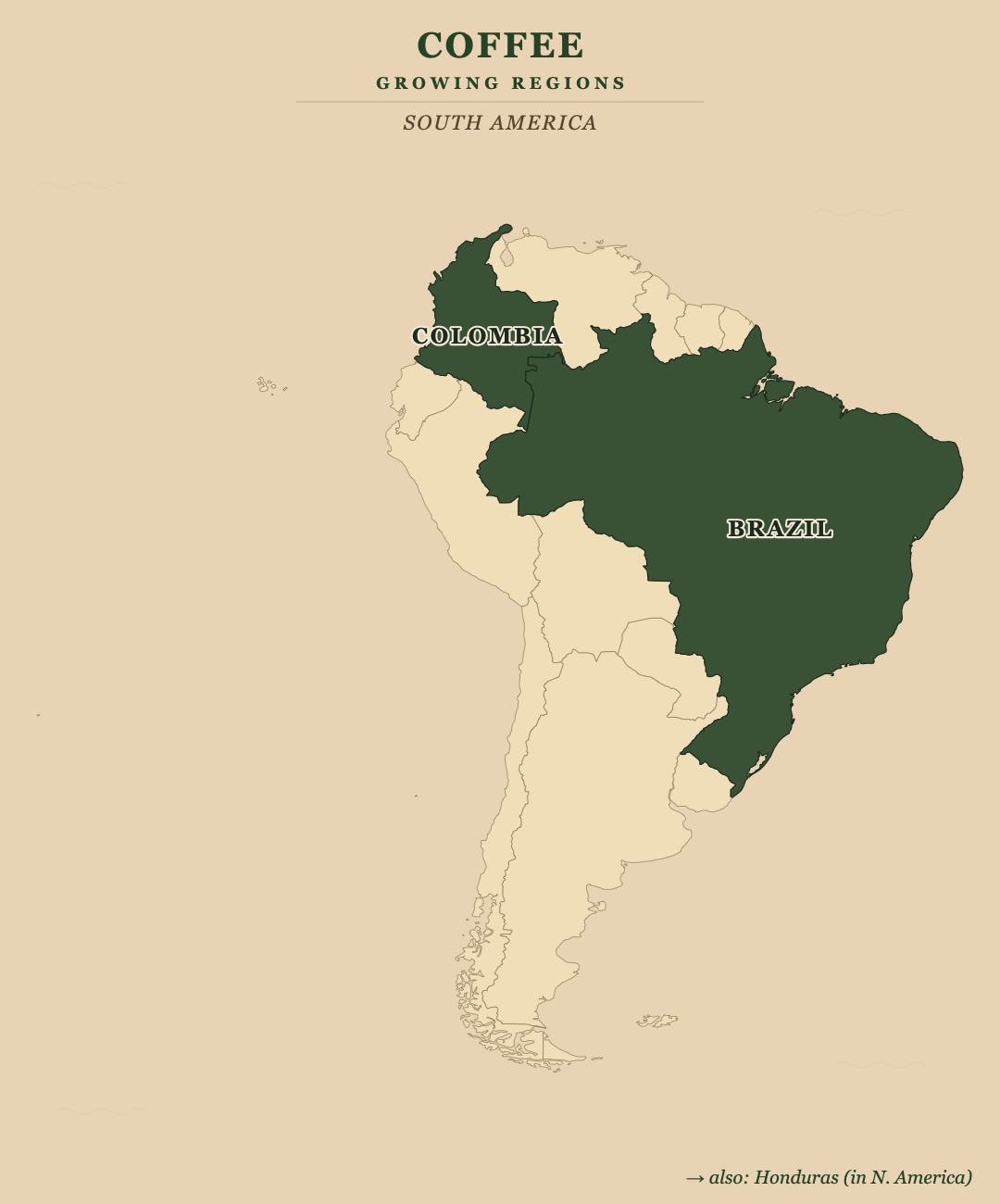
Coffee is primarily cultivated in Brazil (largest producer), Vietnam, Colombia, Ethiopia, Indonesia, with secondary growing regions in Central America (Honduras, Guatemala, Costa Rica), East Africa (Kenya, Rwanda, Uganda).
Spice Story
Coffee originated in Ethiopia, where it has been chewed and brewed for many centuries; Ethiopian folklore credits a goatherd named Kaldi with first noticing the energising effects of coffee cherries after his goats became unusually animated from eating them. The plant moved north into Yemen by the 15th century, where Sufi monks used the brewed beverage to stay awake for night-time prayer, and from Yemeni ports radiated outward into the Ottoman Empire and eventually to Europe by the 17th century. London's first coffeehouse opened in 1652. Ethiopia still holds the world's widest genetic diversity of arabica, with over 10,000 distinct wild types growing in the forests of Kaffa, Bench Maji and Illubabor. [source] In craft gin, coffee has become a foundational contemporary botanical — used in cold-brew gin liqueurs, espresso Martini gins, and as a roast-bitter complement to juniper in modern London Drys.
Gin Creativity
Coffee brings deep roasted-bitter character with chocolate and fruit-acid complexity. A full sachet pushes a gin firmly into espresso territory — suitable for dessert-style cocktails and after-dinner drinks. A quarter to half sachet adds quiet roasted depth that pairs beautifully with cacao nibs for a "Coffee and Cocoa" gin, or with cardamom and orange peel for Middle Eastern-style spiced coffee character. Avoid combining with very bright florals — coffee's bitter depth buries them. Roast level matters: light roasts taste fruit-acid-bright, dark roasts taste caramel-bitter — choose the roast to match your gin.
Blending Science
Main flavour compounds
 Caffeine—
 Chlorogenic acids—
 Furanonescaramel, sweet
 Pyrazinesroasted, nutty
Pairs well with
Coffee's character is built from a vast and complex chemistry — over 800 aromatic compounds have been identified, more than in any other commercial food product. Caffeine is the most famous compound but contributes bitterness rather than aroma; coffee with caffeine removed still smells and tastes coffee-like. Chlorogenic acids (a family of polyphenols) contribute the bright fruit-acid notes characteristic of high-quality arabica. Furanones develop during roasting via Maillard reactions and contribute the caramel-sweet body. Pyrazines (especially 2-furfurylmercaptan) develop during darker roasts and contribute the "roasty" depth. The lighter the roast, the more chlorogenic acid; the darker the roast, the more pyrazines. Both vapour and warm maceration work; cold-brew style cool maceration produces the cleanest, most acid-bright extraction.
Food Partners
- Espresso desserts: Tiramisu, affogato, coffee crème brûlée — coffee-gin as a finishing pour.
- Dark chocolate: Coffee and cocoa are textbook pairing.
- Slow-braised beef and game: Coffee-rubbed brisket, coffee-marinated venison.
- Coffee-rubbed steaks: Coarse-ground espresso in a dry rub for grilled beef.
- Coffee-spiced cocktails: Modern category — coffee gin in spiced cocktails, especially Negronis.
Cocktails To Try

- Espresso Martini: Coffee-gin in place of vodka, fresh espresso, coffee liqueur, sugar.
- Coffee Negroni: Coffee-gin, Campari, sweet vermouth.
- Cold Brew Old Fashioned: Coffee-gin, demerara, orange bitters.
Release The Flavour
- Cool extraction: Cold-brew-style extraction produces the cleanest, fruitiest character.
- Brief contact: 4–24 hours; longer extractions emphasise bitterness.
- Filter carefully: Coffee oils cloud the spirit; cold filtration helps.
- Match roast to use: Light roasts for bright, fruit-forward gin; dark roasts for dessert and after-dinner styles.
Discover more
From the same region

Pairs well with
Same flavour family
Surprise me

Sources & Citations
- scientific_name (Coffea arabica, Rubiaceae):en.wikipedia.org/wiki/Coffea_arabica
- Ethiopian_origin (south-west forests; 10,000+ wild types):www.ethiocoffee.co/insights/ethiopia-coffee-origin-birthp...
- hybrid_origin (Coffea canephora x C. eugenioides, ~600k years ago):www.sci.news/genetics/coffea-arabica-reference-genome-128...
- cultivation_altitude (1200-2200m, 15-24C):en.wikipedia.org/wiki/Coffea_arabica
- arabica_60_percent_global_production:en.wikipedia.org/wiki/Coffea_arabica
- main_flavour_compounds (CSV-sourced):inputs/source.csv — Coffee row
