
CORIANDER SEED


- Botanical name
- Coriandrum sativum
- Also known as
- Cilantro seed (American English), Dhania (Hindi), Kishneesh (Russian)
- Main flavour compound
- Linalool
- Part used
- Dried fruit (technically two fused mericarps; commonly called the seed)
- Method of cultivation
- Annual herb of the Apiaceae family (the same family as carrot, parsley, fennel, dill), 30–100 cm tall, bright-green, with pale mauve or white umbels of small flowers maturing into globular, beaked, finely ribbed yellow-brown seeds about 5 mm in diameter. Cultivated worldwide; the leaves are sold fresh as cilantro/coriander herb and the seeds are dried separately as a spice.
- Commercial preparation
- Plants are harvested when most of the seed heads are mature but not yet shedding. Heads are dried, threshed, cleaned of stalks and chaff, and graded by size and oil content. The Netherlands, India, Russia, Egypt, Morocco and Eastern Europe are all major producers.
- Non-culinary uses
- Perfumery (linalool is a major fragrance compound; coriander seed essential oil is widely used in soaps and colognes); traditional medicine across Mediterranean, Indian and Middle Eastern systems for digestion; pickling spice in Eastern European and Middle Eastern traditions.
Coriander seed comes from Coriandrum sativum, an annual herb of the Apiaceae family — the same family as carrot, parsley, fennel and dill. The plant grows knee to waist height, with bright-green feathery leaves at the base (these are the fresh herb, sold as cilantro or coriander leaf) and a flowering stem topped with delicate umbels of small white or pale mauve flowers in summer. The flowers mature over a few weeks into the globular yellow-brown seeds — technically two fused mericarps — that we use as the dried spice. The seed has a completely different aromatic character from the fresh leaf: warmer, sweeter, citrus-floral rather than the bright soapy-green of cilantro.
Whole dried seed
The standard form — bruise lightly to release the volatile linalool before use.
Ground
Convenient but loses character within 3–6 months.
Region of cultivation
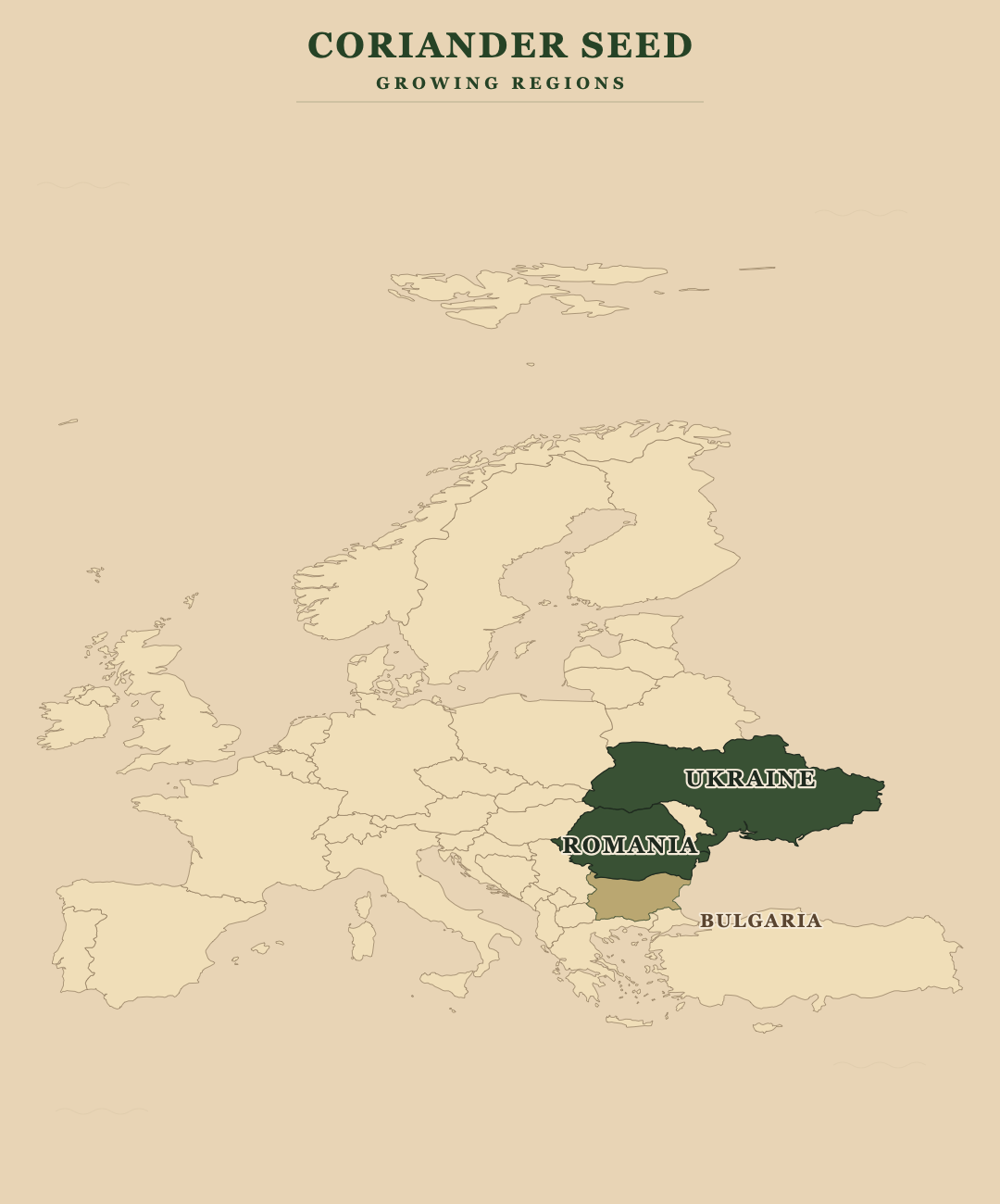
Coriander Seed is primarily cultivated in Russia, India, Morocco, Romania, Egypt, with secondary growing regions in USA, Australia, Bulgaria, Iran.
Spice Story
Coriander seed has been cultivated for at least 5,000 years — seeds have been found in ancient Egyptian tombs (including King Tutankhamun's), and the plant appears in early Egyptian and Mesopotamian texts as both a culinary and a medicinal herb. [source] It is one of the most globally widespread spices, used across Mediterranean, Middle Eastern, Indian, Mexican and South-East Asian cuisines, and in pickling traditions from Russia to Morocco. In gin, coriander seed is the second most important botanical after juniper — present in almost every classical and contemporary gin recipe in the world. The two botanicals share key aromatic compounds (linalool especially), which is why they integrate so completely. A gin without coriander seed often tastes "thin," even when other botanicals are abundant — coriander provides the structural floral-citrus body that allows juniper to shine. [source]
Gin Creativity
Coriander seed is foundational to almost every gin you'll ever make. A full sachet is the standard inclusion for any classic London Dry style; a half-sachet allows other botanicals to take more space. It pairs with literally everything — citrus peel, angelica, juniper, cardamom, bay, ginger — and is the universal "balancer" that pulls disparate botanicals together. Avoid pairing it with very heavy aniseed or anise botanicals — the result can read muddled rather than additive.
Blending Science
Main flavour compounds
 Linaloolfloral, soft
 Geranyl acetaterose-citrus, soft
 Camphor—
 Limoneneclean citrus lift
Pairs well with
- Juniper
- Angelica root
- Citrus peel
- Cardamom
- Bay leaf
The chemistry of coriander seed is dominated by terpenes. Linalool is the dominant compound — typically 60–80% of the essential oil — and it carries the soft floral-woody character that defines coriander seed and provides the foundational structure of nearly every gin. [source] Geranyl acetate layers a sweet floral-rose note that gives coriander its distinctive lift. Camphor contributes a faint cool depth. Limonene adds a citrus brightness that bridges coriander to citrus peels. Linalool is the same compound that defines lavender, bergamot and basil — which is why coriander seed integrates so beautifully across botanical bills. Heat-stable, alcohol-soluble; vapour and warm maceration both work cleanly.
Food Partners
- Curry pastes and dry rubs: Foundational across Indian, Thai and Mexican cooking.
- Middle Eastern lamb and chicken: Coriander seed is essential to za'atar, baharat and shawarma rubs.
- Pickled vegetables: Polish, German and Eastern European pickling spice.
- Citrus marmalades: Coriander and orange peel are exceptional partners.
- Spice-bread bakings: Scandinavian and German rye-bread tradition.
Cocktails To Try

- Classic Gin & Tonic: Coriander-rich London Dry with a fresh lime garnish.
- White Negroni: Coriander-and-bergamot gin, Suze, Lillet Blanc.
- Coriander Sour: Coriander-heavy gin, lemon, sugar, egg white.
Release The Flavour
- Bruise lightly: Crack the seeds in a mortar to expose the linalool.
- Heat-friendly: Both vapour and warm maceration extract cleanly.
- Time: 24–48 hours for full development.
- Pair generously: Coriander seed is the universal botanical companion — use it across blends.
Discover more
From the same region
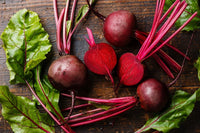

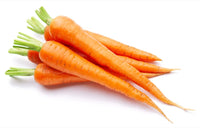
Pairs well with
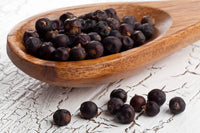
Same flavour family
Surprise me

Sources & Citations
- scientific_name and family (Coriandrum sativum, Apiaceae):en.wikipedia.org/wiki/Coriander
- Egyptian_cultivation_history:www.superfoodevolution.com/coriander-seeds.html
- linalool_as_main_aroma_compound:www.sciencedirect.com/topics/agricultural-and-biological-...
- second_most_important_gin_botanical (after juniper):www.cabi.org/ISC/datasheet/15300
- main_flavour_compounds (CSV-sourced):inputs/source.csv — Coriander Seed row
