
BEETROOT (POWDER)

- Botanical name
- Beta vulgaris
- Also known as
- Beet, Red beet, Garden beet
- Main flavour compound
- Geosmin
- Part used
- Dried and ground root (taproot)
- Method of cultivation
- Cultivated biennial of the Amaranthaceae family, grown worldwide as a vegetable crop. For the powdered ingredient trade, the roots are harvested at full maturity (high sugar and pigment content), washed and trimmed before further processing.
- Commercial preparation
- Roots are sliced, blanched briefly to inactivate degradative enzymes, then either freeze-dried or low-temperature dehydrated and milled to a fine powder. Sun-drying is rare because the betalain pigments are heat-sensitive and oxidise quickly. Quality is graded on colour intensity and absence of fermented off-notes.
- Non-culinary uses
- Natural food colourant (betalain pigment, often labelled E162 in foods); cosmetic colourant; folk medicine for circulation and digestion across Eastern Europe and the Mediterranean.
Beetroot is the taproot of Beta vulgaris, a biennial vegetable of the Amaranthaceae family. The plant grows as a low cluster of dark green leaves above ground and stores its energy below ground as a swollen, ruby-red root that can reach the size of a tennis ball. The same species — Beta vulgaris — gives us not only beetroot but also Swiss chard, mangold and sugar beet, distinguished only by which part of the plant has been bred for emphasis. In the wild it grew along Mediterranean and Atlantic coastlines; in cultivation it now appears almost everywhere with a temperate climate.
Fine powder
The standard form — disperses quickly in a botanical bill or sachet.
Dried chips
Less common but available; slower-extracting, useful for visible-fruit infusions.
Region of cultivation
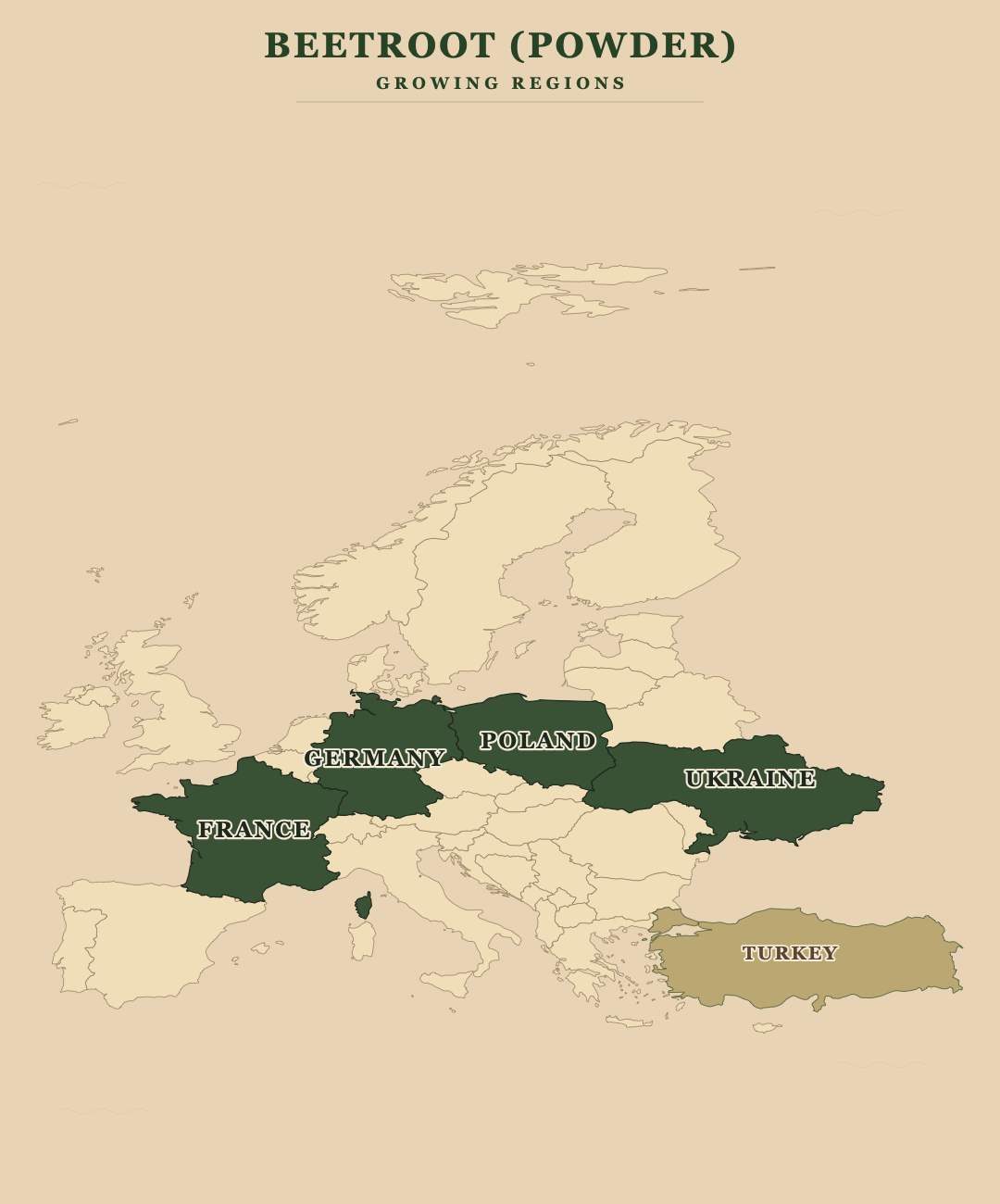
Beetroot (powder) is primarily cultivated in Russia, USA, Germany, France, Poland, with secondary growing regions in Egypt, Turkey, Australia.
Spice Story
Beetroot has been eaten since the ancient world — Greeks and Romans used it as both food and medicine, the leaves more prominent in early use than the roots. The deep-red root variety that dominates modern cooking was selected for in Northern and Eastern Europe through the 16th–18th centuries, becoming foundational to the cuisines of Russia (borscht), Ukraine, Poland and Scandinavia. In the 19th century, scientific cultivation produced the sugar-beet variety that now supplies around 20% of the world's sugar. As a craft-gin botanical, beetroot is unusual — it's not a classical inclusion, but the powdered form has emerged in contemporary gin (especially in Eastern European and Scandinavian distilleries) as a natural way to add both an earthy-sweet flavour note and the gentle pink hue that comes from betalain pigment in cold maceration.
Gin Creativity
Beetroot brings two things to a gin: an earthy-sweet flavour layer and a soft pink-to-red colour. A full sachet produces a clearly tinted gin (especially in a cold cold-maceration), with noticeable earthy-mineral depth on the palate. A half-sachet provides flavour without much colour change — useful if you want the earth note but not the visual signal. It pairs particularly well with horseradish, caraway and dill for a "Nordic gin" profile, or with citrus and juniper for a contemporary balance. Avoid heat extraction — betalain pigments lose colour rapidly.
Blending Science
Main flavour compounds
 Geosmin—
 Betalain pigments (betanin, isobetanin)—
 Sugars (sucrose-rich)—
Pairs well with
- Horseradish
- Caraway
- Juniper
- Dill
- Citrus peel
The earthy character comes mainly from geosmin — the same compound responsible for the smell of freshly turned soil and the after-rain smell that humans can detect at parts-per-trillion concentrations. Geosmin is alcohol-soluble but heat-sensitive, which is why a cold-extracted beetroot gin tastes "earthier" than a hot one. Betalain pigments (primarily betanin) give the deep red-violet colour but are not aromatic themselves; they are extremely sensitive to heat, light, and alkaline pH, which is why a beetroot-coloured gin can fade in a sunny bottle. [source] Residual sucrose and other sugars contribute a soft natural sweetness that doesn't require added sweetening.
Food Partners
- Smoked fish: The classic Scandinavian pairing — beetroot, dill, smoked salmon.
- Goat's cheese: Fresh chèvre and roast beetroot — sweet, earthy, sharp.
- Roast game: Venison, hare and beetroot share an iron-rich earthiness.
- Borscht and earthy soups: The foundational Eastern European use.
- Walnut and apple salads: Beetroot adds depth to autumnal greens.
Cocktails To Try

- Pink Negroni: Beetroot-infused gin with Lillet Rosé and a dash of Campari.
- Beetroot Bloody Mary: A "Red Snapper" rebuilt around beet juice instead of tomato.
- Beet-and-honey Sour: Beetroot-gin, honey syrup, lemon, egg white — the colour is part of the appeal.
Release The Flavour
- Cold only: Betalain pigments and geosmin both prefer cool extraction.
- Brief contact: 30–60 minutes is usually enough; longer extractions go muddy.
- Strain through fine mesh: Beet particles will continue to leach colour in storage if left in suspension.
- Bottle in dark glass: Light fades the colour over weeks; store cool and dark.
Discover more
From the same region

Pairs well with
Same flavour family
Surprise me

Sources & Citations
- scientific_name (Beta vulgaris):www.intechopen.com/chapters/83567
- betalain pigments (betanin = up to 90% of red colour):pmc.ncbi.nlm.nih.gov/articles/PMC9138100/
- pigment_stability (light/heat/oxygen sensitivity):pmc.ncbi.nlm.nih.gov/articles/PMC9138100/
- extraction methods (Soxhlet vs ultrasonic):pmc.ncbi.nlm.nih.gov/articles/PMC12006923/
- commercial_use_as_colourant:aiherba.com/what-is-beetroot-powder-production-uses-indus...
- main_flavour_compounds (CSV-sourced):inputs/source.csv — Beetroot row
