
DILL

- Botanical name
- Anethum graveolens
- Also known as
- Dillweed (the herb), Dill seed (the fruit), Indian dill (var. sowa)
- Main flavour compound
- Carvone (R-(-)-carvone)
- Part used
- Dried leaf (frond) and/or dried seed; the leaf is more common in gin botanical use
- Method of cultivation
- Annual herb of the Apiaceae family (the same family as carrot, parsley, coriander, fennel) with origins probably in the Mediterranean and East Asian regions. Plants grow about 60–90 cm tall, with finely-divided feathery leaves and umbels of small yellow flowers that mature into ridged "seeds" (technically dried fruits) similar to caraway in appearance.
- Commercial preparation
- Fresh dill is harvested at peak leaf and freeze-dried or low-temperature dehydrated to preserve the volatile aromatic compounds. Dill seed is harvested when ripe but before shedding, threshed and cleaned. Scandinavian seed firms produce specialised herb-production cultivars including Dukat, Superdukat, Mammut and Pikant.
- Non-culinary uses
- Traditional medicine for digestion across many European, Middle Eastern and Indian systems (the word "dill" derives from Old Norse *dilla* meaning "to lull" — historically used to settle babies); essential oil in soap manufacture and perfumery; foundational pickling spice.
Dill — Anethum graveolens — is a tall, slender annual herb of the Apiaceae family, growing knee to waist high with bright green, finely-divided feathery leaves and umbels of small yellow flowers. The plant is native somewhere between the Mediterranean and Western Asia (the precise origin is contested), and has been cultivated for at least 3,000 years across Europe, the Middle East and India. Two main forms are distinguished commercially: European dill (the type used in Scandinavian pickling and Western cooking) and Indian dill (Anethum graveolens var. sowa), which has a slightly different chemistry — less carvone and more dillapiole, producing a sharper aromatic. [source]
Freeze-dried leaf (fronds)
The standard form for gin distilling — bright green, intensely aromatic.
Whole dried seed
Slower extraction, deeper aromatic — useful in long maceration.
Region of cultivation
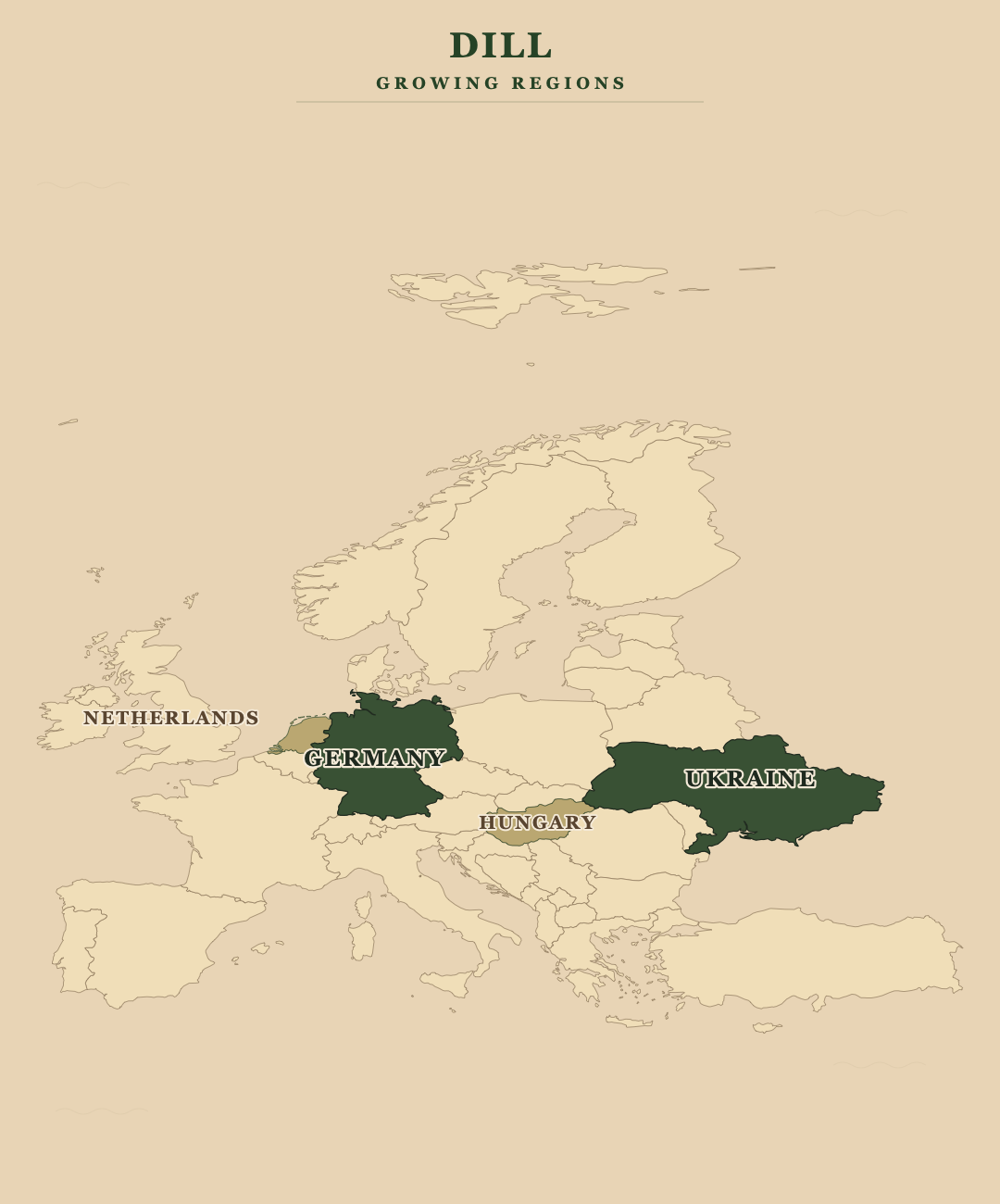
Dill is primarily cultivated in Germany, Russia, India (Anethum graveolens var. sowa), with secondary growing regions in Netherlands, USA, Canada, Hungary.
Spice Story
Dill has been used as both a culinary herb and a medicinal plant across continuous European, Middle Eastern and Indian history for thousands of years. Archaeological evidence places it in Egyptian tombs (it was used in mummification and as an aromatic offering); the Romans cultivated it widely and introduced it across their empire. [source] The English name derives from Old Norse dilla, "to lull" or "soothe" — reflecting the traditional Scandinavian use of dill water to settle infants. Today dill is foundational to Scandinavian, Eastern European and Russian cooking — pickles, gravlax cures, herring sauces, cold soups, potato salads — and has been embedded in those cuisines for centuries. In gin, dill is a defining contemporary botanical for Scandinavian-style craft expressions, where it pairs with caraway and juniper for a clearly Nordic profile.
Gin Creativity
Dill brings a bright, fresh, anise-citrus character that pushes a gin firmly into garden-and-pickled-vegetable territory. A full sachet produces a clearly dill-forward gin perfect for Bloody Mary-style drinks and food pairing; a half-sachet provides a quietly herbaceous lift that integrates with juniper and citrus peel. It pairs particularly well with caraway and cucumber for a Scandinavian profile, or with chives and lemon balm for a "kitchen garden" gin. Avoid combining with very heavy warming spices — dill's brightness is easily buried.
Blending Science
Main flavour compounds
 Carvone (R-(-)-carvone)caraway, minty
 Limoneneclean citrus lift
 Alpha-Phellandrenecitrus-mint, peppery
 Dillapiole (in seed)parsley, musky-green
Pairs well with
- Cucumber
- Caraway
- Lemon balm
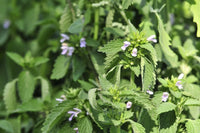
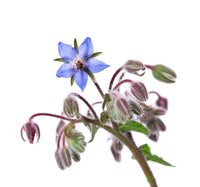
- Borage
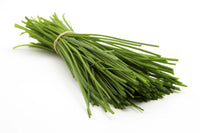
- Chives
The dominant compound is R-(-)-carvone — the mirror image (enantiomer) of the S-(+)-carvone that defines caraway. Despite identical chemical structure, the two enantiomers smell completely different: caraway's S-form reads warm-anise-rye, while dill's R-form reads cool-sweet-grassy. This is one of the most-cited examples of how molecular chirality changes perceived flavour. Limonene layers a citrus brightness underneath. Alpha-phellandrene adds a green-herbaceous depth. Dillapiole is more prominent in Indian dill (var. sowa) than in European dill, contributing a sharper, slightly anise-bitter top. [source] Cool extraction preserves the bright top notes; warm extraction develops the deeper body.
Food Partners
- Pickled vegetables: Dill pickles, pickled cucumber, pickled beetroot, sauerkraut.
- Smoked salmon and gravlax: The defining Scandinavian pairing.
- Yoghurt and cucumber dips: Tzatziki, raita, Bulgarian tarator — all benefit from dill.
- Fresh peas and broad beans: Spring vegetables with dill butter.
- Egg-and-mayonnaise dishes: Egg salad, deviled eggs, Hollandaise variations.
Cocktails To Try

- Scandinavian Martini: Dill-and-caraway gin, dry vermouth, lemon twist.
- Pickle Bloody Mary: Dill-gin, tomato, lemon, pickle brine — savoury and bright.
- Garden Gimlet: Dill-gin, cucumber juice, lime, sugar.
Release The Flavour
- Cool extraction: Preserves the bright fresh-herb character.
- Brief contact: 1–4 hours captures the brightness.
- Whole leaf or seed: Holds character better than crushed/ground.
- Storage: Freeze-dried dill leaf holds for 12+ months; air-dried fades faster.
Discover more
From the same region
Pairs well with
Same flavour family
Surprise me

Sources & Citations
- scientific_name and family:hort.extension.wisc.edu/articles/dill-anethum-graveolens/
- Mediterranean_ancient_cultivation_egyptian_tombs:uses.plantnet-project.org/en/Anethum_graveolens_(PROSEA)
- Indian_var_sowa_dillapiole_difference:uses.plantnet-project.org/en/Anethum_graveolens_(PROSEA)
- Roman_introduction_to_Europe:uses.plantnet-project.org/en/Anethum_graveolens_(PROSEA)
- main_flavour_compounds (CSV-sourced):inputs/source.csv — Dill row
