
CHIVES

- Botanical name
- Allium schoenoprasum
- Also known as
- Garden chives, Wild chives
- Main flavour compound
- Allyl sulphide compounds
- Part used
- Dried green stem (the hollow leaf-stem)
- Method of cultivation
- Hardy perennial herb of the Amaryllidaceae family (formerly Liliaceae) — the same family as onion, garlic, and leek. Native to both Europe and Asia, and the only *Allium* species native to both the Old World and the New World. Cultivated in Europe since the Middle Ages and in China for at least 4,000 years. Grows as a clump-forming perennial with hollow green tubular leaves and purple edible globe-shaped flowers.
- Commercial preparation
- Fresh chives are picked at peak season, washed and snipped to short lengths, then either freeze-dried or low-temperature dehydrated. Freeze-drying preserves the bright green colour and most of the volatile sulphur compounds; high-heat drying produces a duller, more vegetable-broth-style flavour.
- Non-culinary uses
- Companion planting (chives repel many garden pests with their sulphur compounds); traditional folk medicine across Europe and Asia for digestive complaints; the purple flowers are edible and ornamental.
Chives — Allium schoenoprasum — is a small clump-forming perennial herb of the onion family (Amaryllidaceae), distinguished from its more pungent relatives by its mildness. The plant grows as a tuft of hollow green tubular leaves about 30 cm tall, topped in summer with edible round purple flower-heads. Botanically remarkable in one specific way: chives is the only species of Allium (the onion genus) that is native to both the Old World and the New World. [source] The Chinese have cultivated chives for at least 4,000 years; medieval European gardens have grown it continuously since at least the 1100s.
Freeze-dried short cuts
The standard form — rehydrates quickly in cool extraction.
Dehydrated rings
Slower extraction but holds character longer in storage.
Region of cultivation
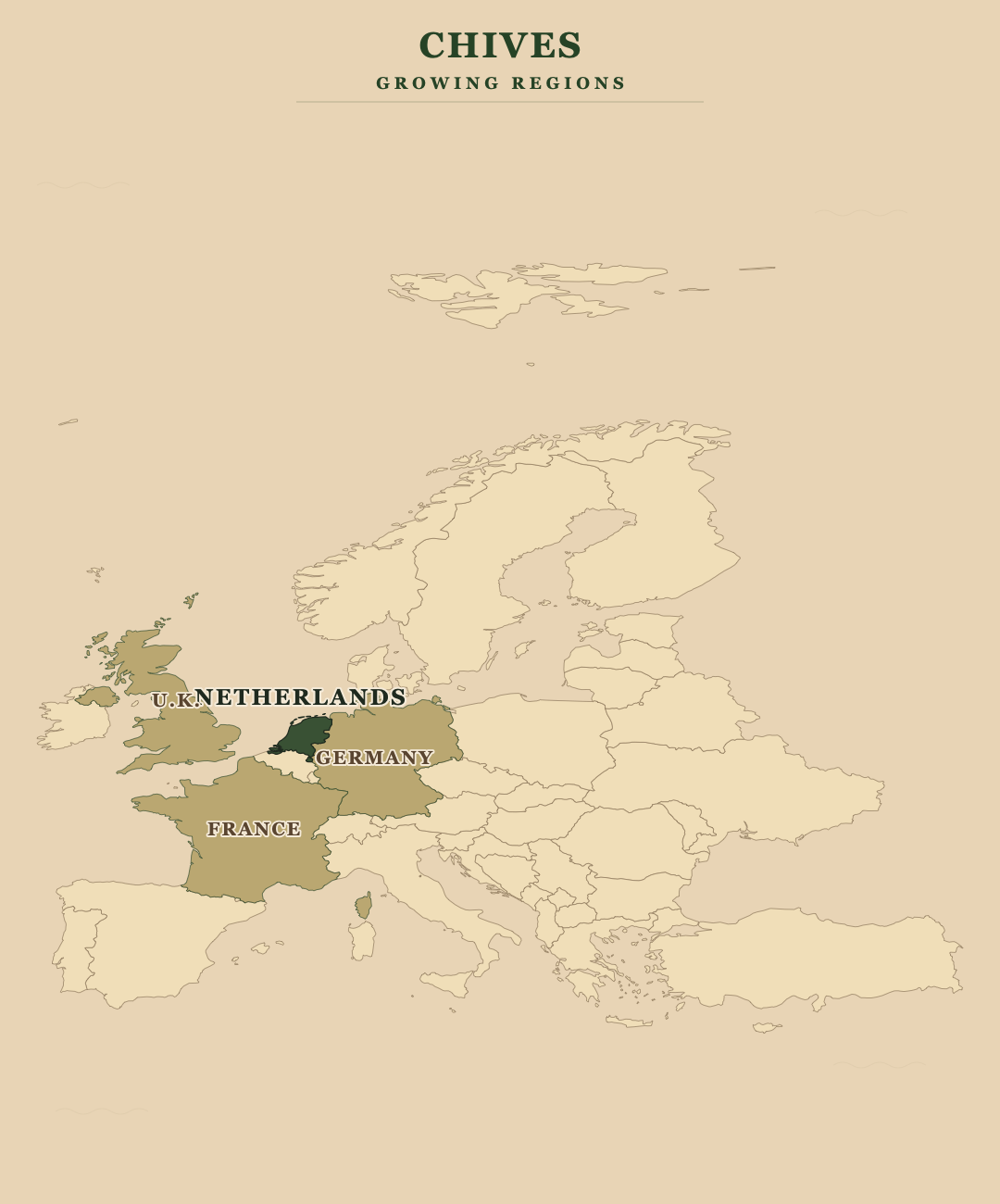
Chives is primarily cultivated in Worldwide cultivation; commercial production in the Netherlands, USA, China, with secondary growing regions in UK, Germany, France.
Spice Story
Chives is one of the everyday culinary herbs of temperate world cuisine — the alpine, Northern European and Mediterranean ranges all have native wild chive populations, and humans have been gathering or growing them for at least four millennia. The 4,000-year cultivation tradition in China makes chives one of the oldest continuously grown culinary herbs anywhere. In Europe chives entered the cottage garden in the medieval period and never left. Its modern role in cooking is foundational but quiet — chopped into sour cream, sprinkled over potatoes, stirred into eggs — a herb that signals "fresh" without taking over. In craft gin, dried chives is an unusual but growing contemporary botanical, particularly in Scandinavian and farm-to-bottle craft expressions where the goal is genuine kitchen-garden character. Used carefully, it bridges juniper and the more vegetal botanicals like cucumber and dill.
Gin Creativity
Chives is a quiet supporting botanical — never the headline, but capable of adding a fresh green-onion lift to a botanical bill. A full sachet pushes a gin into clearly onion-vegetal territory and pairs naturally with dill and cucumber for a Scandinavian-style gin; a quarter to half sachet adds a soft savoury background that integrates with juniper. It works particularly well alongside lemon balm and borage for a "garden gin" profile. Avoid pairing with very heavy spices — the sulphur compounds in chives are easily overwhelmed.
Blending Science
Main flavour compounds
 Allyl sulphide compounds—
 Methyl sulphide compounds—
 Hexanal—
Pairs well with
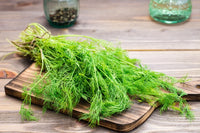
- Dill
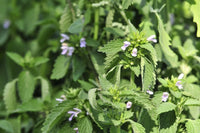
- Lemon balm
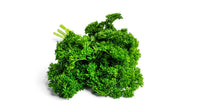
- Parsley
- Cucumber
- Borage
Chives' character comes from the same family of organosulphur compounds responsible for the flavour of all alliums, but at much lower concentrations than onion or garlic. Allyl sulphides and methyl sulphides contribute the characteristic mild-onion note; these compounds are formed enzymatically when the cells of the plant are broken (chopped or chewed), which is why a fresh chive on the tongue is more pungent than an intact one. [source] Hexanal ("leaf aldehyde") adds the green-grass top note that prevents chives from reading as merely "onion". The sulphur compounds are volatile and water-soluble; cool extraction in alcohol preserves the brightness, while long warm extractions develop a more cooked-onion register.
Food Partners
- Sour cream and chive dressings: The defining pairing — try chive-gin in the dressing.
- Cold cucumber soups: Especially in Mediterranean and Scandinavian summer dishes.
- Boiled potatoes with butter: A traditional Eastern European use — chives transform plain potatoes.
- Smoked salmon and cream cheese: Bagels, blinis, cold canapés.
- Light egg dishes: Omelettes, scrambled eggs, soufflés.
Cocktails To Try

- Garden Gin Spritz: Chive-infused gin, tonic, fresh chive flower garnish.
- Cucumber and Chive Gimlet: Chive-gin, cucumber juice, lime, sugar.
- Bloody Mary variant: Chive-gin instead of vodka, with savoury Bloody Mary spice.
Release The Flavour
- Cool extraction: Preserves the bright sulphur top notes; warm extraction makes chives taste cooked.
- Brief contact: 30 minutes to 4 hours is enough.
- Strain carefully: Chive fragments will continue to leach sulphur compounds.
- Storage: Freeze-dried chives hold character for 12+ months; air-dried for less.
Discover more
From the same region
Pairs well with
Same flavour family
Surprise me

Sources & Citations
- scientific_name and family:www.gardenia.net/plant/allium-schoenoprasum-chives
- cultivation_history (4000 years in China, Middle Ages in Europe):www.gardenia.net/plant/allium-schoenoprasum-chives
- only_allium_native_to_both_old_and_new_worlds:www.gardenia.net/plant/allium-schoenoprasum-chives
- sulphur_compounds_pest_repellence:www.gardenia.net/plant/allium-schoenoprasum-chives
- main_flavour_compounds (CSV-sourced):inputs/source.csv — Chives row
