
CAPSICUM/BELL PEPPER (GREEN)

- Botanical name
- Capsicum annuum (Grossum Group)
- Also known as
- Green pepper, Sweet pepper, Capsicum, Paprika (in some European usage)
- Main flavour compound
- 2-Methoxy-3-isobutylpyrazine (the "bell pepper pyrazine")
- Part used
- Dried unripe fruit (flesh, seeds and white pith removed)
- Method of cultivation
- Cultivated annual of the Solanaceae family, native to Mexico, Central America and northern South America. Grown worldwide in warm climates; the same species *Capsicum annuum* produces fresh green peppers (harvested unripe), red peppers (harvested at full ripeness), and most table chillies. The Grossum Group covers all the large-fruited mild bell pepper cultivars. A recessive gene in this group suppresses capsaicin production, which is what makes bells sweet rather than spicy.
- Commercial preparation
- Unripe green fruits are picked while firm and glossy, cored, seeded, and either dehydrated or freeze-dried. Quality producers blanch briefly before drying to inactivate enzymes that would otherwise produce off-flavours. Air- or low-temperature drying preserves the bright green colour; high-heat drying turns the dried flesh dull and slightly bitter.
- Non-culinary uses
- Largely culinary; the seeds and flesh contain antioxidant carotenoids and capsanthin pigments used as natural food colourants and in some skincare formulations.
The bell pepper is the mild, large-fruited cultivar group of Capsicum annuum — the same species that produces poblanos, jalapeños, paprika and cayenne. What distinguishes bells is a single recessive gene that suppresses capsaicin production, so the fruit grows large, sweet and heatless. [source] The plant is a low bushy annual rarely more than half a metre tall, with broad green leaves and pendulous fruit that ripens through a colour sequence — green to yellow to red — depending on cultivar and how long the fruit stays on the plant. Green bell peppers are the unripe form: harvested while still firm and bright, with a distinctive green-grass flavour very different from the sweeter, fruitier red ripe form.
Dried flakes
The standard form — easy to portion, fast-extracting in cool maceration.
Powdered
Concentrated but prone to clouding the spirit.
Region of cultivation
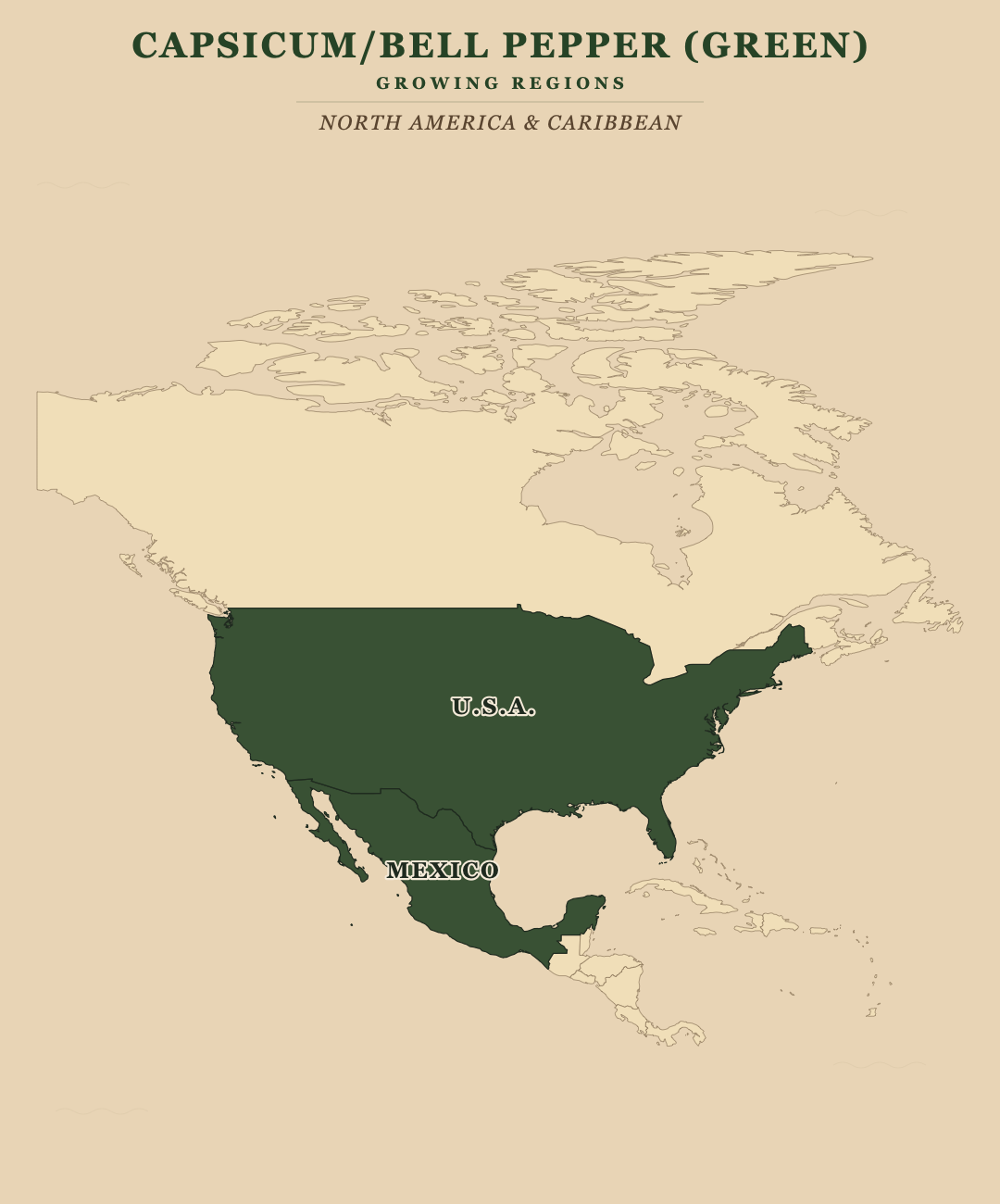
Capsicum/Bell Pepper (Green) is primarily cultivated in China (largest producer), Mexico, Turkey, USA, with secondary growing regions in Spain, Netherlands, Australia.
Spice Story
The bell pepper's lineage traces to Capsicum annuum wild ancestors that were being consumed in the Oaxaca Valley of Mexico more than 8,000 years ago. [source] Domesticated forms were widely cultivated by the Aztecs and the broader Mesoamerican world before Spanish contact; Columbus brought peppers back to Spain in 1493, from where they radiated quickly through the Mediterranean and along the Silk Road into Asia. [source] Hungarian, Bulgarian, Turkish and Chinese cuisines all rebuilt around the new arrival within a single generation. The sweet, heatless bell cultivar was selected in Europe during the 17th–19th centuries and is now grown almost everywhere — China produces the largest volume worldwide. Bell pepper has become a contemporary craft-gin botanical thanks to one of the most distinctive flavour compounds in all of food chemistry: a single pyrazine molecule detectable at parts-per-trillion concentrations.
Gin Creativity
Green bell pepper is one of the most powerful "vegetal" aromatics available to a distiller — a tiny amount is identifiable, a moderate amount is dominant. A quarter to half sachet is enough to push a gin into clearly garden-vegetal territory. A full sachet produces an explicitly "tomato-and-pepper" character that pairs naturally with basil and lemon for a Mediterranean garden gin, or with cucumber and dill for a Scandinavian fresh-vegetable profile. Avoid combining with very heavy spice — green pepper's brightness disappears under warming compounds.
Blending Science
Main flavour compounds
 2-Methoxy-3-isobutylpyrazine (the "bell pepper pyrazine")roasted, nutty
 Hexenol—
 Linaloolfloral, soft
Pairs well with
The defining compound is 2-methoxy-3-isobutylpyrazine — often just called "bell pepper pyrazine" because it is the dominant identifier of green bell pepper, and one of the most powerful aroma compounds known. The human nose detects it at concentrations below 2 parts per trillion, which is why a small amount in a blend is unmistakable. [source] Hexenol (cis-3-hexenol, "leaf alcohol") adds a green-grass note underneath. Linalool contributes a soft floral lift that prevents the pyrazine from reading purely vegetal. All three compounds are highly volatile and heat-sensitive — green pepper performs much better in cold, brief extraction than in warm maceration or vapour infusion.
Food Partners
- Fresh tomato sauces: Pepper and tomato are inseparable — try a green-pepper gin Bloody Mary.
- Cucumber and feta salads: Greek- and Turkish-style summer dishes where green pepper does most of the aromatic work.
- Grilled white fish: Green-pepper aromatics on grilled fish add a Mediterranean lift.
- Lentil and bean dishes: A foundational Mexican use — green pepper in beans is the classic sofrito.
- Cool gazpacho-style soups: Spanish chilled vegetable soup where green pepper aromatics are essential.
Cocktails To Try

- Green Bloody Mary: Green-pepper gin, tomatillo, lime, celery — a savoury summer drink.
- Garden Martini: Green-pepper-infused gin, dry vermouth, an olive — a savoury, vegetal Martini.
- Pepper Spritz: Green-pepper gin, tonic, basil leaf, lemon.
Release The Flavour
- Cold only: Heat destroys the pyrazine quickly. Cold-infuse only.
- Brief contact: 30–60 minutes is enough. The pyrazine is so powerful that long extractions emphasise the green-bitter character.
- Strain finely: Pepper particles will continue to extract over time if left suspended.
- Less is more: The pyrazine threshold is so low that small amounts go a long way.
Discover more
From the same region
Pairs well with

Same flavour family
Surprise me

Sources & Citations
- scientific_name and family (Solanaceae):en.wikipedia.org/wiki/Bell_pepper
- native_origin (Mexico, Central and northern South America):en.wikipedia.org/wiki/Bell_pepper
- recessive_no-capsaicin_gene (bells are sweet because):en.wikipedia.org/wiki/Bell_pepper
- 8000_year_domestication_history (Oaxaca Valley archaeology):en.wikipedia.org/wiki/Capsicum_annuum
- Spanish_to_Europe_1493:en.wikipedia.org/wiki/Bell_pepper
- bell_pepper_pyrazine_chemistry:myfoodjobrocks.com/flavor-investigator-bell-peppers/
- main_flavour_compounds (CSV-sourced):inputs/source.csv — Capsicum/Bell Pepper (Green) row
