
BLUE GUM

- Botanical name
- Eucalyptus globulus
- Also known as
- Tasmanian blue gum, Southern blue gum, Eucalyptus
- Main flavour compound
- 1,8-Cineole (eucalyptol)
- Part used
- Dried leaf
- Method of cultivation
- Fast-growing evergreen tree of the Myrtaceae family, endemic to Tasmania and the south-east Australian mainland, now one of the most widely cultivated eucalypts in the world. In its native range it grows tall (50+ metres) and lives for many decades; in commercial plantation it is often coppiced for repeat leaf harvest. China is now the largest commercial producer of *Eucalyptus globulus* oil, with significant production also from Portugal, Spain, South Africa and Australia.
- Commercial preparation
- Leaves are harvested from plantation or coppiced regrowth, gently dried (or used fresh for steam distillation), and either sold whole/cracked for direct culinary use or distilled for the essential-oil trade. Oil yield from leaf material is around 1.0–2.4% by fresh weight, with the dominant compound being 1,8-cineole at 70–85% of the oil.
- Non-culinary uses
- Pharmaceuticals (decongestants, throat lozenges, cough syrups); cleaning products; perfumery; insect repellent; pulp and paper plantations (the same species is the world's dominant pulp eucalyptus). Floral emblem of Tasmania.
Blue Gum — Eucalyptus globulus — is a tall, fast-growing evergreen of the Myrtaceae family, endemic to Tasmania and the southern fringe of mainland Australia. In its native old-growth, the tree reaches 50–60 metres or more, with a smooth grey-blue bark that peels in long ribbons and intensely aromatic leaves that release their character at the slightest crush. Adult leaves are long and lance-shaped, with a characteristic glaucous blue-grey bloom that gives the species its name. The species was first scientifically recorded in 1792 by Jacques Labillardière, a French naturalist on the d'Entrecasteaux expedition searching the Tasmanian coast for the missing explorer La Pérouse. [source]
Whole dried leaf
The standard form for distilling — crumble lightly to expose the oils before use.
Cracked
Faster extraction; loses brightness within months.
Region of cultivation
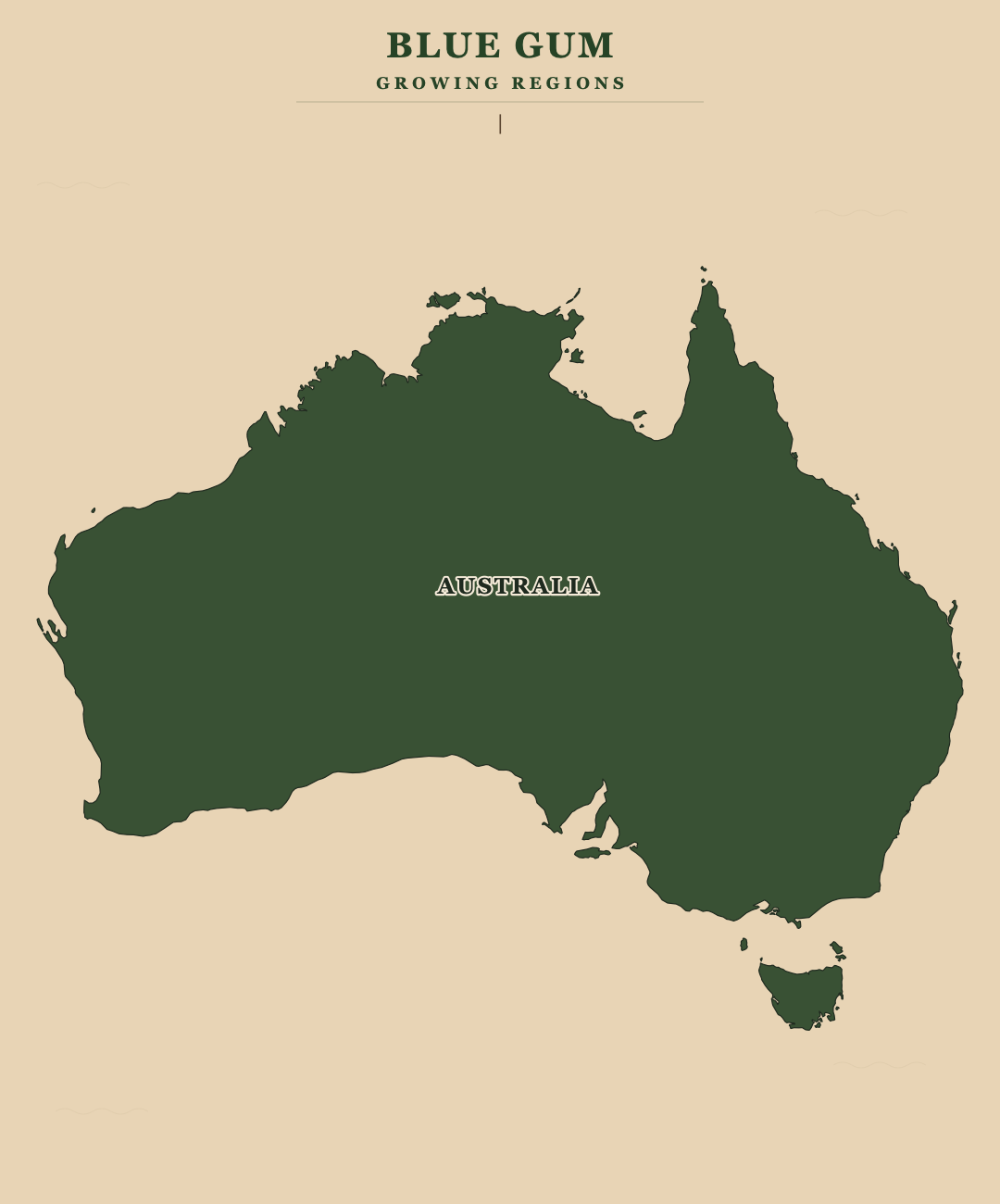
Blue Gum is native to Australia, Australia — Tasmania, south-east Victoria, with secondary growing regions in Worldwide plantation (China, Portugal, Spain, South Africa, Brazil). |
Spice Story
Blue Gum is, on one level, the most globally widespread Australian botanical — Eucalyptus globulus is now grown in commercial plantations in China, Portugal, Spain, Brazil, South Africa and a dozen other countries, and China has been the largest producer of the essential oil for several decades. [source] On another level it remains deeply Tasmanian — it is the state's floral emblem, and the old-growth stands of the south-east still hold trees that pre-date European settlement. Eucalyptus oil has dominated the cineole-rich essential oil market since the 1850s, when colonial Australian chemists like Joseph Bosisto built distillation plants near Melbourne and exported the oil worldwide. [source] In gin, Blue Gum appears across a range of contemporary Australian craft expressions, where it bridges juniper and native botanicals like lemon myrtle and pepperberry with a clear, identifiably Australian aromatic.
Gin Creativity
Blue Gum is intense — a little goes a long way. A full sachet pushes a gin firmly into eucalyptus-medicinal territory; a half-sachet adds the recognisably "fresh-Australian" lift that many native-style gins build around. It pairs particularly well with lemon myrtle (the citrus-eucalypt and pure-eucalypt sit harmoniously) or with juniper alone for a contemporary Tasmanian-style London Dry. Avoid combining with bay leaf or cardamom — they share cineole and the result tastes one-note rather than layered.
Blending Science
Main flavour compounds
 1,8-Cineole (eucalyptol)eucalyptus, cool
 Alpha-Pinenefresh pine, top note
 Limoneneclean citrus lift
Pairs well with
The chemistry is almost entirely about one compound. 1,8-Cineole (eucalyptol) makes up 70–85% of Blue Gum oil — one of the highest concentrations of any commercial eucalypt species, which is why this species defines the world's "eucalyptus oil" standard. [source] Cineole carries the unmistakable cool-camphor-medicinal note that the rest of the world recognises as "eucalyptus". Alpha-pinene layers a softer pine resin underneath (the same compound that defines juniper, which is why the two integrate). Limonene adds a citrus brightness that prevents the cineole from reading medicinal. Cineole is heat-stable, alcohol-soluble, and survives both vapour infusion and traditional maceration cleanly.
Food Partners
- Eucalypt honey: A natural partnership — eucalypt-honey-glazed roast lamb is a Tasmanian classic.
- Roast lamb with bush herbs: Native rosemary, blue gum, and rosemary all work together.
- Cool summer sorbets: Eucalypt-leaf syrup over lemon or lime sorbet is unexpectedly elegant.
- Aniseed-flavoured desserts: Cineole and trans-anethole are complementary aromatic axes.
- Marinated olives: Tasmanian-style marinade with eucalypt, native thyme and lemon.
Cocktails To Try

- Tasmanian Gin & Tonic: Blue Gum-leaf gin with native tonic and a sprig of fresh eucalypt.
- Forest Sour: Blue Gum-infused gin, eucalypt honey, lemon, egg white.
- Bush Negroni: Australian gin with significant Blue Gum content, native amaro, vermouth.
Release The Flavour
- Crumble, don't crush: Light pressure releases the cineole; aggressive grinding makes the leaf bitter.
- Heat: Cineole is heat-stable and survives all extraction methods.
- Time: A short infusion (1–2 hours) captures the bright cineole top; longer extractions deepen the pine.
- Less is more: Blue Gum dominates a blend in small amounts.
Discover more
From the same region
Pairs well with
Same flavour family
Surprise me

Sources & Citations
- scientific_name and family (Myrtaceae):staging.cabi.org/isc/datasheet/22680
- native range (Tasmania, south-east Victoria):essentiallyaustralia.com.au/product/eucalyptus-blue-gum-e...
- first scientific record (1792):essentiallyaustralia.com.au/product/eucalyptus-blue-gum-e...
- 1,8-cineole content (70-85% of essential oil):aromaticstudies.com/about-eucalyptus-globulus-and-18-cine...
- oil_yield (1.0-2.4% of fresh weight):aromaticstudies.com/about-eucalyptus-globulus-and-18-cine...
- largest_global_producer (China):staging.cabi.org/isc/datasheet/22680
- market_dominance (since 1850s):aromaticstudies.com/about-eucalyptus-globulus-and-18-cine...
- main_flavour_compounds (CSV-sourced):inputs/source.csv — Blue Gum row
