
BORAGE FLOWER

- Botanical name
- Borago officinalis
- Also known as
- Starflower, Bee plant, Tailwort
- Main flavour compound
- Nonadienal (cucumber aldehyde)
- Part used
- Dried flower (occasionally with young leaf)
- Method of cultivation
- Annual herb of the Boraginaceae family, native to the Mediterranean region. Easy to grow from seed in temperate conditions; the plant reaches 30–100 cm tall, with rough, bristly leaves and brilliant star-shaped electric-blue flowers. Borage is one of the few genuinely, unambiguously blue flowers in the European herb garden. Most commercial production is small-scale and oriented to fresh herbs and seed oil; dried-flower supply for distilling is often artisanal.
- Commercial preparation
- Flowers are picked at peak bloom (when fully open but before any bee damage), gently dried at very low temperature to preserve the colour, and sold whole or as colour-graded batches. Sun-drying is avoided — direct light bleaches the famous blue almost immediately.
- Non-culinary uses
- Cosmetics (borage seed oil is rich in gamma-linolenic acid and used in skin formulations); cake decoration (the blue flowers candied); historical "courage" tonic (Roman soldiers reportedly drank borage-infused wine before battle); the plant is a major bee-forage species.
Borage — Borago officinalis — is a vigorous Mediterranean annual of the Boraginaceae family, growing to about a metre tall with deeply ridged stems, rough bristly leaves, and brilliant electric-blue star-shaped flowers that face downward like small bells. The blue is unusual — most "blue" flowers in the garden are really violet or grey-tinted, but borage is a clean cobalt with no purple in it, an effect created by anthocyanin pigments in flowers grown on slightly acidic soil. [source] The plant self-seeds prolifically and appears almost as a weed once established in a garden.
Whole dried flower
The standard form — visually striking and slow-releasing in cool maceration.
Fresh
Maximum cucumber character; use immediately or freeze the flowers into ice.
Region of cultivation
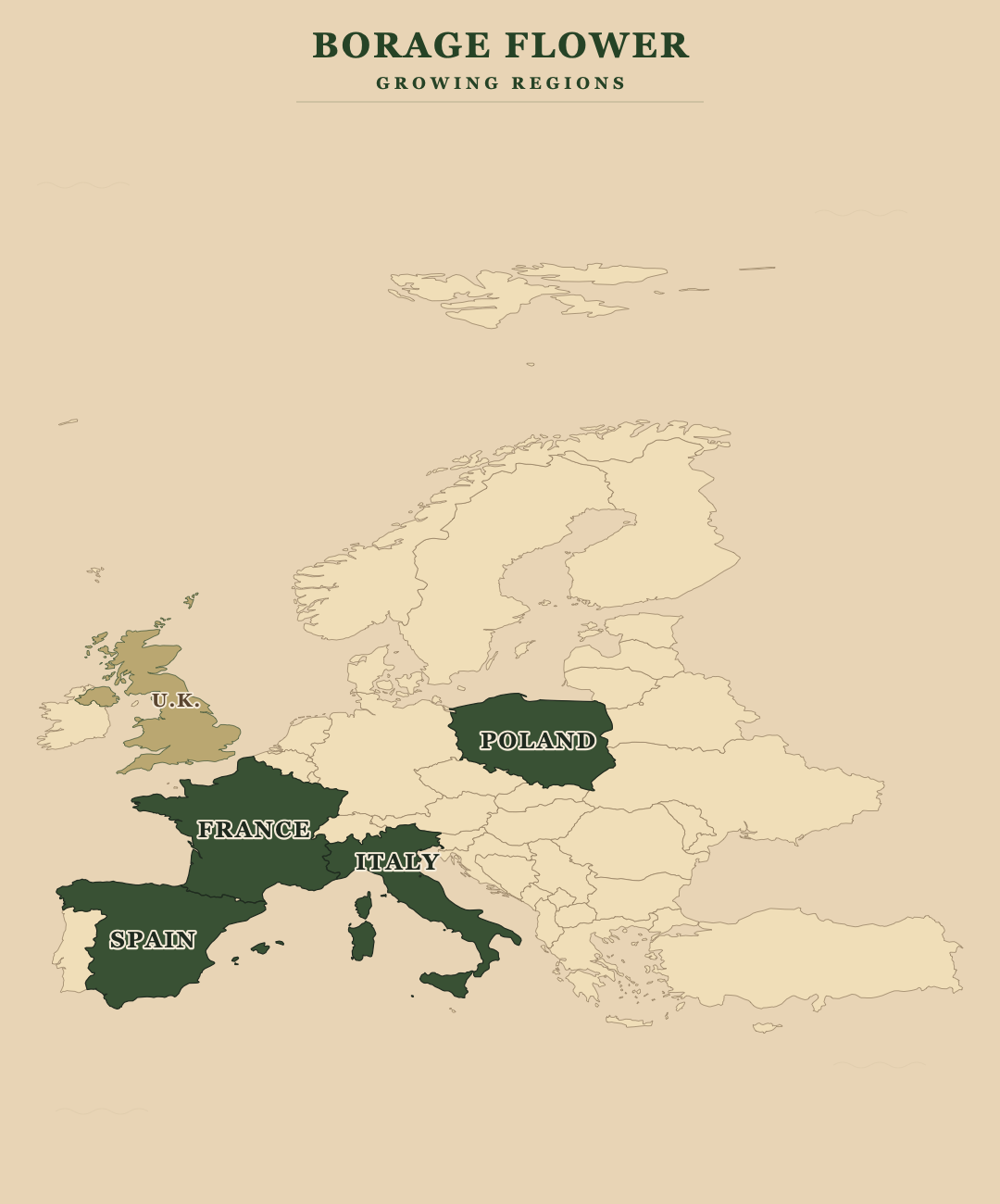
Borage Flower is primarily cultivated in Spain, Italy, France, Eastern Europe, with secondary growing regions in North America (cultivated garden plant), UK, Australia.
Spice Story
Borage has been cultivated around the Mediterranean for at least 2,000 years, and Roman soldiers reportedly drank borage-infused wine before battle for courage — the herbalist John Gerard wrote in 1597 that "borage brings always courage", quoting a Latin phrase already old at his time. [source] The plant remained a staple of medieval European cottage gardens, used both for the leaves (with their distinctive cucumber flavour) and for the flowers (as edible decoration and as a wine flavouring). Modern use is dominated by two registers: as a Pimm's-style summer cocktail garnish, and as a craft-gin botanical where the cucumber-fresh aromatic provides a clear summer signal. The "true blue" of the flower is part of the appeal — drop one into a clear gin sour and the effect is striking even before you taste it.
Gin Creativity
Borage flower brings two things to a gin: a quietly fresh, cucumber-aldehyde aromatic and visual character that no other dried botanical provides. A full sachet adds noticeable cucumber lift; a half-sachet provides a soft summer freshness that pairs naturally with lemon balm or elderflower for a "garden gin" profile. The flower works particularly well in cold-macerated, "compound" style gins where the alcoholic extract carries some of the blue colour into the finished spirit. Avoid heavy warming spices — they overwhelm borage's delicate aromatic.
Blending Science
Main flavour compounds
 Nonadienal (cucumber aldehyde)—
 Hexenal—
 Linaloolfloral, soft
Pairs well with
- Cucumber peel
- Lemon balm
- Elderflower
- Coriander
- Rose
The cucumber character comes almost entirely from (E,Z)-2,6-nonadienal — usually just called "cucumber aldehyde" because it's the dominant compound in fresh cucumber and the source of the characteristic fresh, green aroma. [source] Hexenal (cis-3-hexenal, "leaf aldehyde") layers a green-grass note underneath. Linalool adds a quiet floral lift. All three compounds are highly volatile and heat-sensitive, which is why borage performs best in cool, brief extraction — long warm steeps destroy the cucumber character entirely. The flower itself contains anthocyanin pigments that contribute the deep blue colour but no significant aroma.
Food Partners
- Pimm's-style cups: The defining English summer use — borage and mint over crushed ice.
- Cucumber and yoghurt soups: Cold Bulgarian tarator or Indian raita — borage doubles the cucumber.
- Goat's cheese salads: Fresh chèvre, summer leaves, borage flowers, lemon dressing.
- Edible-flower garnishes: The blue flower as visual signal across dessert and savoury plates.
- White fish ceviche: Borage leaf and flower in a citrus marinade for delicate fish.
Cocktails To Try

- Pimm's #1 Cup: The classic — gin, Pimm's, ginger ale, mint, cucumber, strawberry, borage flowers.
- Garden Gin Smash: Crushed cucumber, mint, borage flowers, gin, lime, soda.
- Blue-flower Gin Sour: Gin, lemon, sugar, egg white — finished with floating borage flowers.
Release The Flavour
- Cold only: Heat destroys the cucumber aldehyde quickly. Cold-infuse or use fresh.
- Brief contact: 30–60 minutes is enough. Longer extractions go grassy and bitter.
- Whole flowers: The flower head holds character better than crushed petals.
- Freshness matters: Borage character fades within months even in optimal storage — buy small, use fresh.
Discover more
From the same region
Pairs well with
Same flavour family
Surprise me

Sources & Citations
- scientific_name and family (Boraginaceae):en.wikipedia.org/wiki/Borage
- cultivation_history (2000+ years Mediterranean):www.britannica.com/plant/borage
- Roman soldiers / courage tonic legend:en.wikipedia.org/wiki/Borage
- cucumber_flavour_compound (nonadienal):en.wikipedia.org/wiki/Borage
- blue_flower_colour (true blue — rare in plants):www.wineboxgardener.com/home/2018/6/24/borage
- main_flavour_compounds (CSV-sourced):inputs/source.csv — Borage Flower row
