
ELDERFLOWER


- Botanical name
- Sambucus nigra
- Also known as
- Black elder, European elder, Common elder
- Main flavour compound
- Linalool
- Part used
- Dried flower (the white cream-coloured umbel)
- Method of cultivation
- Small deciduous tree or large shrub of the Viburnaceae family (formerly Adoxaceae/Caprifoliaceae depending on classification), native to most of Europe and parts of North America. The plant grows in hedgerows, riverbanks and forest edges across temperate Europe, producing large flat-topped clusters (cymes) of small creamy-white flowers in late May and early June, followed by deep purple-black berries in early autumn. Most commercial elderflower is wild-harvested from European hedgerows, particularly in Hungary, Poland, Austria and the UK.
- Commercial preparation
- Flowers are hand-picked at peak bloom — typically a 2-3 week window in early summer — on dry mornings before insect damage. They are dried very gently at low temperatures to preserve the volatile floral aromatics; high-heat drying destroys the delicate character. Quality is graded on flower-head intactness and absence of green stems.
- Non-culinary uses
- Elderflower cordial and "fizz" (a fermented summer drink) traditions across Europe; traditional medicine for colds and respiratory complaints (the dried flowers are still listed in European pharmacopoeias); the elder tree has deep folkloric significance across Northern and Central Europe, with traditions of asking permission before picking the flowers.
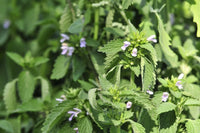
Elderflower comes from Sambucus nigra, a deciduous shrub or small tree of the Viburnaceae family, native to most of Europe and parts of North America. The plant grows 4–6 metres tall in hedgerows, on riverbanks and along forest edges across temperate Europe, with pinnate compound leaves and large flat-topped clusters (cymes) of tiny creamy-white flowers in late May and early June. The flowers are followed by deep purple-black berries in early autumn — both flower and fruit have been used in European cooking and medicine for thousands of years. The flowers are remarkably aromatic for their size: a single cluster fills a room with a honeyed, slightly muscat-grape, faintly pear-like fragrance that defines the smell of European hedgerows in early summer. [source]
Whole dried flower head
The standard form — visually appealing, slow but clean extraction.
Loose dried florets
More efficient for sachet use; loose florets extract faster.
Region of cultivation
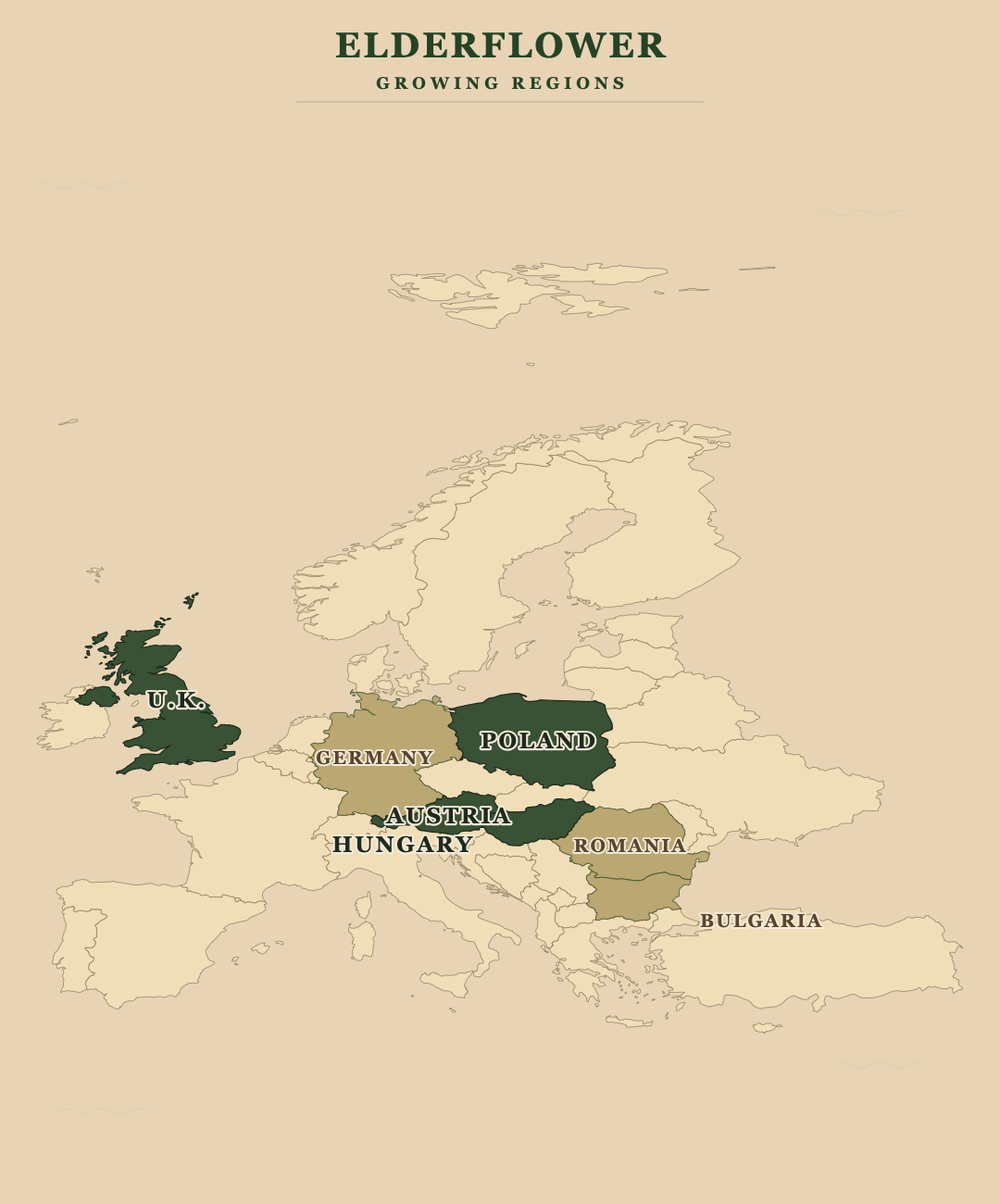
Elderflower is primarily cultivated in Hungary, Poland, Austria, UK, with secondary growing regions in Germany, Romania, Bulgaria, Australia (wild-harvested in cooler areas).
Spice Story
The elder tree holds deep folkloric significance across Northern, Central and Western Europe. In many traditions the tree was believed to house protective spirits, and there was a widespread custom of asking permission of the tree (or its spirit) before picking flowers or berries. [source] Elderflower cordial — fresh flower heads steeped in cold water with sugar and lemon, sometimes lightly fermented — is one of the oldest continuously made European summer drinks, recorded in cottage recipe books from at least the medieval period and still produced commercially across the UK, Scandinavia and Central Europe. The flowers also appear in traditional European medicine for colds and respiratory complaints. In gin, elderflower has become one of the most foundational contemporary floral botanicals — present in St-Germain liqueur (the modern commercial standard), in Hendrick's-style florals, and in Mediterranean and "garden gin" expressions worldwide.
Gin Creativity
Elderflower brings a quiet, honey-sweet floral character that pushes a gin toward "summer garden" without overwhelming juniper. A full sachet adds clearly identifiable elderflower lift and a faintly sweet body; a half-sachet provides a soft floral background that integrates with traditional London Dry. It pairs particularly well with cucumber and lemon balm for a "garden gin" profile, or with bergamot and lavender for a Mediterranean register. Avoid combining with very heavy warming spices — elderflower's delicate honey character disappears quickly.
Blending Science
Main flavour compounds
 Linaloolfloral, soft
 Cis-rose oxide—
 Beta-Damascenone—
 Hotrienol—
Pairs well with
Elderflower's aromatic chemistry is built around a complex blend of monoterpenes that together create its honey-pear-muscat signature. Linalool provides the soft floral lift (the same compound that defines coriander seed and lavender). Cis-rose oxide contributes the characteristic muscat-rose-like floral lift that distinguishes elderflower from generic "white floral" aromas. Beta-damascenone layers an apple-honey-stone-fruit depth. Hotrienol adds a green-floral top note that gives elderflower its distinctive "fresh hedgerow" character. The compounds are mostly heat-sensitive — cool extraction preserves the bright floral top, while warm extraction tends to flatten the character.
Food Partners
- Elderflower cordials and summer drinks: The defining traditional pairing.
- Strawberry-and-cream desserts: Elderflower-strawberry is a chef's classic.
- Cool yoghurt and stone-fruit dishes: Greek yoghurt, peach, elderflower syrup.
- Soft fresh cheese: Burrata, fresh ricotta with elderflower honey.
- Sparkling wine drinks: Elderflower gin and prosecco is summer in a glass.
Cocktails To Try

- Elderflower Gin Spritz: Elderflower gin, prosecco, soda, lemon twist — Italian summer.
- Hugo: Elderflower gin, prosecco, mint, lime — the Alpine alternative to a Spritz.
- English Garden: Elderflower gin, cucumber, mint, lime, soda.
Release The Flavour
- Cool extraction: Preserves the delicate honey-floral top notes; heat flattens them.
- Brief contact: 30 minutes to 4 hours is enough.
- Whole flowers: Hold up better than crushed; intact umbels look beautiful in a compound gin.
- Source matters: Genuine wild-harvested European elderflower has a depth that cultivated production sometimes lacks.
Discover more
From the same region
Pairs well with
Same flavour family
Surprise me

Sources & Citations
- scientific_name (Sambucus nigra, Viburnaceae):en.wikipedia.org/wiki/Sambucus_nigra
- native_range (most of Europe; North America):en.wikipedia.org/wiki/Sambucus_nigra
- flowering_season (late May / early June):en.wikipedia.org/wiki/Sambucus_nigra
- european_folklore (protective tree spirits; permission tradition):en.wikipedia.org/wiki/Sambucus_nigra
- gin_use_flavour_profile:www.theginguild.com/ginopedia/gin-botanicals/elderflower/
- main_flavour_compounds (CSV-sourced):inputs/source.csv — Elderflower row
