
BERGAMOT

- Botanical name
- Citrus bergamia
- Also known as
- Bergamot orange, Calabrian bergamot
- Main flavour compound
- Limonene
- Part used
- Dried peel (zest)
- Method of cultivation
- Cultivated citrus of the Rutaceae family, almost certainly a hybrid of bitter orange and lemon (or possibly lemon and *Citrus limetta*). More than 90% of world production comes from a single small stretch of coastline in Calabria, southern Italy, where a particular combination of climate, soil and microclimate produces fruit with the highest essential-oil yield in the world.
- Commercial preparation
- Fruit is hand-picked in winter (November–March), and the peel oil is cold-pressed using machines called *macchine pelatrici* that abrade the surface to release the oil glands while leaving the fruit whole. For dried-peel use, the zest is removed from fresh fruit before juicing, then air-dried at low temperature to preserve the volatile terpenes. The flesh is mostly inedible — too bitter to eat — so the peel is the only commercial product.
- Non-culinary uses
- Perfumery (one of the foundational citrus notes in Eau de Cologne); flavouring of Earl Grey tea; aromatherapy; traditional Calabrian folk medicine.
Bergamot — Citrus bergamia — is a small citrus tree of the Rutaceae family, almost certainly a hybrid of bitter orange and lemon, though its exact parentage remains the subject of botanical debate. It grows to about 4 metres, bears fragrant white blossom in spring, and produces lemon-yellow fruit with a slightly knobbly, oil-rich peel from November through March. The flesh is too acidic and bitter to eat — bergamot is grown entirely for the peel oil. More than 90% of the world's bergamot comes from one strip of coastline in Calabria, southern Italy, where a specific combination of climate and soil produces fruit with the highest essential-oil yield of any cultivated citrus. [source]
Dried peel chips
The standard form — adds to a botanical bill cleanly with strong floral-citrus lift.
Dried peel powder
Faster extraction; loses brightness within months.
Region of cultivation
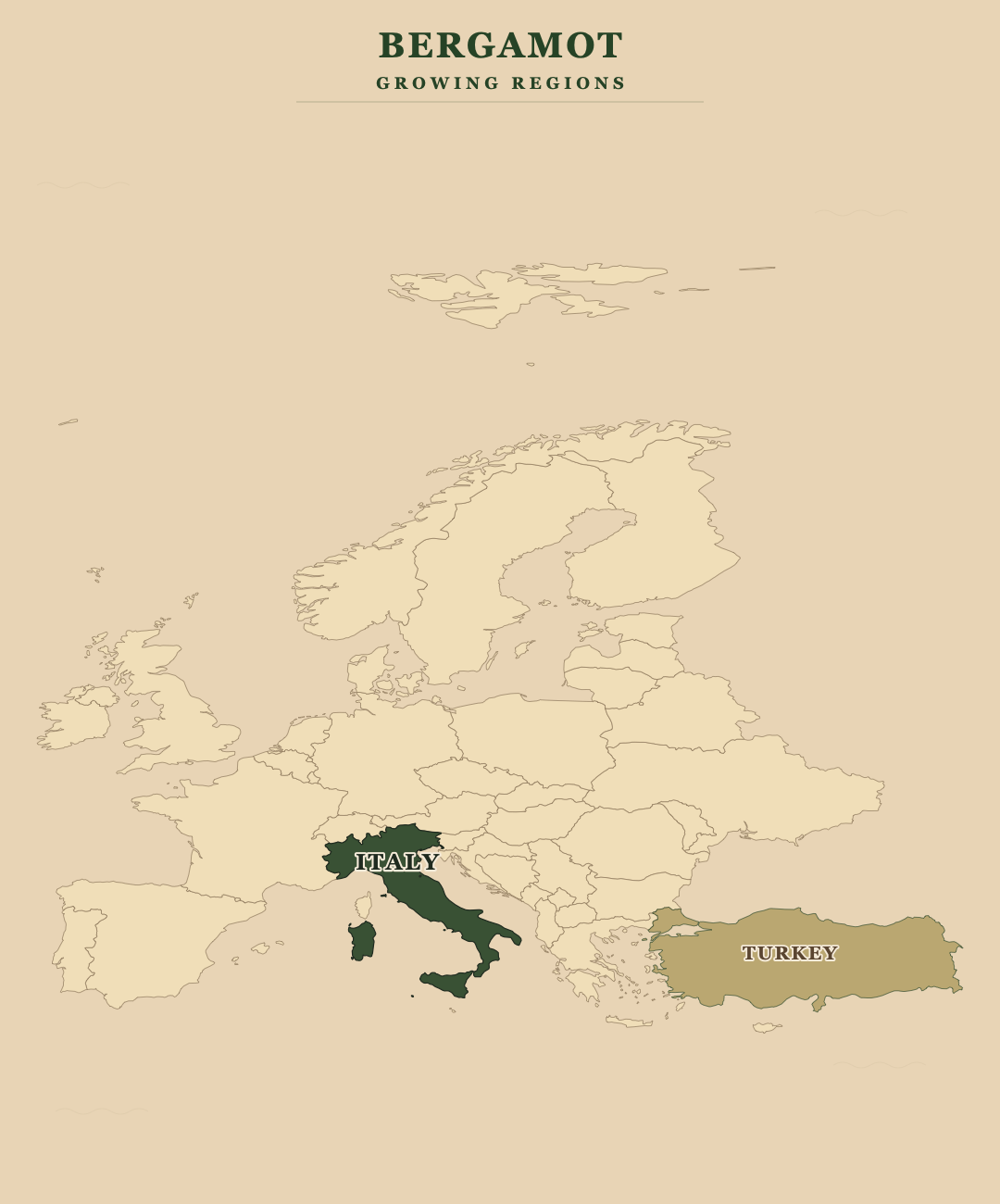
Bergamot is primarily cultivated in Italy — Calabria (Reggio Calabria province), 90%+ of world production, with secondary growing regions in Côte d'Ivoire, Argentina, Turkey, southern Brazil.
Spice Story
The first known bergamot orchard was established near Reggio Calabria in 1750, although the tree had been grown ornamentally in Italian aristocratic gardens since at least the 16th century. Bergamot essential oil first appears in commercial pharmacy records from Giessen, Germany, in 1688, [source] and from the early 18th century onward became a foundational ingredient in Eau de Cologne and modern perfumery. Its most famous culinary use is the flavouring of Earl Grey tea — black tea scented with bergamot oil — a blend most often attributed to Charles Grey, the 2nd Earl Grey and British Prime Minister in the 1830s, who is said to have received an early example as a diplomatic gift. [source] In gin, bergamot has become one of the signature contemporary citrus botanicals — used in everything from Hendrick's-style floral gins to modern Italian craft distillations — because it offers a citrus character no other peel can match.
Gin Creativity
Bergamot is one of the most distinctive citrus notes available to a distiller — floral, slightly bitter, both brighter and more complex than lemon or orange. A full sachet pushes a gin firmly into Earl-Grey territory; a half-sachet adds an aromatic citrus lift without dominating, working beautifully alongside juniper and coriander. Pair with lavender for an explicitly Mediterranean profile, or with cardamom and pink peppercorn for something more spice-route. Avoid combining with very heavy floral botanicals (jasmine, rose) — bergamot itself is floral enough.
Blending Science
Main flavour compounds
 Limoneneclean citrus lift
 Linalyl acetate—
 Linaloolfloral, soft
 Bergamottin—
Pairs well with
Bergamot's chemistry is dominated by limonene (typically 30–45% of the oil) — the same compound that defines lemon, orange and grapefruit, but here paired with two distinguishing aromatics. Linalyl acetate (15–30%) is the soft floral note that gives bergamot its perfumery character — it's also a major component of lavender, which is why the two pair so well. Linalool layers a sweet woody-floral lift on top. Bergamottin is a furanocoumarin not aromatic itself but responsible for bergamot oil's well-documented photosensitivity (don't apply bergamot oil to skin before sun exposure). [source] Cool vapour infusion preserves the linalyl acetate floral note best; long maceration tends to deepen the bitter background.
Food Partners
- Earl Grey-flavoured desserts: The defining pairing — bergamot and tea cream, tarts, ice cream.
- Citrus marmalades: Bergamot marmalade is a Calabrian classic.
- Dark chocolate: Bitter cocoa and bittersweet bergamot lock together.
- Roast poultry: Bergamot-honey glaze on duck or quail.
- Soft-ripened cheese: Bergamot zest cuts through the richness of triple-cream.
Cocktails To Try

- Earl Grey MarTEAni (Audrey Saunders, NYC): Earl Grey-infused gin, lemon, sugar, egg white.
- Bergamot Negroni: Bergamot-peel-infused gin with Campari and a herbal vermouth.
- Sicilian Spritz: Bergamot-gin, prosecco, soda, fresh peel garnish.
Release The Flavour
- Cool extraction: Preserves the floral linalyl acetate; heat tends to flatten it.
- Peel only: Avoid the bitter pith — the oil is in the coloured zest.
- Brief contact: 2–4 hours is often enough; longer extractions emphasise the bitter background.
- Source matters: Genuine Calabrian bergamot has a depth other regions can't match.
Discover more
From the same region
Pairs well with
Same flavour family
Surprise me

Sources & Citations
- scientific_name and family:pmc.ncbi.nlm.nih.gov/articles/PMC4345801/
- Calabrian production dominance (>90%):mediterreaneanwayof.com/bergamot-the-treasure-of-calabria/
- cultivation_history (first orchard near Reggio Calabria, 1750):mediterreaneanwayof.com/bergamot-the-treasure-of-calabria/
- Earl Grey connection (Charles Grey, 2nd Earl Grey):bergamiatea.co.uk/pages/earl-grey
- bergamot_essential_oil_first_documented (1688 Giessen pharmacy):essentialoilspedia.com/bergamot-essential-oil-history-aro...
- main_flavour_compounds (CSV-sourced):inputs/source.csv — Bergamot row
