
BUDDHA'S HAND

- Botanical name
- Citrus medica var. sarcodactylis
- Also known as
- Fingered citron, Buddha's Hand citron, Bushukan (Japanese), Foshou (Chinese)
- Main flavour compound
- Limonene
- Part used
- Dried peel and "fingers" (the segmented outer fruit; the inside is mostly pith with little juice or flesh)
- Method of cultivation
- Cultivated variety of citron — *Citrus medica* var. *sarcodactylis* — distinguished by fruit that splits into finger-like segments, often described as resembling clasped praying hands. The tree is small, thorny, and frost-tender; it has been grown across northern India, southern China, Japan and (more recently) parts of the Mediterranean and California for over a thousand years.
- Commercial preparation
- Fruit is hand-harvested in winter and used either whole as a fragrant offering, sliced thin and dried (for tea, distilling and confectionery), or candied. For gin botanical use, the dried peel-and-finger slices are added directly to the distillation; the aromatic compound concentration in the peel is very high and the flesh contributes very little, so most of the fruit is genuinely usable.
- Non-culinary uses
- Buddhist religious offerings (the closed-hand shape is symbolic); perfumery (a foundational floral-citrus accord in East Asian fragrance); ornamental tree and bonsai; symbolic gift in Chinese New Year traditions (representing happiness, wealth and longevity).
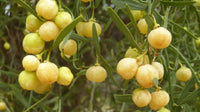
Buddha's Hand — Citrus medica var. sarcodactylis — is one of the strangest-looking fruits in cultivation. Each fruit splits into elongated, finger-like segments that range from pale lemon-yellow to deep saffron, often clustering together so the whole fruit resembles a clenched or open hand. The tree is a relatively small thorny shrub, frost-tender, with fragrant white-and-purple-tinted blossom. The interior of the fruit is unusual for a citrus — almost entirely pith and dry segment-walls, with little flesh or juice. What it lacks in flesh it makes up for in fragrance: the peel oil is intensely aromatic, floral-citrus with a softer profile than lemon or orange. [source]
Dried sliced finger
The standard form — concentrated peel oil, easy to portion.
Whole dried fruit (smaller specimens)
Visually stunning; usually reserved for display or short steeps.
Region of cultivation
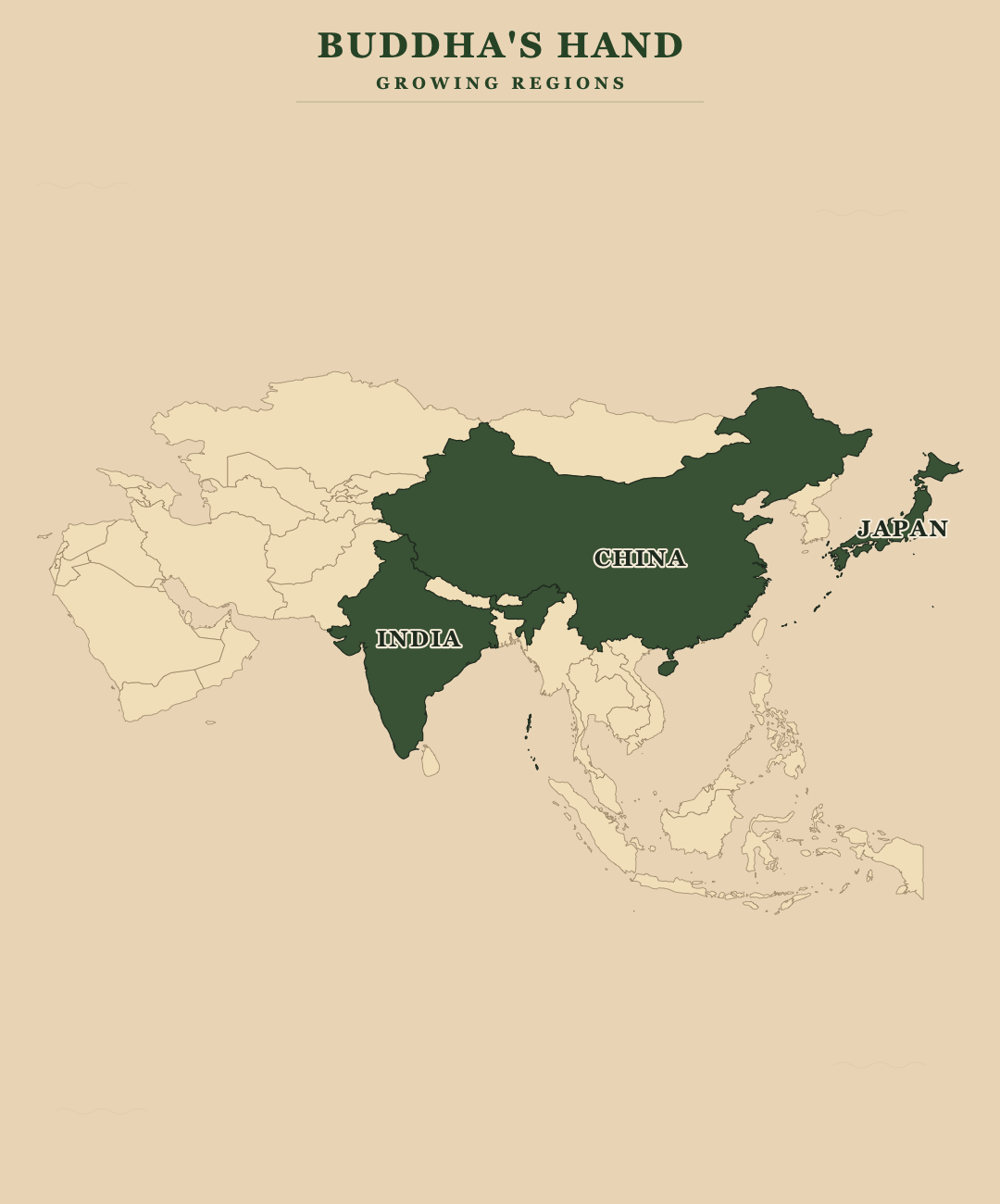
Buddha's Hand is primarily cultivated in China (Guangdong, Yunnan, Sichuan), Japan, India (northeast), with secondary growing regions in Mediterranean (Italy, Greece), California, Australia (specialty growers).
Spice Story
Buddha's Hand is one of the oldest cultivated citrons in the world — it almost certainly originated in north-east India or southern China, and was carried into China by Buddhist monks along the Himalayan trade routes by around the 4th century CE. [source] By the Tang Dynasty (618–907 CE) it had become a cultural icon in Chinese painting, religious ritual and traditional medicine. The closed-hand shape resembles a Buddhist gesture of prayer, which gave the fruit its modern name; in Chinese it is foshou — "Buddha's hand" — and in Japanese bushukan. The fruit appears at Chinese New Year as a symbol of happiness, wealth and longevity, and the peel is candied, made into tea, or steam-distilled for perfumery. Its arrival in Western craft gin is recent — a handful of innovative distilleries have started using it as a citrus alternative — and the result is a quieter, more floral character than common lemon or orange peel.
Gin Creativity
Buddha's Hand brings citrus character without bite — softer and more floral than lemon, less bitter than bergamot, less sharp than yuzu. A full sachet pushes a gin firmly into floral-citrus territory; a half-sachet provides a subtle, aromatic citrus lift that pairs naturally with jasmine or cardamom for an East Asian profile. It works particularly well alongside other citrons (yuzu, bergamot) where the family of floral-citrus notes layer rather than compete. Avoid pairing with very sharp, juicy citrus (lime, grapefruit) — Buddha's Hand's softness gets buried.
Blending Science
Main flavour compounds
 Limoneneclean citrus lift
 Gamma-Terpinenefresh pine, top note
 Citrallemon-bright
 Linaloolfloral, soft
Pairs well with
The chemistry is dominated by limonene — typically over 50% of the essential oil — but it is the supporting compounds that distinguish Buddha's Hand from common citrus. Gamma-terpinene layers a soft, slightly herbaceous depth that gives the fruit its characteristic roundness. Citral contributes a lemon-bright top note. Linalool adds the floral lift that defines the aroma — and it's this linalool content that bridges Buddha's Hand naturally to floral botanicals like jasmine or lavender. Almost all the aromatic activity is in the peel; the fruit's internal pith contributes nothing aromatic but does provide bulk for the dried product. Cool extraction preserves the floral linalool; warm extraction emphasises the limonene brightness.
Food Partners
- White fish and seafood: Buddha's Hand zest over steamed sea bass — a Cantonese classic.
- East-Asian rice dishes: Zest the peel directly into the rice while it steams.
- Citrus marmalades: Buddha's Hand marmalade is treasured for its floral character.
- Earl Grey-style desserts: Buddha's Hand and bergamot share linalyl acetate territory.
- Lightly perfumed sorbets: Lemon-jasmine-Buddha's Hand sorbet is a study in citrus complexity.
Cocktails To Try

- Buddha's Hand Martini: Strip of dried Buddha's Hand peel expressed over a crystalline Martini.
- East-Asian Gin and Tonic: Buddha's Hand and jasmine gin with a delicate floral tonic.
- Citron Sour: Buddha's Hand-infused gin, lemon, honey, egg white — soft and aromatic.
Release The Flavour
- Cool extraction: Preserves the floral linalool; heat tends to flatten it.
- Peel-only: The flesh contributes nothing; concentrate on the coloured rind.
- Brief contact: 2–4 hours is often enough; longer extractions emphasise bitterness.
- Source matters: Genuine Asian-grown Buddha's Hand has a depth that some Mediterranean grown varieties don't match.
Discover more
From the same region
Pairs well with
Same flavour family
Surprise me

Sources & Citations
- scientific_name (Citrus medica var. sarcodactylis):en.wikipedia.org/wiki/Buddha's_hand
- cultivation_history (Buddhist monks brought to China via trade routes by 4th c. CE):thursd.com/articles/buddhas-hand
- Tang_dynasty_cultural_use (618-907 CE):thursd.com/articles/buddhas-hand
- native_range (NE India, S China, SE Asia):www.sciencedirect.com/science/article/abs/pii/S0141813024...
- lemon_blossom_aroma_character:en.wikipedia.org/wiki/Buddha's_hand
- main_flavour_compounds (CSV-sourced):inputs/source.csv — Buddha's Hand row
