
GINSENG

- Botanical name
- Panax ginseng
- Also known as
- Korean ginseng, Asian ginseng, Insam (Korean), Ren Shen (Chinese)
- Main flavour compound
- Ginsenosides (Rb1, Rg1)
- Part used
- Dried root (mature, typically 4–6 years old)
- Method of cultivation
- Slow-growing perennial herb of the Araliaceae family, native to East Asia (Korea, Manchuria, eastern Russia). Cultivated extensively in Korea and China, where it has been grown for over a thousand years. Plants take 4–6 years to reach commercial maturity; "red" ginseng is made by steaming and drying mature roots, "white" ginseng by simple drying.
- Commercial preparation
- Roots are harvested in autumn, washed, and either dried directly for white ginseng or steamed before drying for red ginseng. The red form has darker colour and a slightly different chemistry due to the steaming. Twelve commercial cultivars are registered in South Korea.
- Non-culinary uses
- Foundational tonic herb in traditional Chinese, Korean and Japanese medicine for over a millennium; modern adaptogen research; ginseng tea and ginseng candy across East Asia; significant commercial role in functional drinks and supplements.
Ginseng — Panax ginseng — is a slow-growing perennial of the Araliaceae family, native to the forests of East Asia. The plant grows about 40 cm tall, with palmately-compound leaves and small umbels of greenish flowers, but the working part is below ground: a thick branched taproot that takes 4–6 years to reach commercial maturity. The Latin name Panax — "all-heal" — reflects ginseng's reputation as a tonic-of-everything across East Asian medicine. South Korea has cultivated Panax ginseng commercially for over a thousand years, and Korean Red Ginseng has been made by the same traditional manufacturing methods since at least the 9th century. [source]
Dried sliced root
The standard form — extracts character slowly.
Powdered
Faster extraction; loses character within months.
Region of cultivation
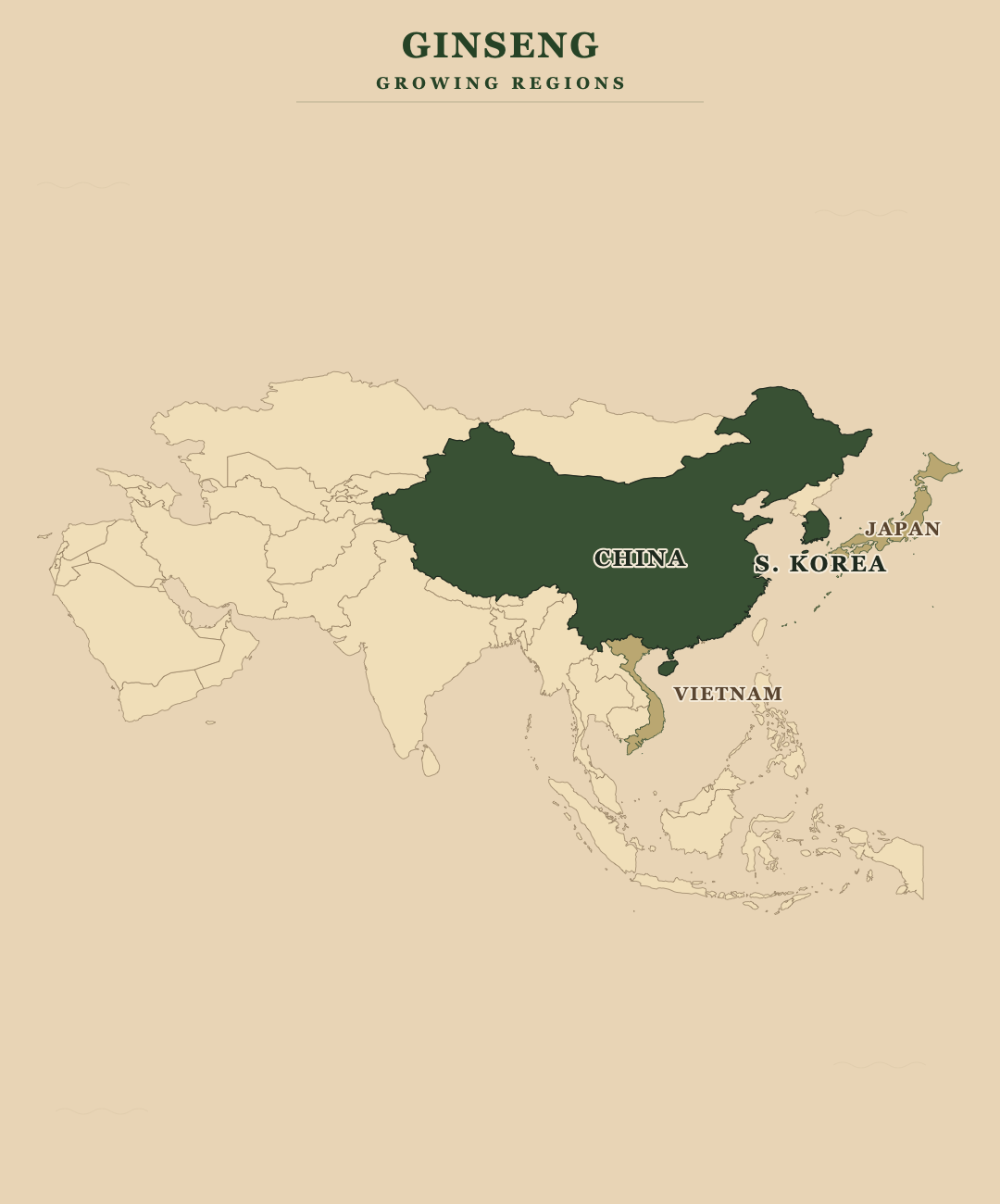
Ginseng is primarily cultivated in South Korea, China (Manchuria), USA (American ginseng — P. quinquefolius), with secondary growing regions in Japan, Russia (eastern), Vietnam.
Spice Story
Ginseng is one of the oldest continuously-used medicinal plants in human history — referenced in Chinese medical texts from at least 100 BCE, foundational to Korean traditional medicine for over a millennium, and a cornerstone of Japanese herbal practice. The plant is classified as an adaptogen in modern herbal medicine — a tonic that supports overall systemic resilience rather than acting as a stimulant or sedative. Today South Korea, China and (to a lesser extent) North America produce most of the world's commercial ginseng; Korean Red Ginseng remains the gold-standard premium grade. In gin, ginseng is an uncommon but distinctive contemporary botanical, particularly in Asian-inspired and "wellness gin" expressions where the goal is genuine tonic-herb character.
Gin Creativity
Ginseng brings earthy-root depth with a quietly sweet undercurrent. A full sachet pushes a gin into clearly East-Asian tonic territory; a quarter to half sachet provides a quietly earthy background that integrates with juniper. Pair with liquorice and cardamom for an Asian medicinal tonic profile, or with honey and chamomile for a softer wellness gin.
Blending Science
Main flavour compounds
 Ginsenosides (Rb1, Rg1)—
 Polysaccharides—
 Slow-extracting flavonoids—
The chemistry is built around ginsenosides — saponin glycosides unique to Panax species, with around 30 different compounds identified. Rb1 and Rg1 are the most-studied ginsenosides, contributing the characteristic bittersweet root character. Polysaccharides contribute body and slight viscosity. Slow-extracting flavonoids add gentle aromatic depth. Long warm extraction is needed for ginseng to develop fully — short cool extractions barely capture the character.
Food Partners
- Korean samgyetang (ginseng chicken soup) — the defining culinary use.
- Asian medicinal tonic broths — ginseng in long-simmered tonic-style soups.
- Honey-sweet desserts — ginseng-honey reductions.
- Earthy mushroom dishes — ginseng and shiitake share an earthy depth.
- Slow-braised root vegetables — ginseng-gin glaze over winter roots.
Cocktails To Try

- Asian Tonic G&T — ginseng-gin with floral tonic and ginger garnish.
- Wellness Sour — ginseng-gin, honey, lemon, egg white.
- Adaptogen Old Fashioned — ginseng-gin, demerara, orange bitters.
Release The Flavour
- Long extraction — 48+ hours for full development.
- Heat is friendly — both vapour and warm maceration work cleanly.
- Slice thin — increases surface area.
- Pair with sweetness — ginseng's bitterness benefits from honey or sweet vermouth.
Discover more
From the same region
Pairs well with

Same flavour family
Surprise me

Sources & Citations
- scientific_name (Panax ginseng, Araliaceae):www.traditionalmedicinals.com/blogs/herb-library/ginseng
- 1100+_year_korean_red_ginseng_history:pmc.ncbi.nlm.nih.gov/articles/PMC4593794/
- 4-6_year_growing_period:pmc.ncbi.nlm.nih.gov/articles/PMC4593794/
- korean_cultivars (12 registered):www.ncbi.nlm.nih.gov/pmc/articles/PMC7321059/
- ginsenosides_as_bioactive_compounds:e-fsbh.org/DOIx.php?id=10.52361/fsbh.2023.3.e11
- main_flavour_compounds (CSV-sourced):inputs/source.csv — Ginseng row
