
LAPSANG SOUCHONG

- Botanical name
- Camellia sinensis (smoked over Pinus taiwanensis pine)
- Also known as
- Zheng Shan Xiao Zhong (正山小种, Chinese), Pine-smoked black tea
- Main flavour compound
- Longifolene (pine smoke)
- Part used
- Black tea leaves smoked over pinewood fire
- Method of cultivation
- Black tea from *Camellia sinensis* grown in the Wuyi Mountains of Fujian province, China — particularly the Zhen Shan area. The tea is processed by traditional smoking over pinewood fires, which is what gives Lapsang Souchong its distinctive character. *Pinus taiwanensis* (Taiwan pine) is the traditional smoking wood, though cedar and cypress are sometimes substituted.
- Commercial preparation
- After picking and initial processing, the tea leaves are dried entirely within a smoke house — the leaves spread on bamboo trays over pine fires for 8–12 hours of final drying. The traditional process is called Zheng Shan Xiao Zhong ("real mountain small-leaf type"). The smoke phenolic compounds — especially longifolene from the pine — are absorbed during this drying phase and define the final character.
- Non-culinary uses
- Hot beverage (the foundational use); Lapsang Souchong has a famous role in Earl Grey-style breakfast tea blends; the smoky character has been adopted into Western cooking for "smoke without fire" applications including syrups, gravies and confectionery.
Lapsang Souchong is a smoked black tea, not a single plant — the leaves of Camellia sinensis (the universal tea plant), grown in the Wuyi Mountains of Fujian province in China, processed by traditional smoking over pinewood fires. The Chinese name Zheng Shan Xiao Zhong (正山小种) translates roughly as "real mountain small-leaf type," distinguishing the genuine Wuyi-grown article from imitations. Pinus taiwanensis is the traditional smoking wood, contributing the distinctive piney-empyreumatic character that no other tea matches. [source]
Loose-leaf smoked black tea
The standard form — open the leaves up before extraction.
Tea-bag form
Convenient but typically lower-grade product.
Region of cultivation
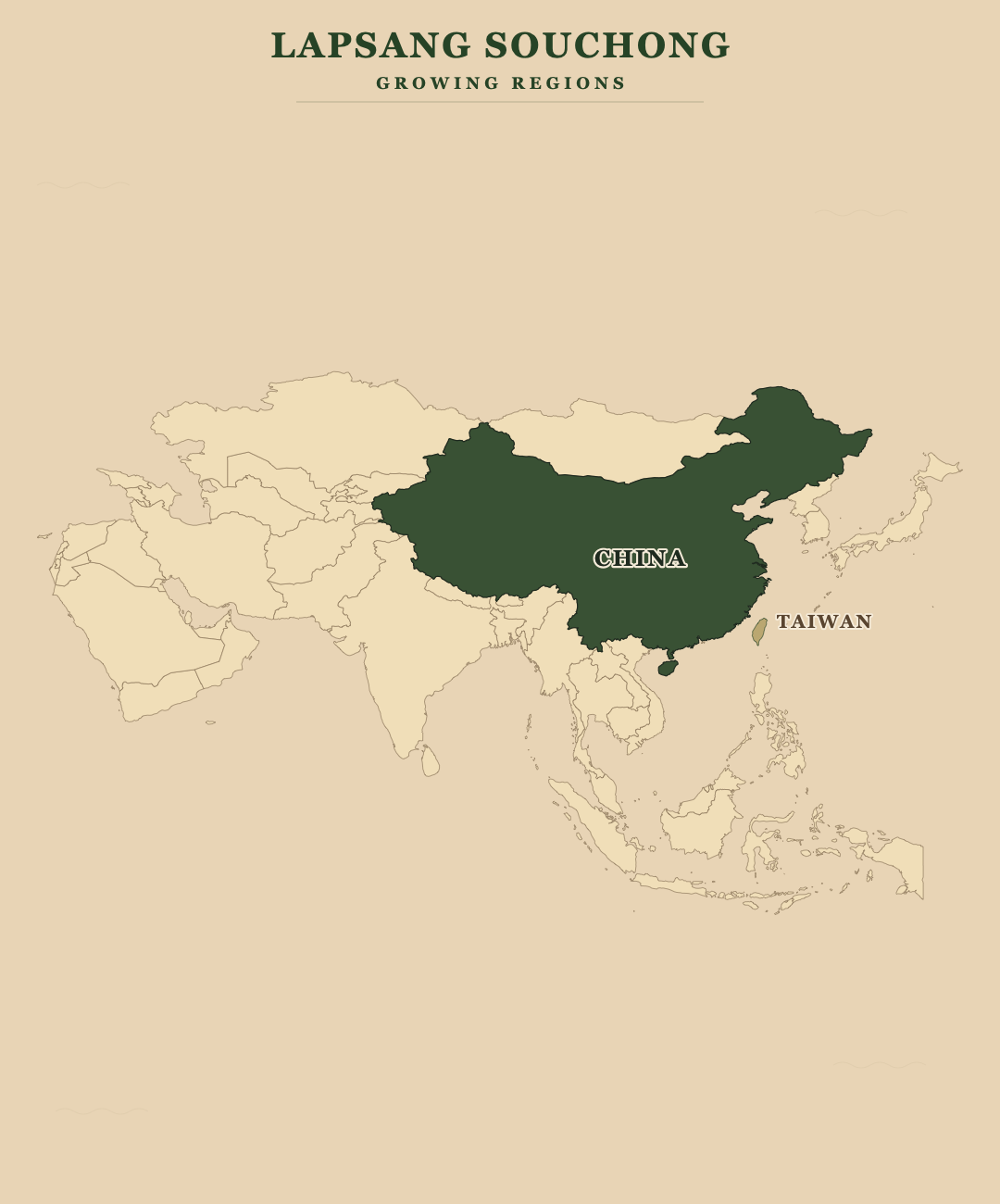
Lapsang Souchong is primarily cultivated in China — Fujian province (Wuyi Mountains, Zhen Shan area), with secondary growing regions in Limited equivalent production in Taiwan.
Spice Story
Lapsang Souchong is often credited as one of the earliest black teas — possibly the first true black tea ever made — with origins in 17th-century Fujian, where (according to local legend) a battlefield disruption forced a tea-processing operation to dry its leaves over pinewood fires instead of charcoal, accidentally creating the smoked character that became the regional speciality. The tea remains commercially produced today by traditional methods in Zhen Shan and nearby villages in the Wuyi Mountains, with the most prized grades — produced from leaves of older "qi zhong" cultivars — costing significantly more than common Lapsang. The tea's empyreumatic ("bacon" or "campfire") character has divided opinions for centuries: some drinkers love it, others find it overwhelming. In gin, Lapsang Souchong is a distinctive contemporary botanical providing genuine smoke without resorting to peat or barrel-finishing.
Gin Creativity
Lapsang Souchong brings deep pine-smoke character with malt-tannin body. A full sachet pushes a gin firmly into smoky-tea territory; a half-sachet provides quiet smoke depth that pairs naturally with juniper. Pair with cacao nibs and orange peel for a smoky after-dinner profile, or with Black Cardamom for layered smoke.
Blending Science
Main flavour compounds
 Longifolene (pine smoke)—
 Guaiacol—
 Theaflavins (tea)—
 Methyl salicylatewintergreen, medicinal
Pairs well with
The character is built from two parallel chemistries. From the tea side: theaflavins (oxidation products) contribute the malt-tannic body. From the pine smoke: longifolene is the pine-derived terpene that defines Lapsang's signature character — it is found in pine smoke and not in other teas. [source] Guaiacol and other phenolics contribute the broader smoky depth. Methyl salicylate adds a wintergreen-like back-palate note. The smoke compounds are alcohol-soluble and heat-stable; long warm extraction develops the full smoky-tannin body.
Food Partners
- Smoke-paired desserts — Lapsang-infused chocolate ganache.
- Smoked salmon and trout — smoke on smoke.
- Slow-braised meats — Lapsang in the braising liquid for pork or lamb.
- Whisky-leaning chocolate truffles — Lapsang in place of peated whisky.
- Pine-smoked cheeses — natural pairing.
Cocktails To Try

- Smoky MarTEAni — Lapsang-infused gin, lemon, sugar, egg white.
- Penicillin (gin variant) — Lapsang gin, honey-ginger syrup, lemon.
- Smoky Negroni — Lapsang gin, Campari, vermouth.
Release The Flavour
- Brief contact — 30 minutes to 2 hours; longer extractions go astringent.
- Cool to warm — both work; warm draws out more smoke.
- Strain finely — tea fragments leach over time.
- Source matters — genuine Wuyi-origin Lapsang has more depth than imitations.
Discover more
Pairs well with
Same flavour family

Surprise me

Sources & Citations
- scientific_name and processing:en.wikipedia.org/wiki/Lapsang_souchong
- origin (Wuyi Mountains, Fujian Zhen Shan):en.wikipedia.org/wiki/Lapsang_souchong
- smoking_process (8-12 hours final drying):en.wikipedia.org/wiki/Lapsang_souchong
- pinus_taiwanensis_traditional_smoking_wood:en.wikipedia.org/wiki/Lapsang_souchong
- longifolene_pine_smoke_compound:pubs.acs.org/doi/10.1021/jf058059i
- main_flavour_compounds (CSV-sourced):inputs/source.csv — Lapsang Souchong row
