
BUDDHA WOOD

- Botanical name
- Eremophila mitchellii
- Also known as
- False sandalwood, Native sandalwood, Australian rosewood, Sandalbox, Bastard sandalwood
- Main flavour compound
- Eremophilane sesquiterpenes (eremophilone, hydroxyeremophilone)
- Part used
- Heartwood (chipped or distilled)
- Method of cultivation
- Endemic Australian shrub or small tree of the Scrophulariaceae family (figwort family) — not, despite the common names, a true sandalwood. Widespread across inland New South Wales and Queensland on grazing country, where the species is technically classified as a pasture pest because of its root-suckering habit. Modern commercial supply for the essential-oil and gin-botanical trade comes from sustainable wild harvest of the heartwood, often working with landholders who want the trees cleared anyway.
- Commercial preparation
- Heartwood is chipped or coarsely ground and steam-distilled for the essential oil trade, or used directly as a botanical input for distillation. The oil is thick, viscous and amber-coloured. For sachet use, the heartwood is shaved or chipped finely and added to the still as a long-extraction botanical.
- Non-culinary uses
- Perfumery (a "smoke" or "leather" base note, often used as a fixative); aromatherapy and meditation incense; Indigenous smoking ceremony; traditional bush medicine for skin complaints and inflammation.
Buddha Wood — Eremophila mitchellii — is not a sandalwood despite its many common names. It is a member of the Scrophulariaceae family (figworts), one of around 200 species in the Australian-endemic genus Eremophila, sometimes called the "emu bushes" because native animals disperse their seeds. [source] The plant is a glabrous large shrub or small tree with flaky bark, narrow leaves and white-to-cream flowers, often forming dense thickets through root suckering. It is widespread across inland New South Wales and Queensland, where its tendency to take over pasture has earned it the unfortunate classification of a grazing-country pest.
Wood chips or shavings
The standard distilling form — used in vapour infusion or long maceration.
Sawdust
Faster extraction; finer particles need careful straining.
Region of cultivation
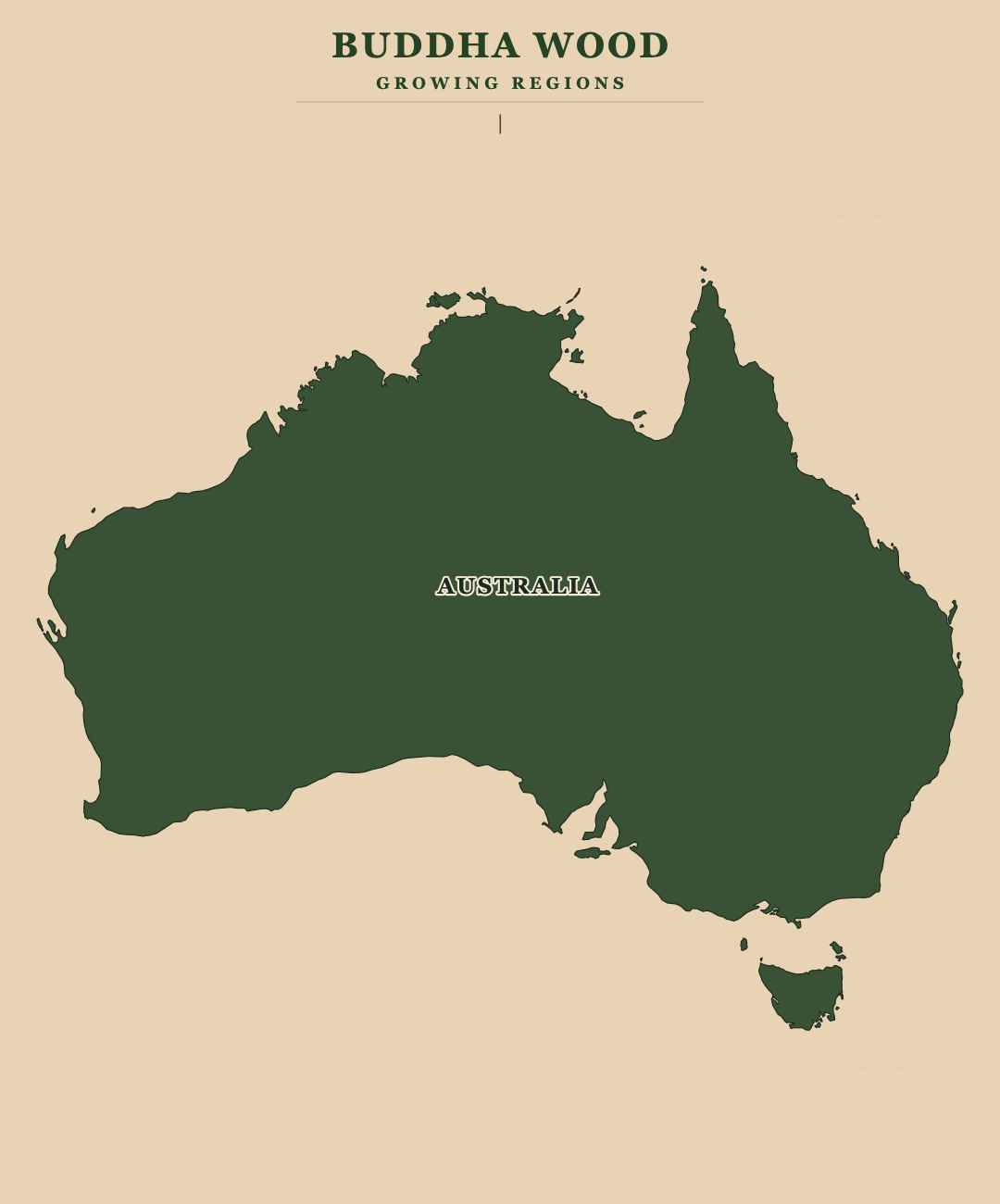
Buddha Wood is native to Australia, Australia — inland New South Wales, Queensland, with secondary growing regions in Northern Territory, South Australia (Far North), Western Australia (eastern Goldfields). |
Spice Story
Buddha Wood occupies an unusual position in Australian botanical commerce: a tree that pastoralists routinely clear from grazing land, but that produces an essential oil of real value for perfumery and aromatherapy. The species has been used by Aboriginal peoples across its range for thousands of years — both as a smoking-ceremony incense and as a traditional bush medicine for skin complaints — and its modern commercial use builds on that knowledge. [source] The oil's character has been called smoky, sweet, leather-edged and meditative; perfumers describe it as a base-note fixative comparable in role (though not in aroma) to true sandalwood. Its arrival in craft gin is recent — Australian distilleries searching for native woody alternatives to expensive imported sandalwood have driven the demand — and it is one of a small handful of botanicals where modern Australian gin can claim genuine terroir.
Gin Creativity
Buddha Wood is a base-note botanical — it provides backbone, fixative depth and a smoky-leather signature rather than a top-note aromatic. A full sachet brings real character to a botanical bill, often pushing a gin into the "incense" or "bush-spirit" register; a half-sachet adds quiet depth that integrates without dominating. It pairs particularly well with sandalwood (the two woods complement rather than compete) or with pepperberry and anise myrtle for a fully native Australian profile. Avoid combining with very bright citrus — Buddha Wood's heavy resinous backbone overwhelms light top notes.
Blending Science
Main flavour compounds
 Eremophilane sesquiterpenes (eremophilone, hydroxyeremophilone)—
 Santalol-analogues—
Pairs well with
- Sandalwood
- Blue Cypress
- Pepperberry
- Anise Myrtle
- Frankincense
The chemistry is dominated by eremophilane sesquiterpenes — a family of compounds essentially unique to the Eremophila genus. Eremophilone and hydroxyeremophilone are the dominant identifiers, contributing the resinous-leather-smoky body that defines the wood. [source] Compared to true sandalwood, which is built around santalol, Buddha Wood is structurally different — drier, smokier, more rubber-leather and less creamy-sweet. These compounds are heavy and slow-volatilising, which is why Buddha Wood needs long, warm extraction to express itself fully; short cold steeps capture almost nothing. Both vapour infusion and warm maceration work; cool extraction wastes the botanical.
Food Partners
- Smoked meats: Buddha Wood's smoky-leather depth integrates with smoking traditions across cuisines.
- Native bush spice rubs: Pair with pepperberry, anise myrtle, lemon myrtle.
- Dark honey: Especially leatherwood honey — both share a resinous backbone.
- Caramel desserts: A surprising pairing — the burnt-sugar caramel takes Buddha Wood beautifully.
- Aged hard cheese: Manchego, Pecorino, aged Gouda.
Cocktails To Try

- Smoke-and-leather Old Fashioned: Buddha Wood gin, demerara syrup, native lemon-myrtle bitters.
- Australian Bush Negroni: Native gin with Buddha Wood and pepperberry, Campari, vermouth.
- Resin Martini: Crystalline gin with a Buddha Wood-rinsed glass — a single drop is enough.
Release The Flavour
- Long extraction: Eremophilanes need time — 48+ hours minimum for full development.
- Heat-friendly: Both vapour and warm maceration work well.
- Chip finely: Maximises surface area for the slow-extracting compounds.
- Less is more: A few shavings transform a blend. Buddha Wood is potent.
Discover more
Pairs well with
Same flavour family

Surprise me

Sources & Citations
- scientific_name (Eremophila mitchellii, Scrophulariaceae):en.wikipedia.org/wiki/Eremophila_mitchellii
- common_names (false sandalwood, native sandalwood, etc.):en.wikipedia.org/wiki/Eremophila_mitchellii
- native range (NSW, QLD inland):en.wikipedia.org/wiki/Eremophila_mitchellii
- classification as pasture pest:en.wikipedia.org/wiki/Eremophila_mitchellii
- chemistry (eremophilane sesquiterpenes):en.wikipedia.org/wiki/Eremophila_mitchellii
- traditional_uses (smoking ceremony, bush medicine):nativesecrets.com.au/product/buddha-wood-essential-oil/
- aroma_description (smoky, woody, sweet, earthen):www.fragrantica.com/notes/Buddha-Wood-821.html
- antimicrobial_activity_research:en.wikipedia.org/wiki/Eremophila_mitchellii