
SIBERIAN GINSENG

- Botanical name
- Eleutherococcus senticosus
- Also known as
- Eleuthero, Russian root, Devil's bush, Ci wu jia (Chinese)
- Main flavour compound
- Eleutherosides (multiple distinct compounds)
- Part used
- Dried root and rhizome
- Method of cultivation
- Spiky deciduous shrub of the Araliaceae family (the same family as Panax ginseng), native to north-east Asia — northern China, Korea, Japan and the Russian Far East. Despite the common name, Siberian Ginseng is NOT a true ginseng (it's a different genus from *Panax ginseng*) and is botanically distinct, though it shares some adaptogenic properties. The plant grows 2–3 metres tall with prickly stems and dark green leaves. Roots are harvested after 4–5 years of growth.
- Commercial preparation
- Roots and rhizomes are dug in autumn, washed, sliced, and dried at low temperature. Commercial production is centred in the Russian Far East, north-east China and parts of Korea.
- Non-culinary uses
- Foundational adaptogen herb in traditional Chinese medicine (where it's called *ci wu jia*); Soviet-era research established the plant as a major commercial adaptogen alongside *Panax ginseng*; modern herbal supplement industry.
Siberian Ginseng — Eleutherococcus senticosus — is a spiky deciduous shrub of the Araliaceae family, native to north-east Asia. Despite the common name, Siberian Ginseng is NOT a true ginseng — it is a different genus (Eleutherococcus, not Panax) and botanically distinct. The name dates to Soviet-era research that promoted the plant as a more readily available alternative to expensive Panax ginseng. The plant grows 2–3 metres tall, with prickly stems and dark green palmately-compound leaves. [source] Roots are harvested after 4–5 years of growth.
Dried sliced root
The standard form — slow-extracting.
Powdered
Faster extraction.
Region of cultivation
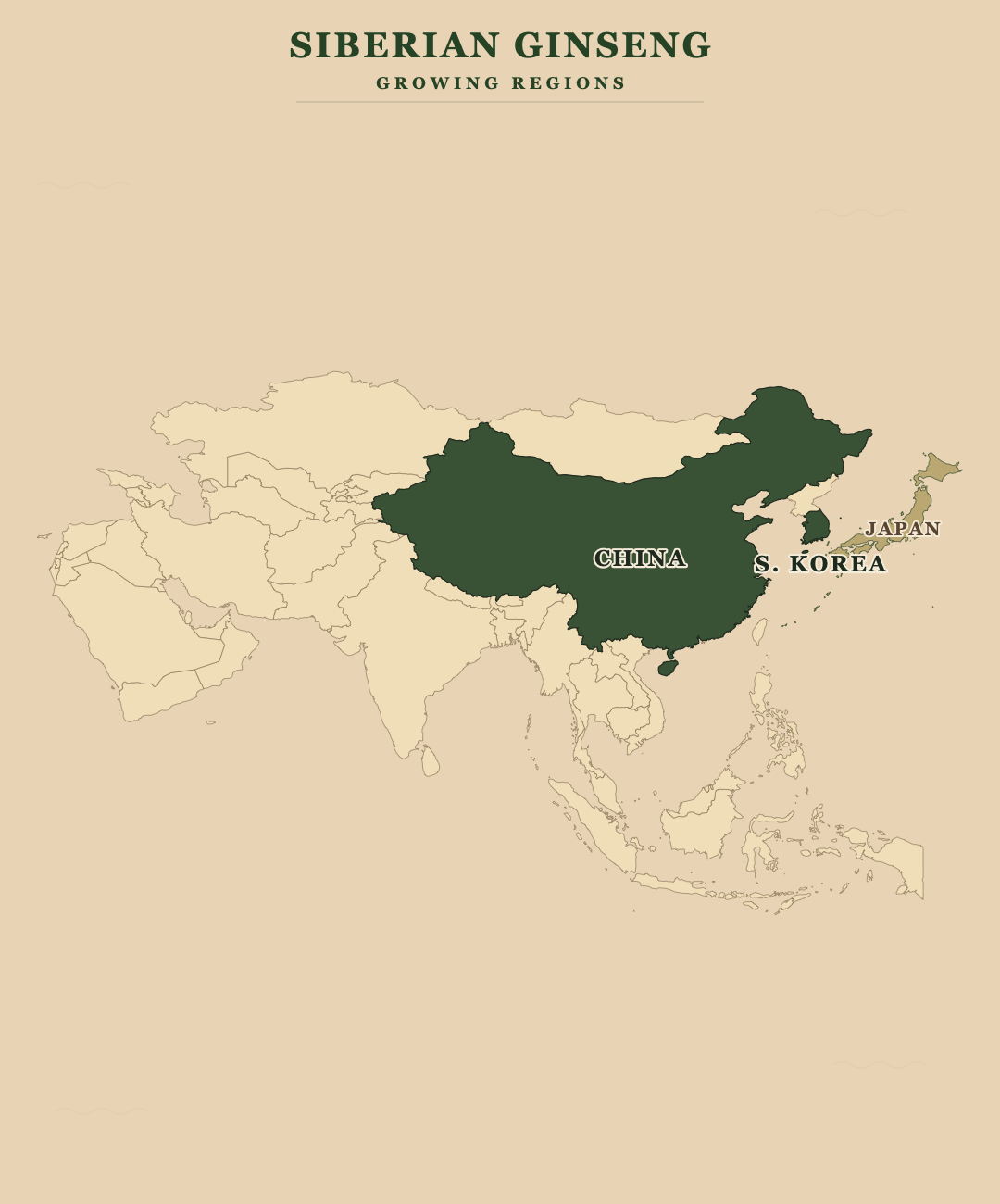
Siberian Ginseng is primarily cultivated in Russian Far East, north-east China, Korea, with secondary growing regions in Japan, limited cultivation in Europe.
Spice Story
Siberian Ginseng has a long history in traditional Chinese medicine, where it's known as ci wu jia and used as an adaptogen and circulatory tonic. The plant's modern global commercial profile dates to Soviet-era research in the 1960s, when researcher Israel Brekhman categorised eleuthero alongside Panax ginseng as an "adaptogen" and the Soviet Union promoted it as a more accessible domestic alternative to imported Asian ginseng. Soviet space and Olympic-athlete programs reportedly used it. Modern herbal commerce includes Siberian Ginseng across wellness teas and supplements. In gin, it's an unusual contemporary botanical providing earthy-root depth.
Gin Creativity
Siberian Ginseng brings earthy-root character with a quietly bitter background. A quarter to half sachet is plenty — full sachet use can dominate. Pair with Panax ginseng for an "adaptogen blend," or with liquorice and cardamom for an East-Asian tonic profile.
Blending Science
Main flavour compounds
 Eleutherosides (multiple distinct compounds)—
 Polysaccharides—
 Lignans—
Eleutherosides (a family of distinct compounds named after the genus) provide the characteristic earthy-bitter character and most of the documented bioactive properties. Polysaccharides contribute body. Lignans add background astringent depth. Long warm extraction develops the full character.
Food Partners
- East-Asian tonic broths — Siberian Ginseng in long-simmered restorative soups.
- Adaptogen-style herbal blends — wellness market.
- Slow-cooked root vegetable dishes — earthy-on-earthy pairings.
- Aged spirits — Siberian Ginseng as bitters base.
- Bitter herbal teas — Siberian Ginseng as a foundational ingredient.
Cocktails To Try

- Adaptogen Sour — Siberian Ginseng gin, honey, lemon, egg white.
- Russian Tonic — Siberian Ginseng gin, tonic, lemon.
- Bitter Negroni — Siberian Ginseng gin, Campari, vermouth.
Release The Flavour
- Long warm extraction — slow-extracting eleutherosides.
- Slice thinly — increases surface area.
- Verify identity — many "Siberian Ginseng" products are adulterated; verify supplier.
- Distinct from Panax ginseng — different chemistry, complementary rather than substitutable.
Discover more
From the same region
Pairs well with

Same flavour family
Surprise me

Sources & Citations
- scientific_name (Eleutherococcus senticosus, Araliaceae):en.wikipedia.org/wiki/Eleutherococcus_senticosus
- NOT_true_ginseng_distinct_from_panax:en.wikipedia.org/wiki/Eleutherococcus_senticosus
- northeast_asia_native:en.wikipedia.org/wiki/Eleutherococcus_senticosus
- soviet_research_established_adaptogen_status:en.wikipedia.org/wiki/Eleutherococcus_senticosus
- main_flavour_compounds (CSV-sourced):inputs/source.csv — Siberian Ginseng row
