
MATCHA

- Botanical name
- Camellia sinensis (shade-grown, stone-ground)
- Also known as
- Japanese green tea powder, Uji matcha (premium origin)
- Main flavour compound
- L-Theanine (the umami amino acid)
- Part used
- Stone-ground powder of shade-grown green tea leaves
- Method of cultivation
- Matcha is a particular preparation of *Camellia sinensis*, the universal tea plant. The defining steps are: tea plants are shaded for about 3 weeks before harvest (which forces the leaves to produce more chlorophyll and amino acids, deepening the green colour and umami sweetness); leaves are steamed, dried without rolling (to preserve the cell structure), and then stone-ground into the fine bright-green powder. Uji (Kyoto, Japan) is the most famous production region — tea cultivation there began over 800 years ago when Zen monks introduced Camellia sinensis from China.
- Commercial preparation
- Premium matcha (especially ceremonial-grade Uji matcha) is stone-ground in granite mills at low speed to prevent heat damage to the chlorophyll and amino acids; cheaper "culinary grade" matcha is machine-ground faster. Quality is graded on colour intensity (deeper green = higher grade), texture fineness, sweetness on the tongue and absence of bitter or grassy off-notes.
- Non-culinary uses
- Foundational ingredient in the Japanese tea ceremony (*chanoyu* or *sadō*); modern matcha-flavoured confectionery (chocolate, ice cream, lattes) — a major global trend since the 2010s; cosmetic and skincare use.
Matcha is not a separate plant — it is a particular preparation of Camellia sinensis, the universal tea plant, made with three specific techniques that set it apart from other green teas. First, the tea plants are shaded for about three weeks before harvest, which forces them to produce more chlorophyll and the amino acid L-theanine (deepening the green colour and umami-sweet character). Second, the leaves are steamed and dried without rolling, preserving the cell structure intact. Third, the dried whole leaves are stone-ground into a fine bright-green powder — traditionally in granite mills running slowly enough that heat doesn't damage the active compounds. [source] Uji (Kyoto, Japan) is the historic centre of premium matcha production.
Fine green powder
The standard form — disperses quickly in cool maceration.
Tea-cut leaf (less common)
Slower extraction; rarely sold as matcha proper.
Region of cultivation
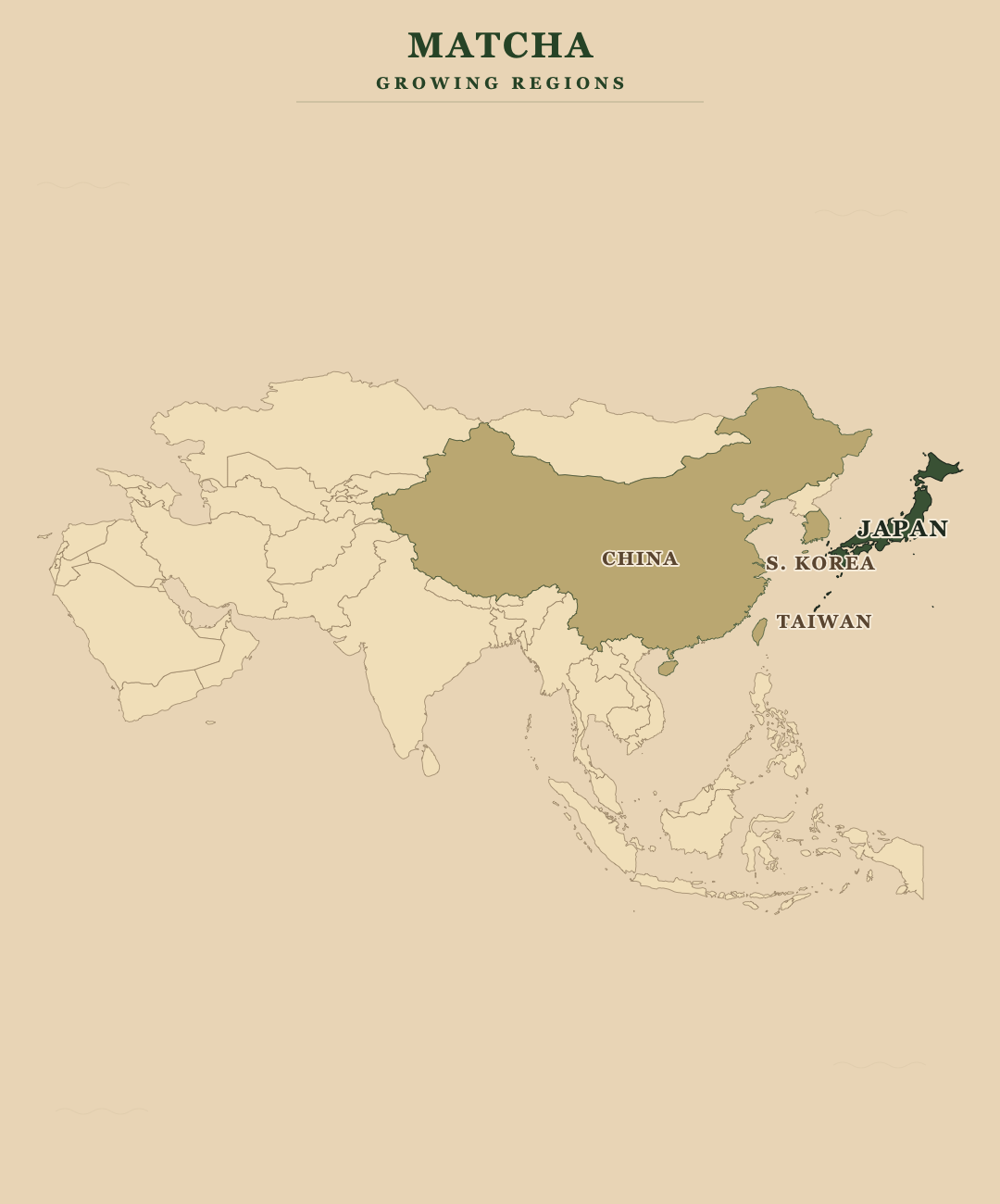
Matcha is primarily cultivated in Japan — Uji (Kyoto), Nishio (Aichi), with secondary growing regions in Limited production in China, Taiwan, Korea.
Spice Story
Tea cultivation in Uji began over 800 years ago, when Zen monks returning from China introduced Camellia sinensis to Japanese soil. [source] The shade-growing and stone-grinding techniques that define matcha developed over the subsequent centuries, particularly in the 12th–15th centuries when Zen Buddhist tea-ceremony culture established itself. Matcha is the foundational ingredient in the Japanese tea ceremony (chanoyu) — a ritualised preparation and drinking practice that has been continuously practised in Japan for over 600 years. Modern matcha's global rise (matcha lattes, matcha desserts, matcha-everything-flavoured) is much more recent — driven by the 2010s wellness movement. In gin, matcha is a contemporary East-Asian-influenced botanical, providing umami-sweet vegetal character and a brilliant green colour.
Gin Creativity
Matcha brings umami-sweet vegetal complexity with a brilliant green colour. A full sachet pushes a gin into clearly matcha-tea territory — best for dessert-style cocktails; a half-sachet adds quiet umami body that integrates with juniper. Pair with white chocolate and vanilla for matcha-dessert profile, or with yuzu and rose petal for a contemporary East-Asian floral blend.
Blending Science
Main flavour compounds
 L-Theanine (the umami amino acid)—
 Catechins (EGCG)—
 Caffeine—
 Chlorophyll—
Pairs well with
- White chocolate
- Yuzu
- Rose petal
- Vanilla
- Sencha-style green tea
L-theanine is the defining amino acid — it's responsible for the savoury umami taste that distinguishes matcha from other green teas, and is significantly higher in shade-grown matcha than in sun-grown sencha. [source] Catechins (especially EGCG — epigallocatechin gallate) provide soft bitter-astringent depth and most of the documented health-benefit research. Caffeine contributes bitterness. Chlorophyll provides the brilliant green colour but is light- and heat-sensitive. Cool, brief extraction preserves both colour and umami.
Food Partners
- Matcha desserts — natural pairing.
- **Japanese confectionery (wagashi)** — matcha and red bean paste.
- Asian-fusion pastry — matcha cheesecake, matcha croissants.
- Lightly-perfumed fish — matcha-poached white fish.
- Fresh berries — matcha and strawberries are a chef's classic.
Cocktails To Try

- Matcha Martini — matcha gin, dry vermouth, citrus twist.
- Matcha-yuzu Sour — matcha gin, yuzu, lemon, egg white.
- Green Tea Negroni — matcha gin, Campari, sweet vermouth.
Release The Flavour
- Cool extraction — preserves the colour and umami.
- Brief contact — 30 minutes to 2 hours is enough.
- Strain very finely — matcha is suspended particle; cold filtration helps clarity.
- Source matters — Uji ceremonial-grade is significantly different from culinary-grade.
Discover more
From the same region
Same flavour family
Surprise me

Sources & Citations
- scientific_name (Camellia sinensis, shade-grown):musubikiln.com/blogs/journal/what-is-uji-matcha-all-about...
- shading_3_weeks_before_harvest:www.riverandstonetea.com/pages/background-on-japanese-mat...
- uji_kyoto_800_year_tradition:www.rishi-tea.com/blogs/journal/journey-to-the-source-uji...
- stone_grinding_traditional_process:breakawaymatcha.com/blogs/masterclass-in-matcha/how-match...
- l-theanine_umami_compound:musubikiln.com/blogs/journal/what-is-uji-matcha-all-about...
- main_flavour_compounds (CSV-sourced):inputs/source.csv — Matcha row
