
GARLIC

- Botanical name
- Allium sativum
- Also known as
- Lasun (Hindi), Suan (Chinese), Thoom (Arabic)
- Main flavour compound
- Allicin
- Part used
- Dried clove (whole, sliced or powdered)
- Method of cultivation
- Bulbous perennial of the Amaryllidaceae family (the same family as onion, leek, chive), native to Central Asia and northeastern Iran. Cultivated for over 10,000 years. The plant grows from a single clove planted in autumn or early spring; each clove produces a bulb of 10–20 cloves over the growing season. Nearly all commercial garlic is propagated asexually by clove division — true seed propagation is rare. China dominates world production by a wide margin.
- Commercial preparation
- Bulbs are harvested, dried in racks or barns for 2–4 weeks, the dry skins removed, and individual cloves separated. For the dried-spice trade, cloves are sliced or chipped and dehydrated, or powdered. Quality is graded on cure quality, intact skins, and absence of bitter or sulfide-off notes.
- Non-culinary uses
- One of the most widely-used medicinal plants in human history — antibacterial, cardiovascular, immunological uses across every major herbal tradition. The bioactive compound allicin (discovered 1944) is the focus of significant pharmaceutical research.
Garlic — Allium sativum — is a bulbous perennial of the onion family, propagated almost exclusively by clove division rather than seed. The plant produces strap-like flat leaves and (sometimes, depending on variety) a flowering scape topped with sterile bulbils. The bulb itself is the working part: a compound structure of 10–20 individual cloves, each one capable of producing a new plant. Garlic has been cultivated continuously across Central Asia, the Middle East, the Mediterranean and China for more than 10,000 years — making it one of the oldest crops in human use. [source]
Dried sliced clove
The standard form — releases pungency slowly across maceration.
Powdered
Convenient but loses character within months.
Region of cultivation
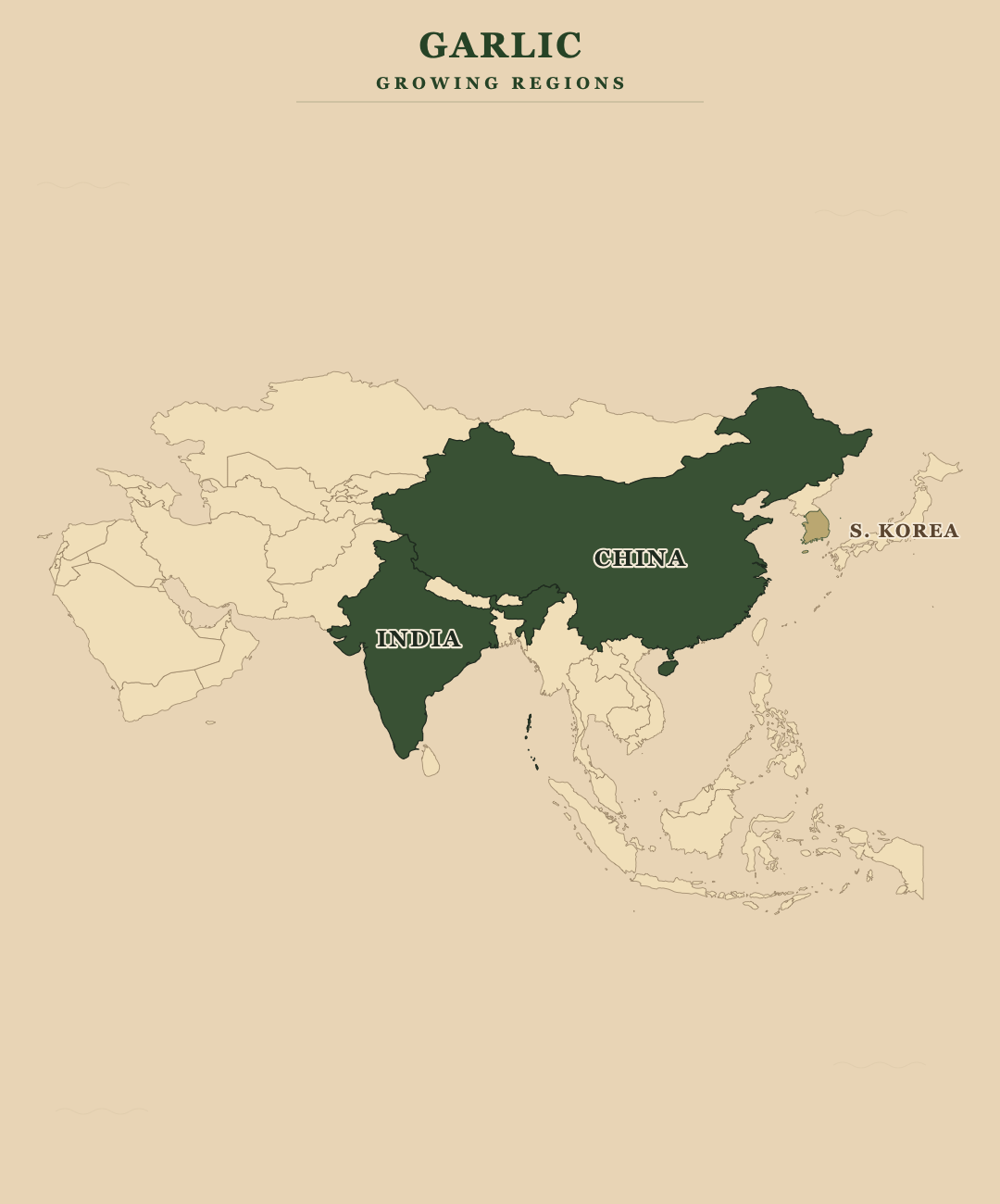
Garlic is primarily cultivated in China (dominant global producer), India, Egypt, Spain, with secondary growing regions in USA, Mexico, Korea, Russia.
Spice Story
Garlic appears in every major human cuisine and in nearly every major medicinal tradition. The Egyptians fed it to pyramid workers; Roman soldiers carried it on campaign; medieval European herbalists prescribed it for everything; Chinese, Indian, Korean and Middle Eastern cooking are all built around it. The defining flavour compound, allicin, was finally chemically identified in 1944. [source] Allicin is not present in intact garlic — it is formed when garlic cells are crushed or cut and the precursor compound alliin reacts with an enzyme (alliinase) to produce the characteristic pungency. China dominates the modern world market by a wide margin, producing the great bulk of commercial garlic. In gin, garlic is an uncommon but increasingly visible contemporary botanical, especially in savoury "kitchen garden" expressions where the goal is genuine cooking-style character.
Gin Creativity
Garlic is powerful — use sparingly. A quarter to half sachet adds clear savoury depth that pushes a gin firmly into Bloody-Mary territory; a full sachet is almost certain to dominate other botanicals. Pair with black pepper and bay leaf for a savoury cooking-style gin, or with rosemary and citrus peel for a Mediterranean profile. Avoid combining with very subtle florals.
Blending Science
Main flavour compounds
 Allicingarlic, sulfurous
 Diallyl disulfide—
 Diallyl trisulfide—
Pairs well with
- Black pepper
- Chilli
- Citrus peel
- Bay leaf
- Rosemary
Allicin is the defining compound, produced when garlic cells are damaged and the precursor alliin reacts with alliinase. Diallyl disulfide and diallyl trisulfide are downstream organosulphur compounds that contribute the deeper, more cooked-garlic notes. The compounds are alcohol-soluble and partially volatile; warm extraction develops a more cooked-garlic register, while cool brief extraction preserves the sharper raw-garlic top.
Food Partners
- Mediterranean and Middle Eastern cooking — every form.
- Asian stir-fries and curries — garlic-and-ginger base.
- Cured meats and sausages — garlic in salami, chorizo, merguez.
- Garlic butter sauces — finishing pour of garlic-gin over butter sauce.
- Spicy pickled vegetables — garlic-and-chilli pickles.
Cocktails To Try

- Savoury Bloody Mary — garlic-and-pepper gin, tomato, lemon, hot sauce.
- Italian Negroni — light garlic-gin, Campari, vermouth (use sparingly).
- Garlic Martini — garlic-rinsed glass, classic gin, dry vermouth, anchovy-stuffed olive.
Release The Flavour
- Cool brief extraction — captures the sharp raw character.
- Slice before use — exposes the alliinase enzyme for full allicin formation.
- Strain quickly — left in suspension, garlic continues to extract.
- Use sparingly — garlic dominates a blend at the first hint of excess.
Discover more
From the same region


Pairs well with
Same flavour family
Surprise me

Sources & Citations
- scientific_name (Allium sativum):en.wikipedia.org/wiki/Garlic
- cultivation_origin (Central Asia, 10,000+ years):hort.extension.wisc.edu/articles/garlic-allium-sativum/
- allicin_discovery_1944:www.frontiersin.org/journals/nutrition/articles/10.3389/f...
- china_dominant_producer:www.ebsco.com/research-starters/agriculture-and-agribusin...
- asexual_propagation_via_cloves:hort.extension.wisc.edu/articles/garlic-allium-sativum/
- main_flavour_compounds (CSV-sourced):inputs/source.csv — Garlic row
