
ROSEMARY

- Botanical name
- Salvia rosmarinus (formerly Rosmarinus officinalis)
- Also known as
- Old-style Latin: Rosmarinus officinalis; "Dew of the Sea" (Latin etymology)
- Main flavour compound
- Alpha-Pinene
- Part used
- Dried leaf
- Method of cultivation
- Small, dense evergreen aromatic shrub of the Lamiaceae (mint) family, native to the Mediterranean. In 2017 botanists reclassified rosemary into the genus *Salvia* based on molecular phylogenetic evidence — but the common name and culinary use have stayed exactly the same. The plant grows 60–150 cm tall, with narrow needle-like grey-green leaves and small blue-purple flowers. Cultivated extensively across southern Europe, North Africa, Asia, North and South America.
- Commercial preparation
- Leaves are picked at peak season (just before flowering when oil content is highest), gently dried, and either sold whole or cracked. Essential oil yield is about 1–2.5% by dry weight.
- Non-culinary uses
- Foundational kitchen herb across Mediterranean cooking; perfumery (a foundational fougère-family fragrance ingredient); cosmetics; aromatherapy; the Latin name *Rosmarinus* combines *ros* (dew) + *marinus* (of the sea) — "dew of the sea," reflecting the plant's preference for sea-side cliffs.
Rosemary — Salvia rosmarinus, formerly known as Rosmarinus officinalis — is a dense evergreen aromatic shrub of the mint family, native to the Mediterranean coastlines. The plant grows 60–150 cm tall, with narrow needle-like grey-green leaves that release the characteristic pine-resinous aroma at the slightest brush. Latin rosmarinus combines ros (dew) and marinus (of the sea) — "dew of the sea," reflecting rosemary's natural preference for sea-side cliffs and rocky coastal soils. In 2017, botanists reclassified rosemary into the genus Salvia based on molecular phylogenetic evidence; the plant's common name and culinary use have stayed the same. [source]
Whole dried leaf
The standard form — crumble lightly to release the oils.
Cracked
Faster extraction.
Region of cultivation
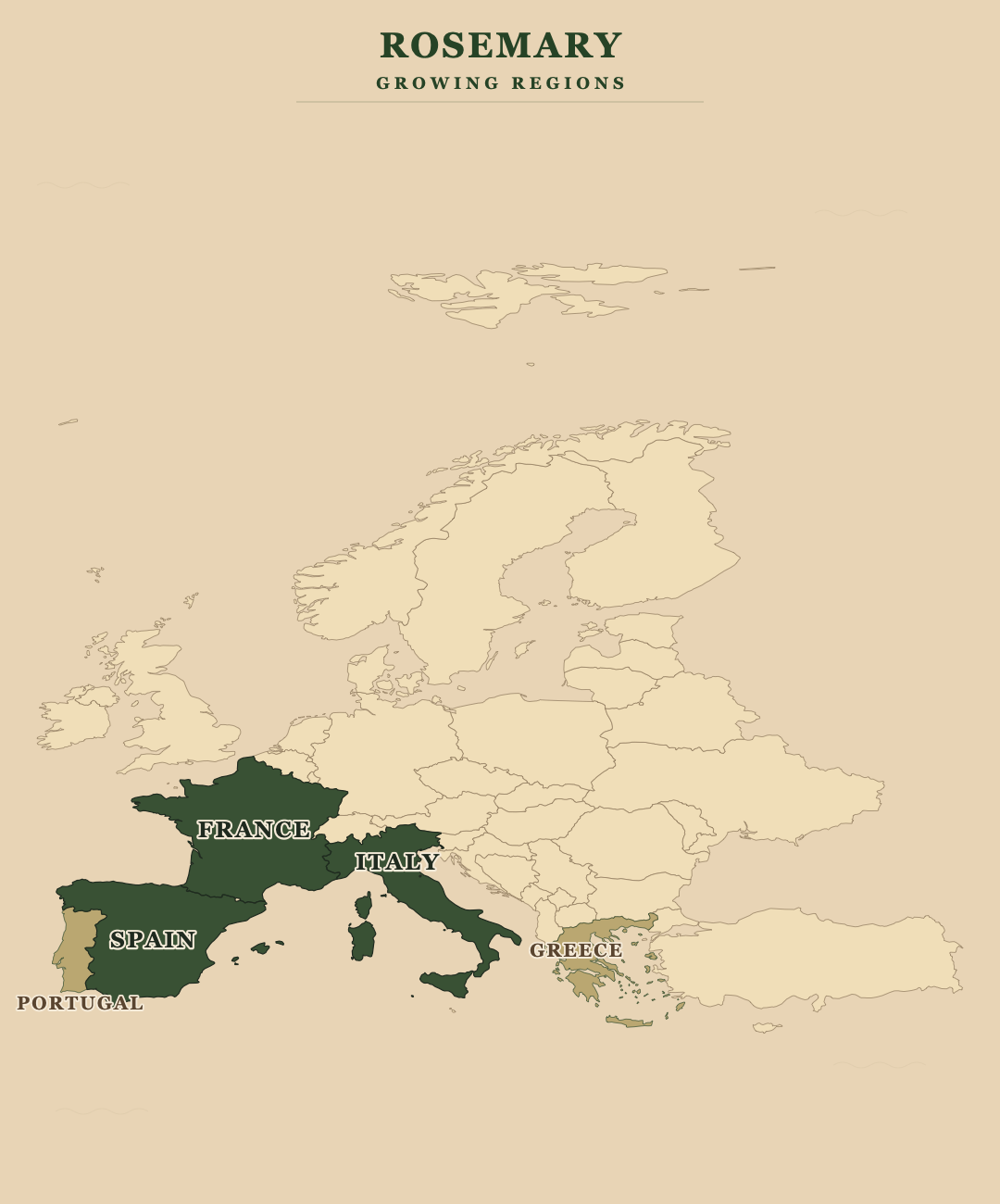
Rosemary is primarily cultivated in Spain, Italy, France, Tunisia, Morocco, with secondary growing regions in Greece, Portugal, USA, Australia, South Africa.
Spice Story
Rosemary has been cultivated continuously around the Mediterranean since at least classical times. The Romans used it widely; Greek and Roman students wore rosemary garlands during exams (a tradition reflected in Shakespeare's Hamlet: "There's rosemary, that's for remembrance"). The herb spread across medieval European gardens and became a staple of Italian, Provençal, Spanish and Greek cooking. Modern global production centres on Mediterranean Spain, Italy, France, Tunisia and Morocco. In gin, rosemary is one of the most foundational contemporary herbaceous botanicals, particularly in Mediterranean garden gins and contemporary craft expressions.
Gin Creativity
Rosemary brings resinous-herbal pine character with a faint camphor edge. A full sachet pushes a gin firmly into Mediterranean herb-garden territory; a half-sachet provides quiet pine-resinous depth that integrates with juniper (the two share alpha-pinene chemistry). Pair with thyme and lemon peel for a Provençal profile, or with sage and marjoram for a broader herb-garden blend.
Blending Science
Main flavour compounds
 Alpha-Pinenefresh pine, top note
 1,8-Cineoleeucalyptus, cool
 Camphor—
 Borneolcamphor, herbal-cool
Alpha-pinene dominates — providing the pine-resinous character that bridges rosemary chemically to juniper. 1,8-Cineole layers a cool eucalypt-edged top note. Camphor contributes the slightly medicinal cool depth that gives rosemary its characteristic "savoury" finish. Borneol adds further woody-camphor complexity. [source] Heat-stable; vapour and warm maceration both work cleanly.
Food Partners
- Roast lamb — the canonical Mediterranean pairing.
- Italian focaccia and bread — rosemary-and-olive-oil bread.
- Roast potatoes and root vegetables — Mediterranean tradition.
- Mediterranean fish — grilled fish with rosemary skewers.
- Honey-and-rosemary desserts — Mediterranean baking.
Cocktails To Try

- Rosemary Negroni — rosemary gin, Campari, vermouth.
- Mediterranean Sour — rosemary gin, honey, lemon, egg white.
- Roast G&T — rosemary gin, tonic, fresh rosemary sprig.
Release The Flavour
- Heat-friendly — survives vapour and warm maceration.
- Crumble gently — releases the volatile oils.
- Time — 24–48 hours for full development.
- Pair with juniper — rosemary and juniper reinforce each other through shared pinene chemistry.
Discover more
From the same region
Same flavour family
Surprise me

Sources & Citations
- scientific_name (Salvia rosmarinus, Lamiaceae):en.wikipedia.org/wiki/Rosemary
- 2017_reclassification_from_Rosmarinus_to_Salvia:en.wikipedia.org/wiki/Rosemary
- mediterranean_origin:www.mdpi.com/2223-7747/13/23/3395
- essential_oil_compounds (pinene, cineole, camphor, borneol):www.mdpi.com/2223-7747/13/23/3395
- oil_yield_1-2.5_percent:www.sciencedirect.com/science/article/abs/pii/S3050475925...
- main_flavour_compounds (CSV-sourced):inputs/source.csv — Rosemary row
