
SAGE

- Botanical name
- Salvia officinalis
- Also known as
- Common sage, Garden sage, Dalmatian sage
- Main flavour compound
- Alpha-Thujone
- Part used
- Dried leaf
- Method of cultivation
- Evergreen subshrub of the Lamiaceae (mint) family, native to the Mediterranean and naturalised worldwide in temperate regions. The plant grows 60–90 cm tall, with grey-green velvety leaves and blue-purple spike flowers. Sage thrives in well-drained calcareous soils and full sun (typical Mediterranean conditions). Picked at peak season just before flowering, when essential-oil content is highest (1–2% of dry weight).
- Commercial preparation
- Leaves are harvested in May or June (just before flowering), gently dried, and either sold whole or cracked. Quality commercial sage is mostly grown in Albania, Croatia (Dalmatian sage — premium grade), Italy, France and the USA.
- Non-culinary uses
- Foundational kitchen herb across Mediterranean and northern European cooking; traditional medicine across European herbalism for digestion, sore throats and as a memory tonic (the Latin *salvia* derives from *salvare*, "to save"); ceremonial smudge use (though this typically uses white sage *Salvia apiana*, a related New World species).
Sage — Salvia officinalis — is an evergreen subshrub of the mint family, native to the Mediterranean and naturalised across temperate regions worldwide. The plant grows 60–90 cm tall, with grey-green velvety pebbly-textured leaves and spikes of small blue-purple flowers. The genus name Salvia derives from Latin salvare — "to save" — reflecting the herb's long history of medicinal use across European herbalism. [source] Croatia's Dalmatian coast produces what is generally considered the premium grade of culinary sage.
Whole dried leaf
The standard form — crumble lightly to release the oils.
Cracked
Faster extraction.
Region of cultivation
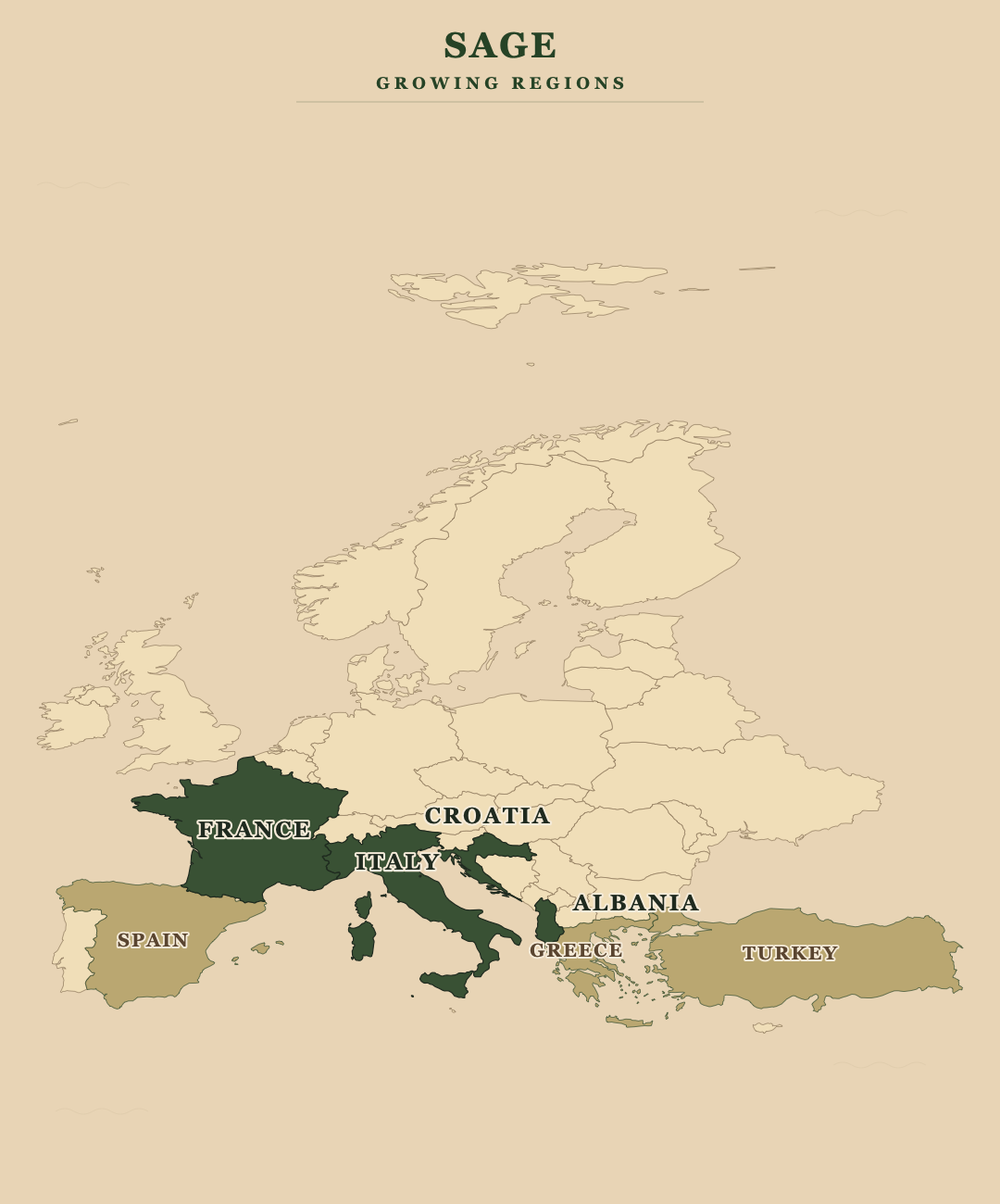
Sage is primarily cultivated in Albania, Croatia (Dalmatia), Italy, France, USA, with secondary growing regions in Greece, Spain, Turkey, Australia.
Spice Story
Sage has been used as both medicinal and culinary herb across the Mediterranean since classical times — Roman writers like Pliny mentioned it for both purposes. The medieval European tradition built sage into garden cooking across the continent, particularly in Italian and French cooking. The thujone content of sage (and its close cousin wormwood Artemisia absinthium) is significant: thujone is a neurotoxin in large doses, and is the same compound that drove the historic regulatory concerns about absinthe. Culinary use is well below safety thresholds. [source] In gin, sage is a contemporary herbaceous botanical, particularly in Mediterranean garden gins and contemporary craft expressions.
Gin Creativity
Sage brings earthy-resinous character with a sharp camphor-cool background. A full sachet pushes a gin firmly into Mediterranean-herb territory; a half-sachet provides quiet herbaceous depth that integrates with juniper. Pair with rosemary and thyme for a Provençal herb-garden profile, or with bay leaf and juniper for a London Dry with extra herbaceous body.
Blending Science
Main flavour compounds
 Alpha-Thujone—
 Beta-Thujone—
 Camphor—
 1,8-Cineoleeucalyptus, cool
Alpha-thujone and beta-thujone are the defining compounds — together typically 30–60% of sage essential oil. Thujone is what gives sage its characteristic earthy-camphor-sharp flavour. Camphor contributes additional cooling character. 1,8-Cineole adds a soft eucalypt edge. Heat-stable; both vapour and warm maceration work.
Food Partners
- Italian saltimbocca and roast veal — sage on veal is canonical Italian.
- Roast pork and lamb — sage in stuffings and rubs.
- Brown-butter sauce with pasta — burro e salvia, the simplest Italian pasta sauce.
- Stuffing for poultry — Thanksgiving and Christmas tradition.
- Cannellini bean dishes — Tuscan tradition.
Cocktails To Try

- Sage Gin & Tonic — sage gin, tonic, fresh sage sprig.
- Mediterranean Negroni — sage gin, Campari, sweet vermouth.
- Sage Sour — sage gin, lemon, honey, egg white.
Release The Flavour
- Crumble gently — releases the volatile oils.
- Heat-friendly — survives both vapour and warm maceration.
- Time — 24–48 hours for full development.
- Source matters — Dalmatian sage from Croatia is the European premium grade.
Discover more
Pairs well with
Same flavour family
Surprise me

Sources & Citations
- scientific_name (Salvia officinalis, Lamiaceae):en.wikipedia.org/wiki/Salvia_officinalis
- mediterranean_native_range:en.wikipedia.org/wiki/Salvia_officinalis
- thujone_content_1-9_percent:www.ncbi.nlm.nih.gov/pmc/articles/PMC7763040/
- salvia_salvare_etymology:en.wikipedia.org/wiki/Salvia_officinalis
- harvest_may_june_pre_flowering:cloverleaffarmherbs.com/sage/
- main_flavour_compounds (CSV-sourced):inputs/source.csv — Sage row
