
PINK PEPPERCORN

- Botanical name
- Schinus terebinthifolia (more common) or Schinus molle (Peruvian pepper)
- Also known as
- Brazilian pepper, Christmas berry, Aroeira (Portuguese), Faux poivre (French)
- Main flavour compound
- Alpha-Phellandrene
- Part used
- Dried fruit (drupe)
- Method of cultivation
- Sprawling shrub or small tree of the Anacardiaceae family (the same family as cashew and mango — not related to true black pepper at all). *Schinus terebinthifolia* is native to Brazil, Paraguay and Argentina; *Schinus molle* (Peruvian pepper) is native to the Andean dry forests. The trees grow 7–10 metres tall, are dioecious (separate male and female plants), and the female trees produce decorative pink-red drupes. Pink peppercorns are NOT true pepper despite the name; they are unrelated to *Piper nigrum*.
- Commercial preparation
- Ripe pink-red drupes are picked, dried gently to preserve the brittle outer shell and the small inner seed inside, and either sold whole or lightly cracked. Réunion Island (a French territory) is a significant commercial source.
- Non-culinary uses
- Decorative use in spice blends (the brilliant pink colour is part of the appeal); some traditional Indigenous South American medicinal use; ornamental tree in Mediterranean and Californian landscaping; the species is classified as an invasive pest in Florida.
Pink Peppercorn is not true pepper. Despite the name and superficial resemblance, pink peppercorns are the dried drupes of Schinus terebinthifolia (or, less commonly, Schinus molle), trees of the Anacardiaceae family — relatives of cashew, mango and poison ivy, but completely unrelated to true pepper (Piper nigrum). The trees are native to South America (Brazil, Paraguay, Argentina) and produce small pink-red berries on female trees only — Schinus species are dioecious. [source] Réunion Island in the Indian Ocean is a significant modern commercial source.
Whole dried drupe
The standard form — bruise lightly before use; the brittle outer shell breaks easily.
Cracked
Faster extraction.
Region of cultivation
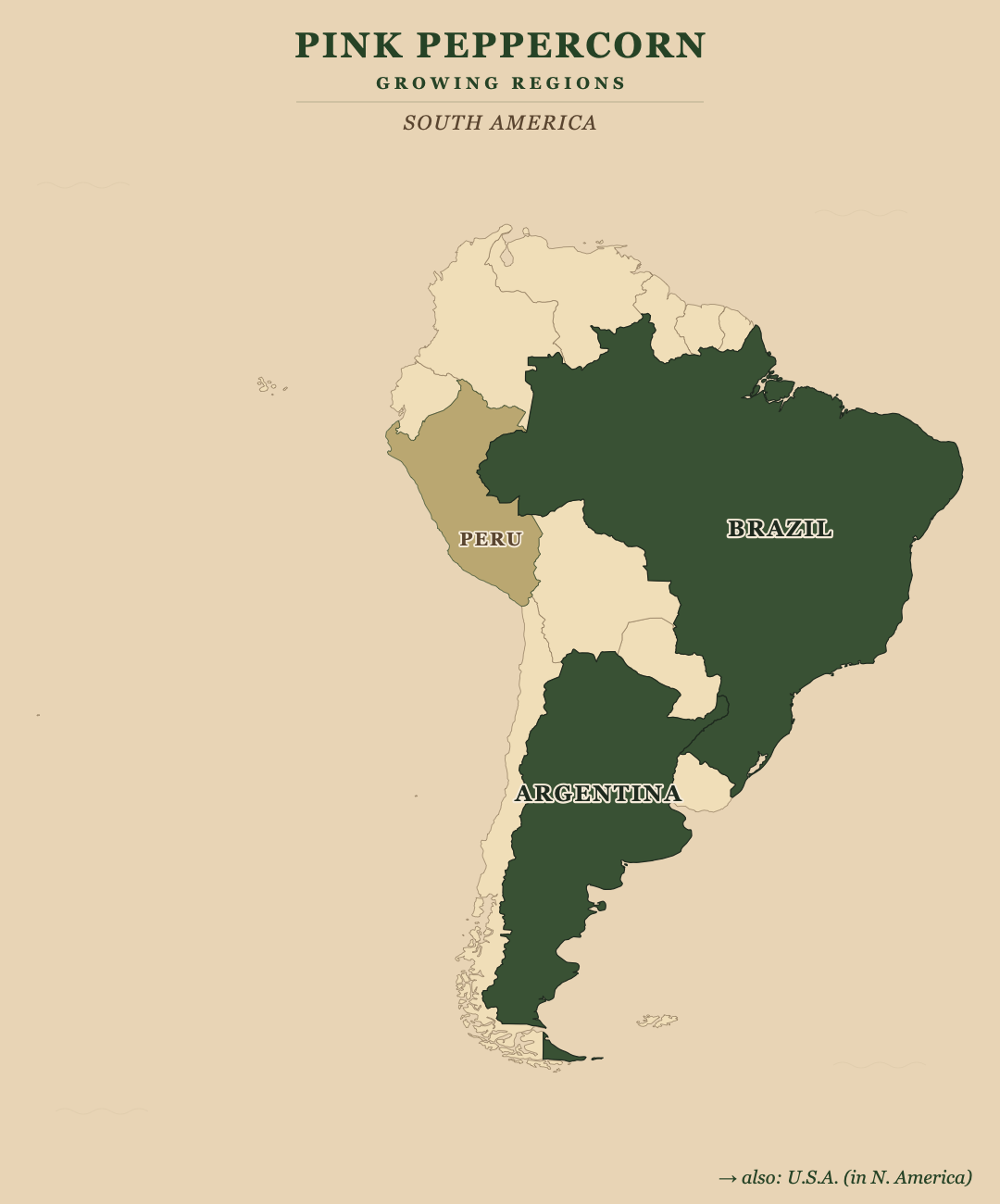
Pink Peppercorn is primarily cultivated in Brazil, Argentina, Réunion Island (commercial), with secondary growing regions in Madagascar, USA (California), Peru.
Spice Story
Pink peppercorns were originally a regional South American spice that became internationally fashionable in the 1980s with the rise of nouvelle cuisine, where the bright pink colour and mild peppery-fruity character fitted perfectly with the aesthetic of the period. The spice was briefly banned in the USA in the 1980s due to allergy concerns (since people allergic to cashew can also react to pink peppercorn — the family connection matters), but is now widely available. The Brazilian pepper tree is also notoriously invasive — classified as a Category I pest in Florida, where its sale and planting is legally prohibited. In gin, pink peppercorns provide mild fruity-pepper character with a distinctive pink visual signal.
Gin Creativity
Pink Peppercorn brings mild fruity-pepper character without the sharp heat of true black pepper. A full sachet pushes a gin into clearly pink-peppered territory; a half-sachet provides quiet fruity warmth that integrates with juniper. Pair with bergamot and rose petal for a contemporary floral-pepper profile, or with cardamom and coriander seed for a more spice-route blend.
Blending Science
Main flavour compounds
 Alpha-Phellandrenecitrus-mint, peppery
 Limoneneclean citrus lift
 Beta-Caryophyllenewarm woody, peppery
Pairs well with
- Bergamot
- Rose petal
- Cardamom
- Citrus peel
- Coriander seed
Alpha-phellandrene is the dominant compound — a monoterpene contributing the characteristic mild-peppery aromatic. Limonene adds citrus brightness. Beta-caryophyllene layers a warm woody depth. Notably no piperine — pink peppercorn is not a true pepper and has none of the heat-driving alkaloids of Piper nigrum. The flavour is fragrant and warm rather than hot. Cool extraction preserves the bright top.
Food Partners
- Pink-themed cocktails and confections — pink peppercorn is as much visual as gustatory.
- Stone-fruit desserts — peach-and-pink-peppercorn syrup.
- Light fish dishes — pink peppercorn in butter sauces.
- Salmon and tuna tartare — pink peppercorn crust.
- Soft white cheese — chèvre with pink peppercorn.
Cocktails To Try

- Pink Negroni — pink peppercorn gin, Aperol, Lillet Rosé.
- Pink Spritz — pink peppercorn gin, rosé, soda.
- Rose-Pepper Gin Sour — pink peppercorn-and-rose gin, lemon, honey.
Release The Flavour
- Bruise lightly — the brittle outer shell breaks easily.
- Cool extraction — preserves the fruity character.
- Brief contact — 1–4 hours captures freshness.
- Allergy note — pink peppercorn can trigger reactions in people allergic to cashew.
Discover more
From the same region
Pairs well with
Same flavour family
Surprise me

Sources & Citations
- scientific_name (Schinus terebinthifolia, Anacardiaceae):en.wikipedia.org/wiki/Schinus_terebinthifolia
- not_true_pepper (unrelated to Piper nigrum):grokipedia.com/page/Pink_peppercorn
- south_american_native_range:grokipedia.com/page/Pink_peppercorn
- anacardiaceae_family (cashew/mango family):en.wikipedia.org/wiki/Schinus_terebinthifolia
- dioecious_separate_male_female_trees:en.wikipedia.org/wiki/Schinus_terebinthifolia
- main_flavour_compounds (CSV-sourced):inputs/source.csv — Pink Peppercorn row
