
ORRIS ROOT


- Botanical name
- Iris pallida (premium), Iris germanica (commercial)
- Also known as
- Iris root, Florentine iris (var. florentina)
- Main flavour compound
- Cis-Alpha-Irone
- Part used
- Dried, aged rhizome
- Method of cultivation
- Perennial flowering plant of the Iridaceae family. The two commercial species are *Iris pallida* (the premium perfumery iris, cultivated in Tuscany, France and Croatia) and *Iris germanica* (the more widely-cultivated common iris, grown in Morocco and China). Plants are grown for 3 years before the rhizomes are harvested; the rhizomes are then aged for a further 3–5 years before the characteristic violet-powdery aroma develops fully (the aroma is not present in fresh root — it forms only during slow enzymatic transformation during ageing).
- Commercial preparation
- Rhizomes are harvested after 3 years of growth, cleaned, peeled, sun-dried, and then aged in controlled-humidity conditions for 3–5 years. During this ageing period, odourless precursor compounds undergo enzymatic transformation to produce the irones — the molecules responsible for the characteristic violet-powdery scent. The total 6–8 year process makes orris one of the most expensive natural materials in perfumery, sometimes selling for hundreds of euros per kilogram for premium Tuscan material.
- Non-culinary uses
- Foundational perfumery base note and fixative (one of the great natural fragrance materials, used in nearly every classical perfume); cosmetics; traditional fixative for sachet pomanders and potpourri.
Orris is the dried and aged rhizome of certain iris species — primarily Iris pallida (the premium perfumery iris) and Iris germanica (the more widely-cultivated common iris). [source] The plants themselves are familiar garden flowers, but the working part is below ground: thick fleshy rhizomes harvested after 3 years of growth. The most remarkable feature of orris is that the characteristic violet-powdery scent that has made it one of the most expensive natural materials in perfumery is not present in fresh root — it only develops during a slow 3–5 year ageing process, during which odourless precursor compounds undergo enzymatic transformation into the irones that define the orris aroma.
Aged chipped root
The standard form — slow extraction.
Powdered (aged)
Faster extraction; classic gin botanical form.
Region of cultivation
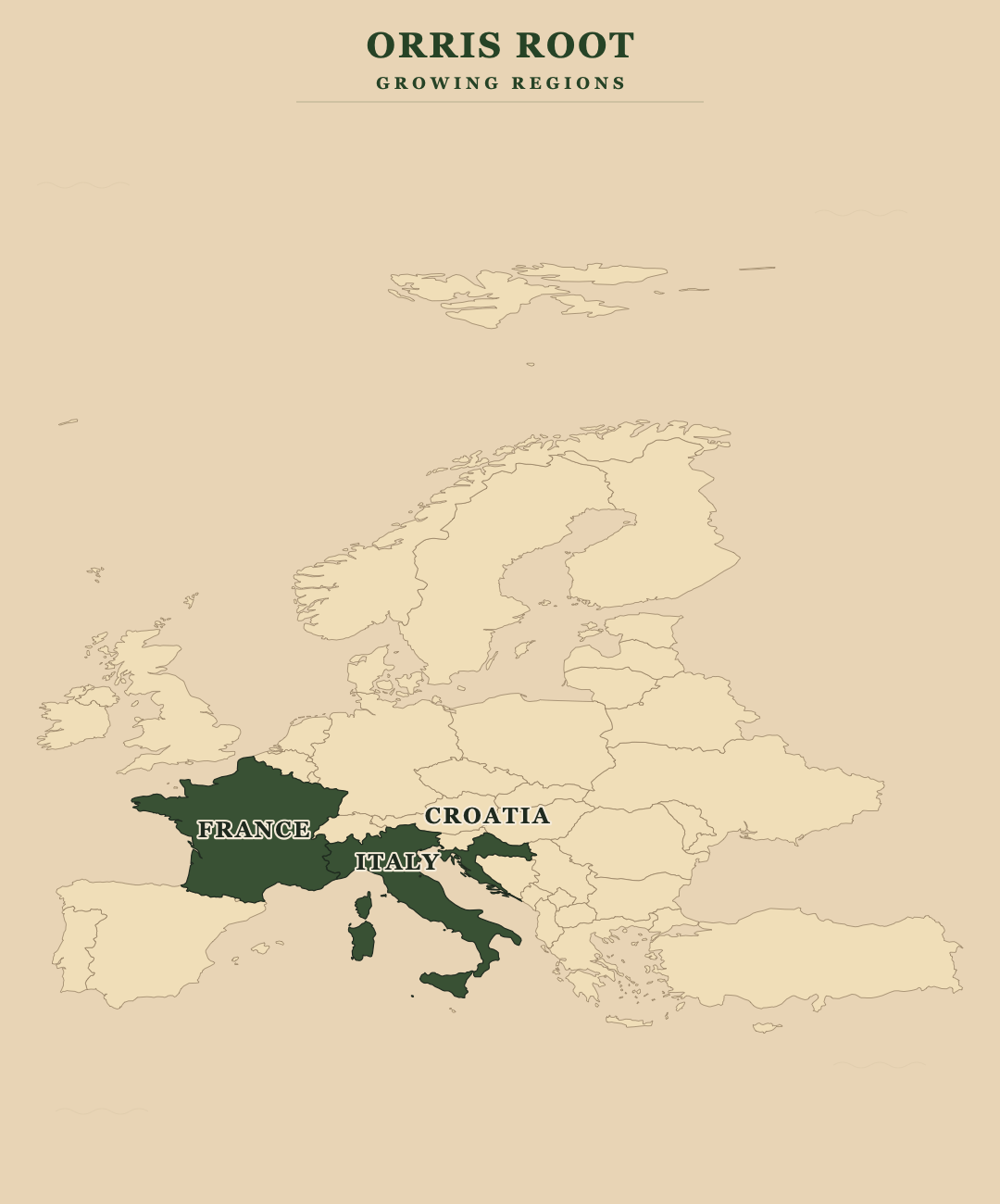
Orris Root is primarily cultivated in Italy (Tuscany — premium *Iris pallida*), France, Croatia (Dalmatian coast), with secondary growing regions in Morocco, China (commercial *Iris germanica*).
Spice Story
Orris root is one of the great underappreciated workhorses of the European spirit and perfumery tradition. The 6–8 year total time investment (3 years cultivation + 3–5 years ageing) makes orris one of the most expensive natural materials in commerce, sometimes selling for hundreds of euros per kilogram for premium Tuscan Iris pallida. [source] Aged orris has been a foundational gin botanical for centuries, providing a non-volatile fixative role — it doesn't contribute a prominent top note, but it binds and rounds the more volatile aromatics in a botanical bill, giving the spirit length and depth on the finish. Almost every classical London Dry uses orris root in small but essential amounts.
Gin Creativity
Orris is a structural botanical, not a flavour botanical — it adds violet-powdery depth and binds other aromatics together. A small amount (less than half a sachet) is the right inclusion for almost any gin; full sachet use is rare. Pair with angelica root for layered structural depth, or with rose petal and cardamom for an explicitly floral profile.
Blending Science
Main flavour compounds
 Cis-Alpha-Irone—
 Cis-Gamma-Irone—
 Methyl Myristate—
Pairs well with
Cis-alpha-irone and cis-gamma-irone are the defining compounds — formed during the long ageing of the rhizome from odourless precursors. [source] These compounds produce the characteristic violet-powdery scent that no other natural material matches. Methyl myristate contributes fatty body. Like other rhizome fixatives, orris extracts slowly and acts more as a structural binder than as a prominent flavour. Long warm extraction develops the full character.
Food Partners
- Rose-and-violet desserts — orris and rose are perfumery's classical pair.
- Fixed-floral confections — violet-flavoured sweets.
- Spirits and aperitifs — gin is the canonical use; also appears in some vermouth recipes.
- Soft fresh cheese — orris-and-honey syrup over chèvre.
- Floral teas — orris in floral tea blends.
Cocktails To Try

- Classic Martini — orris-rich gin shows its structural value most clearly here.
- Negroni — orris adds the "binding" depth that holds Campari and vermouth together.
- Aviation — gin, maraschino, lemon, violet — orris-and-violet axis.
Release The Flavour
- Long warm extraction — 48+ hours for full irone development.
- Aged powder — fresh orris has none of the character; verify age with supplier.
- Less is more — small amounts go a long way.
- Source matters — Tuscan Iris pallida is the absolute premium grade.
Discover more
From the same region


Pairs well with

Same flavour family
Surprise me

Sources & Citations
- scientific_name_species (Iris pallida, Iris germanica):www.fragrantica.com/notes/Orris-Root-101.html
- ageing_process (3-5 years for irones to develop):premierepeau.com/blogs/news/orris-root-perfumerys-5-year-...
- cultivation_regions (Tuscany premium; Morocco China commercial):premierepeau.com/blogs/news/orris-root-perfumerys-5-year-...
- irones_signature_compounds:caperfume.com/pages/discover-ingredient/orris-root
- total_6-8_year_growing_and_ageing:premierepeau.com/blogs/news/orris-root-perfumerys-5-year-...
- main_flavour_compounds (CSV-sourced):inputs/source.csv — Orris Root row
