
EUCALYPTUS BLUE GUM

- Botanical name
- Eucalyptus globulus
- Also known as
- Tasmanian Blue Gum, Southern Blue Gum, Eucalyptus
- Main flavour compound
- 1,8-Cineole
- Part used
- Dried leaf
- Method of cultivation
- Identical to Blue Gum (see Blue Gum entry) — endemic to Tasmania and south-east Victoria, now globally plantation-cultivated for essential oil. The CSV records both "Blue Gum" and "Eucalyptus Blue Gum" as separate entries; this entry refers to the same species *Eucalyptus globulus* in its formally-named market form.
- Commercial preparation
- See Blue Gum entry.
- Non-culinary uses
- Pharmaceuticals (cough syrups, decongestants); cleaning products; pulp and paper plantation timber; perfumery.
Eucalyptus Blue Gum and "Blue Gum" refer to the same species — Eucalyptus globulus — and both names appear in the CSV as separate entries. The plant is endemic to south-east Tasmania and southern Victoria, growing as a tall evergreen of the Myrtaceae family up to 50–60 metres in old-growth, with characteristic glaucous (blue-grey) juvenile leaves that give the species its name. See the Blue Gum entry (botanicals/blue-gum.md) for the fuller plant description, spice story, blending science and food partners.
Whole dried leaf
The standard form; crumble lightly to expose oils.
Cracked leaf
Faster extraction; fades within months.
Region of cultivation
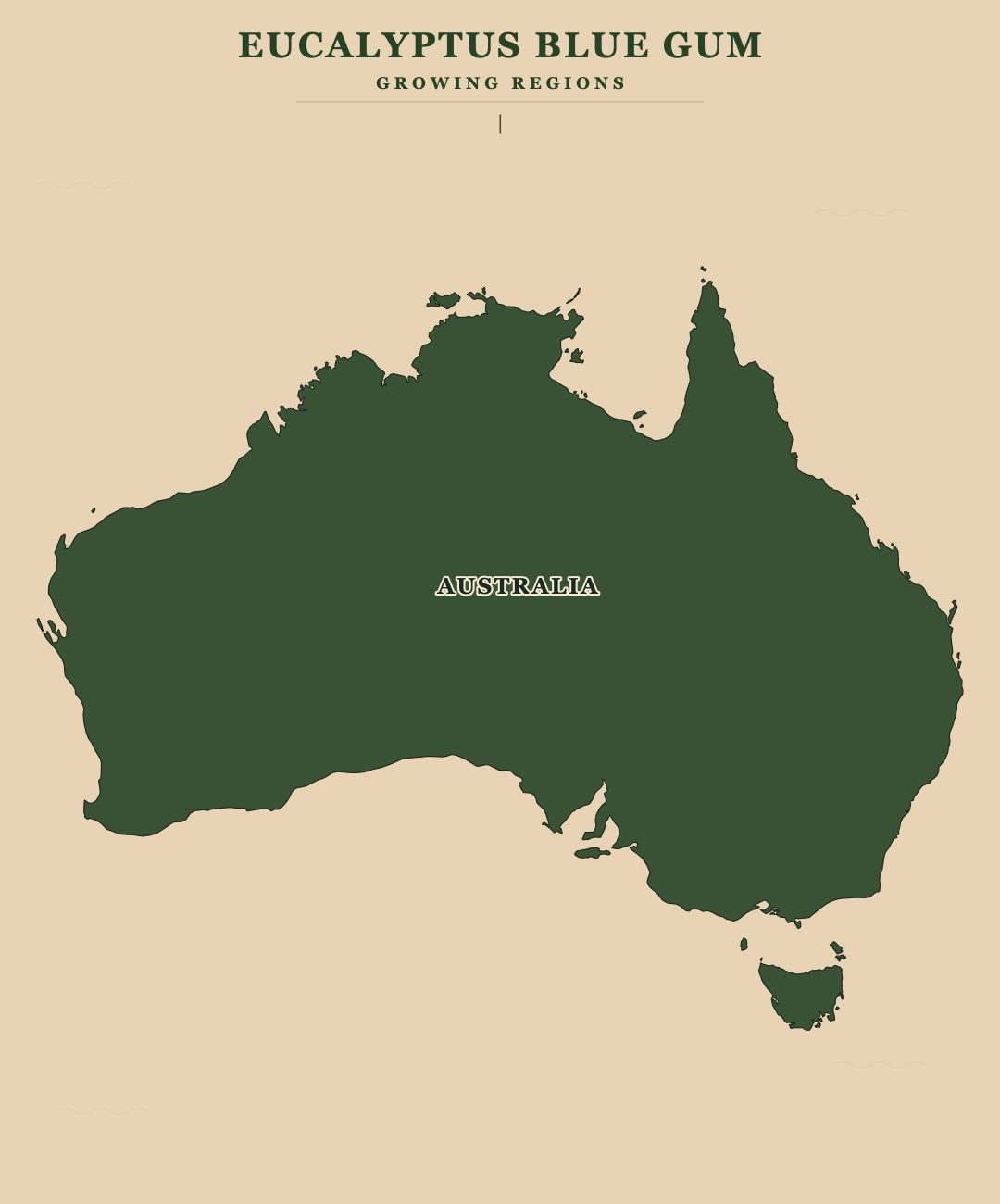
Eucalyptus Blue Gum is native to Australia, Australia — Tasmania, south-east Victoria, with secondary growing regions in Worldwide plantation (China largest producer of oil). |
Spice Story
See Blue Gum entry for full treatment. Key points: the species is the floral emblem of Tasmania, was first scientifically recorded in 1792, and is now the dominant commercial eucalyptus oil species worldwide — with China as the largest producer despite the plant's Australian origin.
Gin Creativity
See Blue Gum entry. Brief recap: a full sachet pushes a gin into clearly eucalypt-medicinal territory; a half-sachet provides recognisably Australian aromatic lift. Pairs with lemon myrtle for a Tasmanian-style native gin.
Blending Science
Main flavour compounds
 1,8-Cineoleeucalyptus, cool
 Alpha-Pinenefresh pine, top note
 Limoneneclean citrus lift
Pairs well with
See Blue Gum entry. 1,8-Cineole at 70–85% is the dominant compound, supported by alpha-pinene (juniper-friendly) and limonene (citrus lift).
Discover more
From the same region
Pairs well with
Same flavour family
Surprise me

Sources & Citations
- cross-reference:botanicals/blue-gum.md (full treatment of this species)
- scientific_name:staging.cabi.org/isc/datasheet/22680
- main_flavour_compounds (CSV-sourced):inputs/source.csv — Eucalyptus Blue Gum row
