
VIOLET


- Botanical name
- Viola odorata
- Also known as
- Sweet violet, English violet, Common violet, Parma violet
- Main flavour compound
- Alpha-Ionone
- Part used
- Dried flower (and sometimes dried leaf)
- Method of cultivation
- Small perennial herb of the Violaceae family, native to Europe and parts of Asia, naturalised across temperate regions worldwide. The plant grows low to the ground (15 cm or less), with heart-shaped leaves and the iconic small purple flowers in early spring. Cultivation centres on Egypt (where commercial violet leaf absolute has been produced since the early 20th century) and Parma in Italy (where the violet industry was established by Marie Louise Bonaparte and still thrives). The flowers are extraordinarily labour-intensive to harvest and process, which is why true violet flower extract is one of the most expensive natural perfumery materials.
- Commercial preparation
- Flowers are hand-picked before dawn at peak bloom. For the dried-flower trade, petals are gently air-dried at low temperature. For perfumery, the violet **leaf** absolute (solvent-extracted) has largely replaced the impossibly-expensive violet flower extract — leaf absolute provides a similar character at a fraction of the cost.
- Non-culinary uses
- Foundational perfumery ingredient (one of the great floral notes of Western fragrance); crystallised violets are a French confectionery classic (Toulouse violets); cosmetics; aromatherapy; ornamental garden plant across temperate Europe and North America.
Sweet Violet — Viola odorata — is a small perennial herb of the Violaceae family, native to Europe and Asia. The plant grows close to the ground, with heart-shaped leaves and the iconic small purple flowers in early spring. The flowers were the foundational source of one of the most-celebrated floral notes in Western perfumery — though modern commercial production has largely shifted from the impossibly expensive flower extract to violet leaf absolute, which provides similar character at much lower cost. Egypt is now the dominant commercial producer of violet leaf absolute; Italy's Parma region established commercial cultivation of Viola odorata in the early 19th century under Marie Louise Bonaparte (Napoleon's second wife) and the industry still thrives there. [source]
Whole dried flower
The standard form — visually striking and slow-releasing.
Loose dried petals
Faster extraction.
Region of cultivation
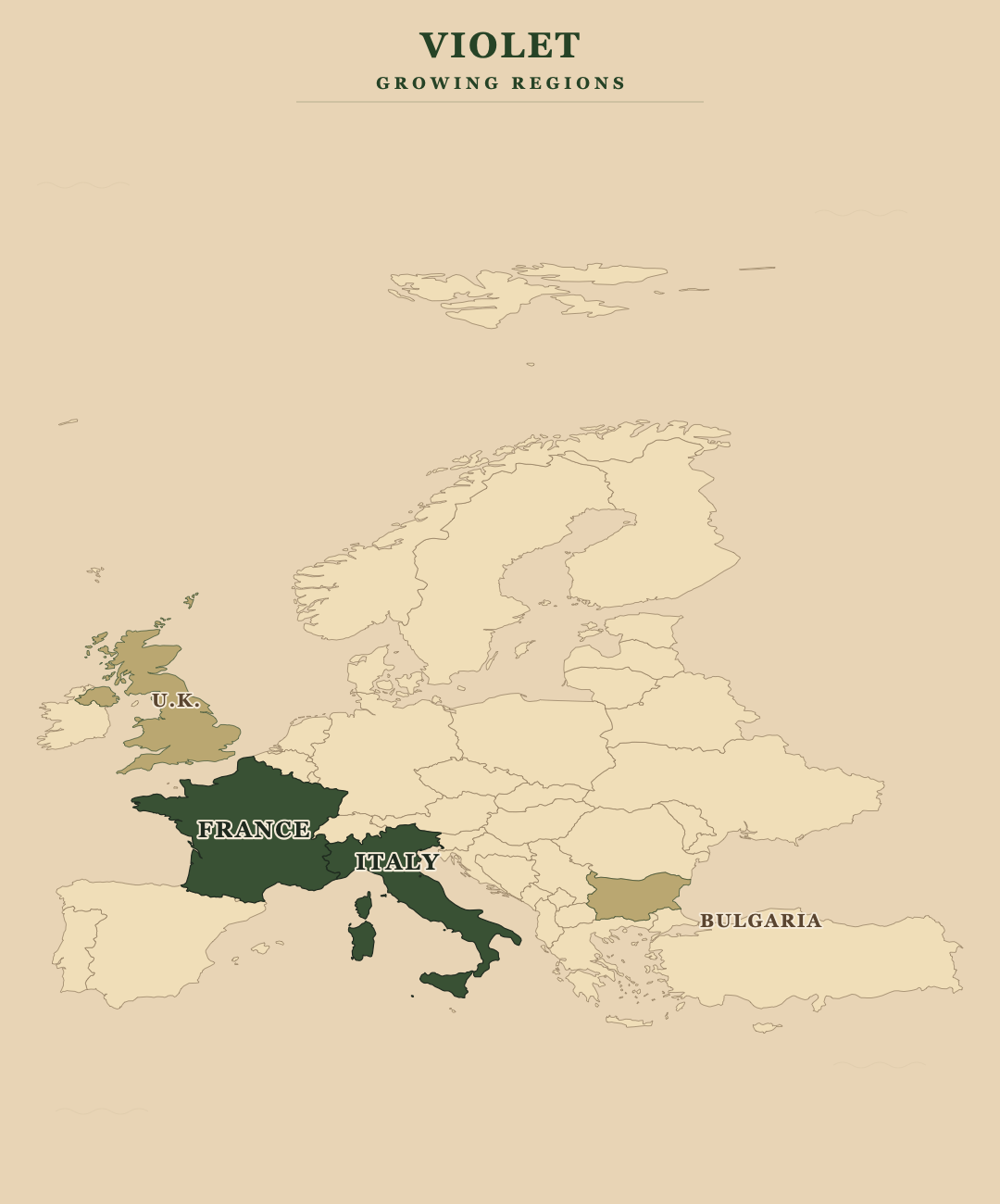
Violet is primarily cultivated in Egypt (largest commercial producer), Italy (Parma), France (Toulouse), with secondary growing regions in Bulgaria, Morocco, India, UK.
Spice Story
The defining compounds of violet aroma — the ionones — were chemically isolated and identified in 1893 by chemists Tiemann and Krüger, [source] and ionones remain one of the most versatile aromatic compound families in modern perfumery. (The discovery of synthetic ionones largely killed off violet flower extract as a commercial perfumery material — synthetic ionones are good enough and dramatically cheaper.) In food, violets appear most famously in French and English crystallised violet confectionery — the violettes de Toulouse are protected by an appellation designation. In gin, violet is a contemporary floral botanical providing a clearly aromatic-perfumed lift.
Gin Creativity
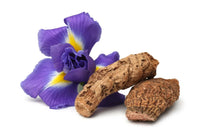
Violet brings powdery-floral character with a soft velvety background. A full sachet pushes a gin firmly into clearly floral territory; a half-sachet provides a quiet rose-violet lift that integrates with juniper. Pair with rose petal and orris root for a classical floral profile, or with bergamot and jasmine for a contemporary perfumery-style blend.
Blending Science
Main flavour compounds
 Alpha-Ionone—
 Beta-Ionone—
 Dihydro-Beta-Ionone—
Pairs well with
Alpha-ionone and beta-ionone are the defining compounds — sesquiterpenoid ketones responsible for the characteristic violet aroma. Notably, ionones display a fascinating sensory quirk: when smelled at length, they fatigue the olfactory receptors and become temporarily undetectable (which is why violet fragrance "disappears" if you smell it for too long). Dihydro-beta-ionone contributes additional sweet-velvet depth. Cool extraction preserves the bright floral character.
Food Partners
- Crystallised violets and French confectionery — Toulouse violet sweets.
- Floral-perfumed desserts — violet panna cotta, violet macarons.
- Earl Grey-style teas — violet often layered with bergamot.
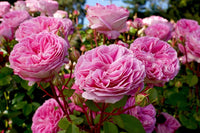
- Rose-and-violet pairings — classical perfumery pair.
- Soft fresh cheese with floral honey — chèvre with violet syrup.
Cocktails To Try

- Aviation — gin, maraschino, lemon, crème de violette — the classic violet cocktail.
- Violet Spritz — violet gin, prosecco, soda.
- Floral Negroni — violet-and-rose gin, Campari, vermouth.
Release The Flavour
- Cool extraction — preserves the bright floral.
- Brief contact — 30 minutes to 2 hours.
- Whole flowers — visually striking, slow-releasing.
- Source matters — Parma Italian and Egyptian production are premium grades.
Discover more
From the same region
Pairs well with
Same flavour family
Surprise me

Sources & Citations
- scientific_name (Viola odorata, Violaceae):en.wikipedia.org/wiki/Viola_odorata
- european_native_range:en.wikipedia.org/wiki/Viola_odorata
- ionones_discovered_1893:www.fragrantica.com/notes/Violet-127.html
- parma_italy_marie_louise_bonaparte:perfumesociety.org/ingredients-post/violet/
- egypt_commercial_leaf_absolute_production:www.olfactivestudio.com/blogs/news/last-but-not-leaf-viol...
- main_flavour_compounds (CSV-sourced):inputs/source.csv — Violet row
